
|
Getting your Trinity Audio player ready...
|
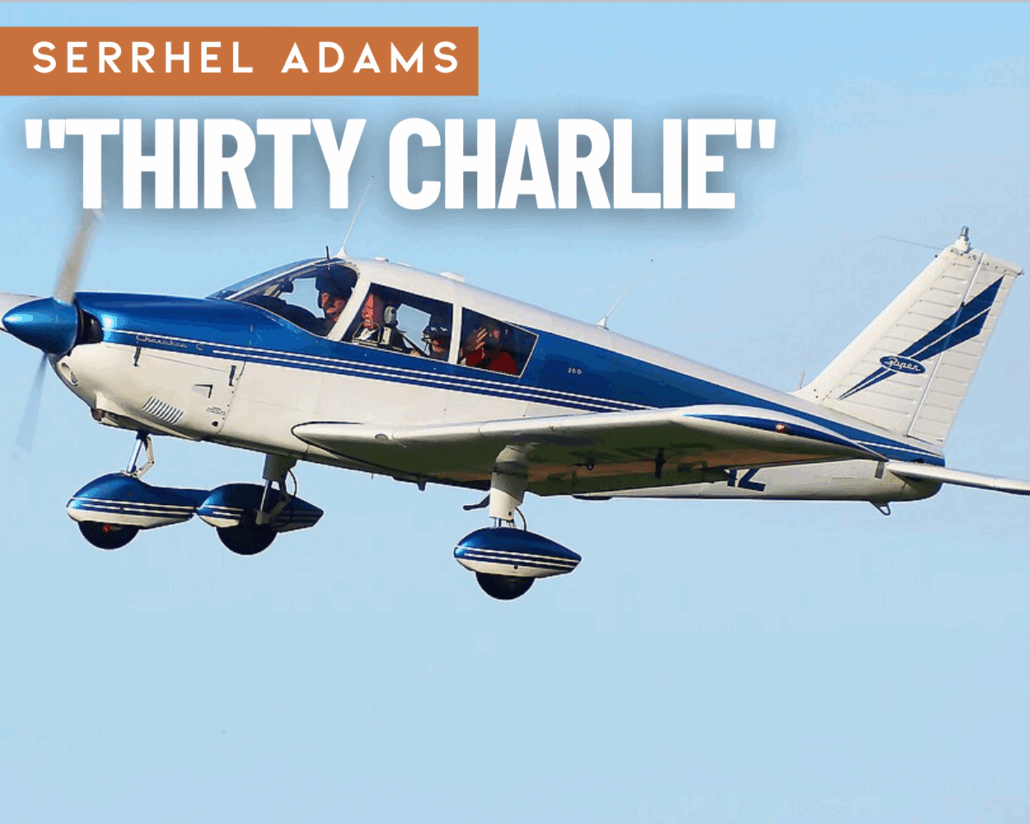
I can close my eyes and still hear “Thirty Charlie,” as if it were yesterday.
N63121 is the Cessna C150 in which I took my first GA flight. N64984 is the Cessna C152 in which I soloed. I remember little of these two aircraft—I had to dig through my logbook to recall them. But I’ll never forget N7630C, a Piper Cherokee 180 (PA-28A), and the instructor who flew it, Eddie Duffard.
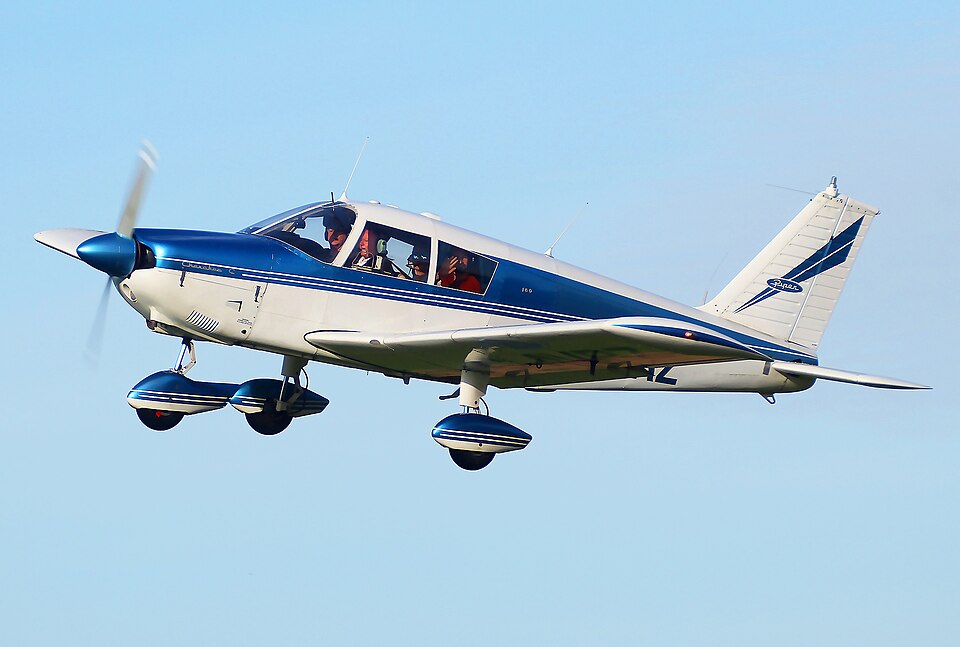
Cherokee 180—Image by Mike Burdett, licensed under CC BY-SA 4.0
No one in my family was a pilot. I never attended an airshow. Other than commercial airline flights, I had no exposure to aviation. Yet, at 19, I had a burning desire to learn to fly. So, I pulled into a Cessna training center in Baton Rouge and took my first flight.
I don’t recall much about my first 12 hours in those Cessnas. I soloed, which should’ve been memorable, but it didn’t stick. I don’t remember the instructors from those early lessons either. I’m sure they were competent, but they left no lasting impression. I do remember the Cessna ground school, which involved watching a filmstrip timed to a cassette tape. Every beep meant turning a knob to advance the film. Yes, I’m that old.
Those early lessons didn’t inspire me. My logbook shows I took a six-month break from flying. When I decided to restart, someone at the airport recommended Eddie Duffard, CFI, as the instructor to learn from in Baton Rouge. I drove to his hangar, and that meeting changed my life.
Eddie was in his 60s when I met him, sitting in his hangar office. I introduced myself, but he never used my name. To him, I was “Ace,” like all his students. Eddie was incredibly personable and sold me on flying with him from that first meeting. He flew a Piper Cherokee 180, N7630C, and his rate—aircraft, fuel, and instruction—was $40 an hour. I booked my first flight.
There were no “introductory flights” back then. I’d jumped straight into training with the Cessnas, but Eddie was different. He asked about my previous flying, and when I described it, he scoffed, “Hell, you haven’t had any fun in the airplane.” Our first flight was an aerial tour of my hometown, Baton Rouge. I’d never seen the city from the air before, and it was the greatest flight of my life at the time.
I was hooked on both the aircraft and the instructor. Eddie meticulously maintained N7630C, a beautiful Cherokee. For 1986, it was well-equipped for IFR, with dual radios, dual HSIs, and an ADF. The exterior and interior were pristine. To my 19-year-old self, it felt like a “real airplane” compared to the two-seat Cessnas. The PA-28 had a throttle lever instead of a push rod, low wings, and four seats. Silly as it sounds now, those details mattered to me then.
Eddie taught me how to treat 30C as if it were my own, instilling the mindset of an aircraft owner. Check the oil and tires. Note any squawks—he’d get them fixed. Nothing on the glareshield. No mud on your shoes. No food or drinks (except water). You get the picture. If you didn’t show 30C the respect she deserved, Eddie let you know—quickly.
He wanted everyone to share his passion for general aviation. At 19, I didn’t know if I’d ever own an aircraft, but Eddie spoke to me as if it were inevitable. He discussed the planes we saw on the tarmac, weighing the pros and cons of different models, talking about purchase, care, and maintenance. He saw his students as lifelong pilots and treated us that way from day one.
Eddie was unapologetic in his teaching. He’d call you out—sometimes with a bite in his voice—if you slacked off. Flying in the “late 1900s” had its quirks, like no headsets. In the Cherokee, we used a roof-mounted speaker and a handheld microphone. Baton Rouge was (and is) a towered airport, and Eddie drilled into us not to rest the mic on our laps. A friend of mine, another of Eddie’s students, learned this the hard way when his mic slipped between his knees, blocking the tower frequency. Eddie was screaming over the radio to get through. When the frequency cleared, Eddie gave my friend an earful, but after landing, he put a hand on his shoulder and said, “You put it between your legs, didn’t you, Ace?” That was the end of it—a lesson never forgotten.
That was Eddie. He didn’t just say, “More right rudder.” He’d pound your right knee with his fist and yell it. If he didn’t like a landing, you’d hear “abort” from the right seat, and off you’d go, sometimes jumping out of your seat faster than the Cherokee left the runway. At Baton Rouge’s 7,500-foot runway, he’d bark, “Get off the brakes!” if you touched them. In today’s world, Eddie would be an anomaly. His gruff style might not be welcome, but beneath it was a deep care and a drive to make you the best pilot possible. Debriefs happened in a comfortable chair in his office, always ending with a smile, a handshake, and a “See you next flight, Ace.” He was training lifelong aviators and demanded excellence.
I didn’t know who Bob Hoover was back then, but Eddie was cut from the same cloth. A WWII veteran (though not a pilot), he learned to fly postwar during what may have been the pinnacle of general aviation in the U.S. He passed that passion on to the next generation, flying 30C for pleasure and business with his wife, fully embracing GA’s potential.
Eddie taught me to fly the airplane to the end. He never said, “Fly it through the crash,” but he instilled the mindset of never giving up, no matter what. During one lesson over a dense forest, he casually said that if we lost an engine, we’d land on the treetops. Our engine-out practice took us below treetop level over Louisiana fields—never touching the ground, but close. He didn’t just train me to be a private pilot; he trained me to be an aviator.
Being pilot-in-command was ingrained in his training. There was no syllabus. Eddie expected you to study ground school independently and be ready for each flight. He rarely touched the controls, talking you through maneuvers—sometimes gruffly. Often, the first time I saw a maneuver was the first time I performed it. He’d demonstrate if I struggled, but he let me make mistakes.
Eddie could be tough when he knew you could do better, calling out mistakes we’d practiced. But he’d also praise you when you got it right. Every flight ended consistently: he’d sign off with the tower as “Thirty Charlie,” and he’d give you a pat on the back with a “See you next time, Ace.”
By the time Eddie signed me off for my checkride, he expected me to pass—and to do so close to the 40-hour mark. He kept the pressure on, but when the day came, the checkride felt easy. The DPE couldn’t hold me to a higher standard than Eddie’s. When I passed, no one was prouder than Eddie. I got a “Congratulations, Ace,” and joined the select group who could rent and solo “Thirty Charlie.”
Life moved on. I left Baton Rouge and didn’t pursue further ratings with Eddie. N7630C was lost in a training accident after a student’s runway excursion during a solo flight. I ran into Eddie in 2002 after flying into Baton Rouge in a Piper Comanche. He remembered me as if we’d flown together the day before, thrilled I was still flying a Piper—his favorite. We talked for hours. Eddie passed away in 2008 at 86. I heard he flew himself just days before his death, and I hope that’s true. His obituary said he taught over 5,000 students and logged over 75,000 flight hours.
I’ve flown with many instructors since Eddie, some now friends, others forgettable. For many CFIs, I was just a stepping stone to the airlines, and I don’t fault them for that. But there was only one Eddie and one “Thirty Charlie.”
I hope you find an instructor who’ll hit your thigh, yell “abort” when you least expect it, and make you sweat as you learn. I hope you find a crusty CFI who’ll chew you out on the tower frequency for a dumb mistake, or make you feel defeated mid-flight—because it’ll mean so much more when they pat your back and say, “Good flight, Ace.” Those lessons will be worth the sweat. If you’ve found your Eddie, cherish them. If not, keep looking, Ace—it’ll be worth it. Thirty Charlie, out.
- My Most Dangerous Flight - February 13, 2026
- Friday Photo: Clouds Above - February 6, 2026
- Friday Photo: Spitfire Over St. Louis - December 26, 2025


My T-37 IP was an Air Force Academy graduate who wore his class ring, with its large stone, on his left hand. He would turn that stone to the inside of his hand and, while sitting next to me in that T-37 cockpit, he would reward my mistakes with a rap on my knee, leading with that stone. He landed a few ‘Whacks!’ early in the program, but I got good at seeing it coming and, eventually, the ‘raps’ became fewer. He was a great IP who enjoyed flying and one thing I most enjoyed was when we would do ‘Snoopy Flips!’, which involved flying the airplane as in the airman’s hymn, “…Through the great spaces of the sky…”
Those guys were a different breed. I feel lucky I got a chance to fly with some of them.
Great story. Reminds me of learning to fly back in ’65. Neal was an old WW2 instructor. You learned to fly the airplane. I think those were better instructors than what I read about now a days.Of course, learning at an airport at 5,000 feet elevation, in the summer, didn’t hurt either.
Eddie Duffard was my instructor for my instrument rating. What a great guy. I still have fond memories. I learned so much from that man that stayed with me throughout my career.
I was fortunate enough to fly in Nov. 1963 with the Grand Master. His plane was $12.00 an hour. All 160 hp with metal wings and flaps Piper Tri Pacer. He slapped my hands till I understood radio knobs were only to be operated clock wise. A fellow student ground looped the Tri at Baton Rouge downtown airport and the next of many flights were in a Piper 140. What a dog, but for the time it was modern and state of the art. The 180 “30 Charlie was years later and it introduced hundreds of not thousands to aviation. I retired and was at PAI when the call came from his wife that he had gone to sleep in his chair and could not wake up. Not a dry eye in the house that day.
Very well written story. I needed a napkin. It remined me to be appreciative of my Pastor who shares his wisdom so I can fly and land safely in this life. He, also, is a pilot and I have learned numerous lessons from the airplane stories that he shares from the pulpit. I have found my “Eddie”. Thirty Charle, out.
I was fortunate enough to have my “Eddie” while learning to fly at Bolton outside of Columbus while in college back in the mid 70’s. Went home over the summer, flew with another instructor, but was glad to come back to “Eddie” when the new school year started. Got my license after 44 hrs thanks to “Eddie”. Great story, thanks.