
What I Did During the Vietnam War, Part II

Editor’s note: This is the second part of Randall Shumaker’s story about his work as a young engineer testing Naval aviation systems during the Vietnam era. Read Part 1 to learn how he got to the Naval Air Engineering Center at Lakehurst, New Jersey, and what it was like to work on the facility’s unusual test systems.
The Tests I Remember
I was involved in hundreds of routine testing events and don’t remember much about any of them. The memorable events were the one-offs and the tests where something I designed played an important role.
The first design-and-build project I worked on came about because of a problem that surfaced during testing. I was asked whether there was a way to measure the coefficient of friction of a wheel on one of the test aircraft in real time. The goal was to identify potential problems without having to wait for the overnight computer run.
There were no changes that could be made to the vehicle, and, of course, there was no money or time available for a new piece of equipment.
A senior technician and I designed and built a system that could calculate and display the ratio in real time. We built it using a perforated prototyping circuit board and individual components soldered into place. When needed, the device was placed on a shelf in the instrumentation room and wired into the system. It was used for about two weeks of testing and then retired.
The project was considered a big success: it cost almost nothing, was built quickly, and worked as advertised. My reward was being given a series of increasingly complex assignments. The rules remained the same, though: little or no money for equipment and a short project timeline. No good deed goes unpunished.
These assignments seemed perfectly reasonable at the time. In retrospect, I probably should have been worried. Several times during my career, I came to realize that ignorance really can be bliss. But there were other building projects as well, and eventually I was given my biggest project of all. It should have been the one that scared me the most. I simply didn’t know enough to be worried.
Cruise Control for a Jetcar
As described in Part 1, the jetcars used on the test tracks consisted of four high-performance jet engines mounted on a wheeled frame. The jetcar accelerated the test vehicle down the track until it reached the braking area. The jetcar was then arrested and dropped back, while the test vehicle continued into the system being evaluated.
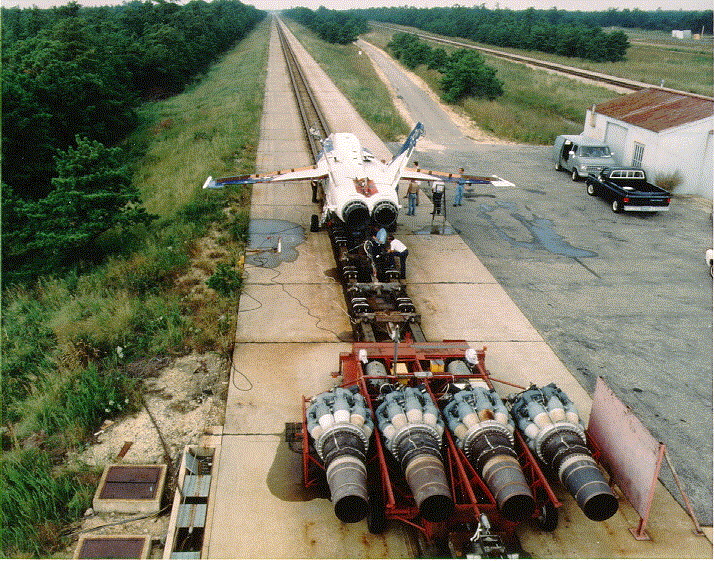
Track 5 launch end with F18A on test rig with J-48 Jetcar. Track 4 to the upper right.
The problem was that the system was open-loop. The jet engines were set to a predetermined percentage of maximum thrust before launch, based on the expected weight, wind, aerodynamic drag, and other factors. Once the jetcar was released, there was no feedback to adjust the thrust.
The final speed of the test vehicle was critical. If it was too slow, the test might not produce the desired results. If it was too fast, the test could result in a major failure.
Engine settings were determined using a gigantic book of historical data covering vehicle weight, wind speed and direction, expected aerodynamic drag, and, of course, various fudge factors based on recent test results.
The system worked reasonably well, but errors were a problem, particularly in windy, rainy, or snowy conditions. It was also difficult to predict the correct settings for brand-new vehicles for which there was little or no historical data.
What we needed was a speed-control system that could measure the vehicle’s current speed and adjust the engine settings in real time. In other words, cruise control for a jetcar.
The principle was similar to the cruise control in a car, except that this machine was much bigger, much noisier, much faster, and considerably more dangerous. Mistakes could also be expensive. I was asked if I could build one. The budget was $1,000. That was ridiculously cheap for such a device, but apparently nobody had told me that.
The design and construction took about three months. We used analog components and hand-built the controls, installing everything in a standard electrical steel box. Almost all of our equipment at the time was analog, and that was technology my senior engineers understood well.
I calibrated the system using an analog computer model of the jetcar system. One of the products of that work was an operational handbook providing the settings to be used for different combinations of weight and desired speed. Finally, we conducted a series of tests on the real jetcar. The resulting “cruise control” worked well enough that two additional units were built and used when precise control was particularly important. Of course, the precision applied only to the point at which the jetcar was arrested. The free-rolling portion of the test vehicle’s movement still depended on “windage,” but the overall control was considerably better.
That improvement became particularly valuable for several unusual tests, where there was little historical experience to tell us what would happen.
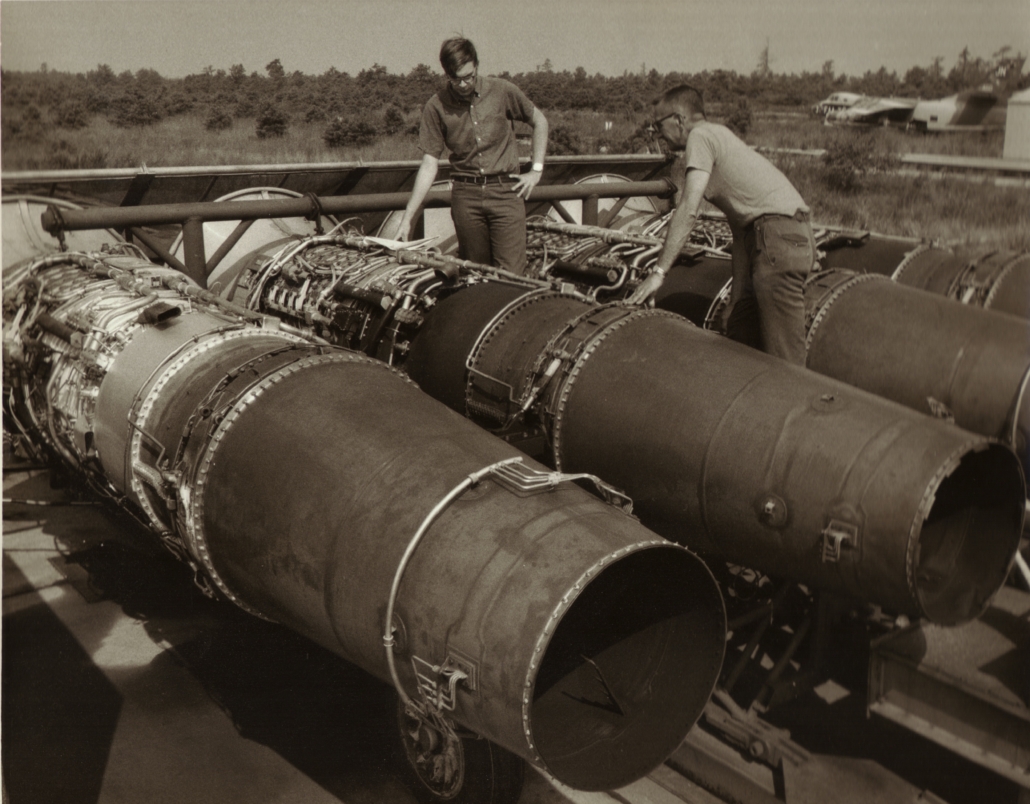
The photo above shows me with a senior technician pondering where to put the prototype speed control on a J-79 jetcar.
Ejection Seat Tests
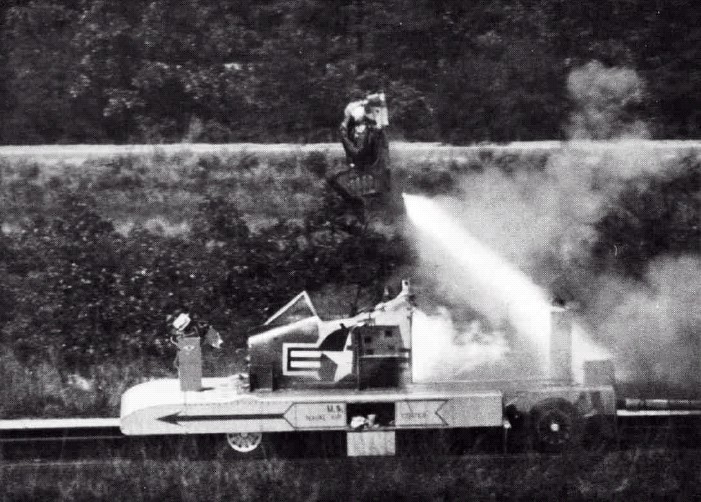
Ejection seat test using A-4 Skyhawk with instrumented dummy NAEC Lakehurst Naval Aviation News1977.
We conducted several types of ejection-seat tests involving partial airframes mounted on deadloads. Some evaluated normal ejections under different speeds and ejection angles.
One particularly memorable test involved an ejection seat designed for a helicopter. The concept was extraordinary. Before the seat could fire, the helicopter’s rotating blades had to be explosively removed. The ejection seat would then fire upward through what had been the rotor disc. It was the sort of test that made precise control of the launch speed especially desirable.
The tests were successful from a speed-control standpoint, although, as expected, not every outcome was successful. Some of the tests confirmed results that had previously been seen in fleet accidents.
For me, these were among the most memorable projects because they involved equipment that had never been tested in quite this way before. There was little room for error, and the results could have consequences far beyond the test track.
One particularly successful project would also become my last assignment involving the jetcar tracks.
- What I Did During the Vietnam War, Part III - October 21, 2026
- What I Did During the Vietnam War, Part II - August 28, 2026
- What I Did During the Vietnam War—Part I - August 5, 2026


Were those pictures taken at NAEC Lakehurst NJ?
So this article is entitled ‘ WHAT I DID DURING THE VIET NAM WAR’, but the photo displayed with that title is of an H-60, which did not even exist during that time from? Does not exactly inspire me to take the time to read it when it is already showing to be factually inaccurate at the onset.
Probably should have titled What I did during the Vietnam war and several years after.
The only one that I am not sure was taken at NAEC was the A4 ejection seat one. It came from naval aviation news and was attributed to NAEC. It could have been at PAX however.
Could have been a test track at PAX. Not to my knowledge though. NAWC China Lake had the SNORT supersonic track. Pics look like desert background except for the F-18. The lake did a lot of ejection seat testing. Worked at both places in Test and Eval. Some very unusual and interesting projects at both places. Very capable people at both places!