
What I Did During the Vietnam War—Part I

Testing the Future of Naval Aviation
When I work as a docent at the Valiant Air Command Warbird Museum, visitors sometimes ask what I did with aircraft or, more specifically, what my war was.
Since they asked, I tell them that I worked in Naval Aviation, and my era was Vietnam.
My work involved testing aircraft carrier catapults and arresting gear, both shipboard and land-based, as well as visual landing aids, ejection seats, crash testing, and some unusual projects such as ejection seats and arresting systems for helicopters. I sometimes get the impression that visitors are skeptical that anyone could have been involved in such a wide range of projects, including things they never knew existed, such as helicopter ejection seats.
It was all true.
I worked at the Naval Air Engineering Center (NAEC) at Lakehurst, New Jersey, beginning in 1968, just as the most intense years of U.S. involvement in Vietnam were getting underway, and remained there through the final winddown in 1976.
This article is not about the Vietnam War itself, although the war was the immediate force driving much of what we did: the need to test new systems, investigate accidents and incidents at sea, and experiment with new ideas. A new generation of faster, heavier, and more complex aircraft was entering service while older aircraft remained in operation, requiring ships to safely handle both.
Young engineers were recruited and given far more responsibility much earlier in their careers than was typical. At the time, though, I assumed this was normal.
The opening minutes of Top Gun: Maverick, beneath the credits, are among the most evocative moments for me. The film shows the carrier aircraft elevator bringing the aircraft to the flight deck, the nose gear launch bar engaging the catapult shuttle, and the holdback breaking during launch. It provides glimpses of other elements too: the jet blast deflector rising, the pilot “wiping” the controls by moving through the flight control positions, and the incredible ballet of people working together on the flight deck.
I can almost see the action, hear the sounds, and, oddly enough, smell the faint JP fuel vapors drifting across the deck.
Then there is the recovery side of carrier operations.
Occasionally, a museum visitor asks about carrier operations, and I take them to our three-foot model of the USS Enterprise to explain the process. I have to admit that much of the grandeur is lost when the F-14A sitting on the bow catapult has a one-inch wingspan, no motion, no sounds, and absolutely no JP fuel scent—real or imagined.
Maybe we could add loud sounds and a fuel-scented aerosol at the right moments.
Nah. Too much.
Most of what I personally worked on happened below deck or out on the test tracks. The rest of this story is about how I got there and the kinds of things I was fortunate enough to do as a young engineer, unaware that they were perhaps unique opportunities.
Getting Started at Lakehurst
The recruiting program for new engineers at the time offered summer jobs with a grade promotion each year during college, along with rotations through various engineering departments. The idea was that new graduates could contribute immediately because they had already spent four summers learning the organization.
After graduation, I was assigned as an instrumentation engineer, working with technicians and senior engineers. My job involved instrumenting aircraft, deadloads, and the equipment being tested, then reviewing and providing test recordings to the mechanical engineers responsible for the systems.
I had not been far into my career when testing, accident investigations, and unusual projects began arriving. Looking back, I realize how unusual those opportunities were. At the time, though, it simply seemed like the work engineers did.
Naval Air Station Lakehurst and the Naval Air Engineering Center that it hosted no longer exist under those names. The facilities I knew are still there and apparently remain largely in use. Today, the site is called Naval Air Warfare Center Aircraft Division (NAWCAD), Lakehurst, part of the rather nondescript Joint Base McGuire-Dix-Lakehurst (JB-MDL).
As far as I can tell, you cannot even drive directly between some of the areas on base without leaving the installation and reentering elsewhere. It is the same physical location, however, and much of the mission remains familiar.
During my flying adventures and commercial flights passing over central New Jersey, I occasionally see the facilities in the distance. The photo below, captured from my FlyQ app, gives some idea of the physical scope of the facility—and perhaps the historical scope as well.
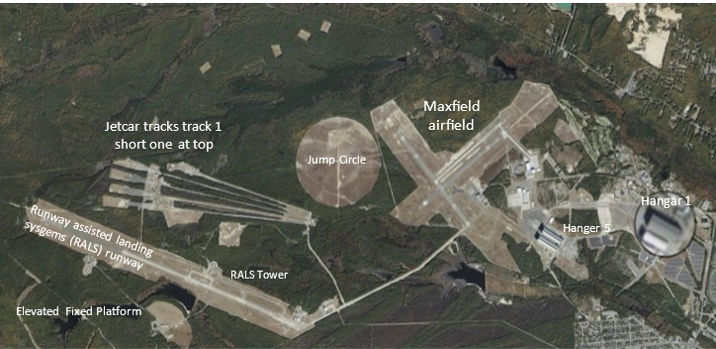
Map view from FlyQ iPad APP
The test runway on the far left is 12,000 feet long and has a control tower similar to what you would find on an aircraft carrier island. Unlike a carrier, however, the launch area is located before the arrestment area. There were occasions when an aircraft would be catapulted, then arrested a few seconds later, only to taxi back and repeat the process.
Underground, the facility contained examples of most of the active arresting and launch systems of the era. The site included visual landing aids, jet blast deflectors, and a steam plant for operating the catapults. In short, it could replicate most of the shipboard configurations then in use.
Just above the runway were the five jetcar tracks where I spent most of my time. These tracks radiated from the launch area and guided a jetcar and its test load until the jetcar was arrested and the test vehicle continued into whatever system was being evaluated.
Tracks two and three shared a blockhouse, as did tracks four and five. These buildings were constructed of concrete block with a row of reinforced glass windows about a foot high at eye level while standing, facing the recovery area. Inside were racks of instrumentation, a stand-up desk for the launch officer, and two tables where we reviewed the event “traces.”
The traces were long charts of recorded data, usually two or three sheets but sometimes more, depending on the number of parameters being measured. We called these initial reviews “quick looks.” Final event results were produced overnight by the computer center.
Just south of the main runway was a square building with an extended clear area in front of it. During my time there, this was called the elevated fixed platform and was used to replicate a small ship’s fantail landing area for helicopters.
At the far right of the photo, you can just make out a gigantic Zeppelin hangar: historic Hangar 1. Next to it are Hangars 2 and 3, also large structures, but designed for the smaller blimps that operated from the base for many years.
When Hangar 1 was built, Lakehurst was the only international airport in the United States. It is also the site where the Hindenburg met its end after 37 successful passenger flights across the Atlantic.
Blimps continued operating from Lakehurst in the antisubmarine role until the early 1960s, when long-range aircraft took over that mission. Another lesser-known piece of history is that Lakehurst served as an artillery test site during World War I, with the test range extending beyond the jetcar tracks.
I can personally attest to that history.
Occasionally, one of the test deadloads would break through whatever system was being evaluated and tumble spectacularly into the dirt overrun area beyond the paved test area. When those vehicles were recovered, fragments of artillery shells were often found in the soil. Sometimes warheads or fragments were kept as souvenirs—probably never a particularly good idea.
The Jetcar Tracks
The jetcar tracks were the workhorses for the most unusual, repetitive, or potentially dangerous tests. Track 1, for example, specialized in wear testing and reliability testing, where many repeated shots were required to build a statistical picture or reproduce a fleet problem.
The photo below shows the launch end of Track 5, my usual assignment. I am not sure how I obtained this view, but it was part of my collection of photographs and illustrates how the system worked.
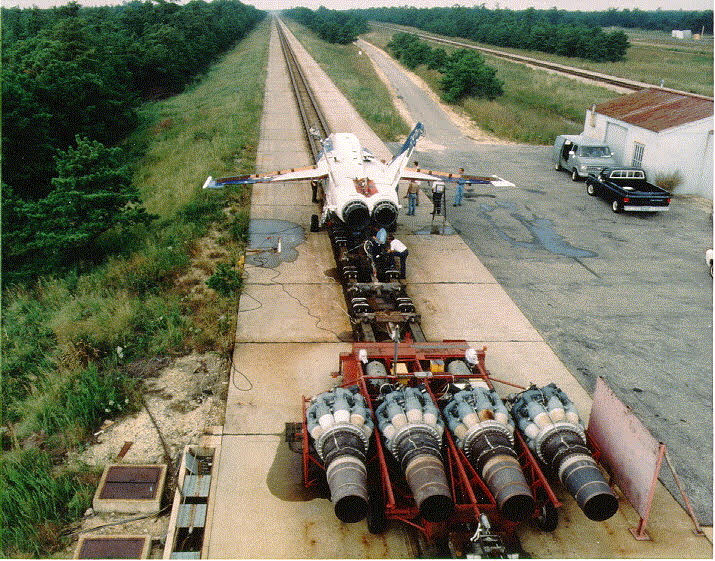
Track 5 launch end with F18A on test rig with J-48 Jetcar. Track 4 to the upper right.
At the bottom of the photo is the jetcar, powered by four jet engines. The jetcar had wheels and a guidance system that kept it on the rails. The engines were retired aircraft engines that were no longer suitable for flight but were perfectly capable of providing the enormous thrust required for these tests.
During my era, the engines were either J-48s producing about 25,000 pounds of total thrust or J-79s producing approximately 48,000 pounds. Even with only a basic understanding of the physics equation F=MA, it is easy to understand how impressive the acceleration could be—especially when launching something as light as an ejection seat or as unusual as a helicopter fuselage.
Trailing behind the jetcar were sets of brakes that rode on the rails and stopped the vehicle at the end of the track. The rails began as single-thickness I-beams. Near the recovery area, the tops of the rails became double thickness, engaging the jetcar brakes so that the jetcar dropped back and the test vehicle continued forward on its own.
At the very end of the track, the rails became triple thickness as a final safeguard against failures in the braking system.
The test vehicle—a deadload or sometimes an actual aircraft—would then continue into whatever arresting system was being tested. The deadload often had a tailhook because we were usually testing arresting gear, although not always. In some tests, the system being evaluated was a barricade rather than a cable arrestment system.
The photo shows the trailing brakes attached to the shuttle beneath the aircraft. The shuttle guided the test vehicle along the track until it too was arrested, allowing the aircraft to continue into the arresting system on its own landing gear.
As you might guess, this complicated sequence involving multiple moving parts did not always go exactly as planned.
Some of my most interesting memories came from the special one-off events and the times when things did not quite work as expected. Keep in mind that the entire system was open-loop. Once the number of brakes was selected, the engine RPM calculated and set, and the release initiated, there was no further control over the process.
One of my most important personal projects later became the creation of a closed-loop control system for the jetcars. The goal was to narrow the range of vehicle end speeds despite variations in wind, track conditions, and, to some degree, human error.
The test sites were some distance from the engineering offices. I started with a desk in the mezzanine of an old blimp hangar, Hangar 5. Depending on the office assignment and specific test location, it could be as much as seven miles of travel on base just to reach the work site.
Because of those distances, once you arrived at the test area, you were usually there for the rest of the day. That meant bringing your own coffee and lunch or taking advantage of the local coffee mess and the “gedunk” truck. The truck visited each test site around lunchtime, selling snacks and sandwiches.
I joined the coffee mess, of course, and learned an apparently Navy-specific method of brewing coffee. As the coffee pot was refilled throughout the day, nobody removed the old grounds. New grounds were simply added on top, with a completely fresh batch started only at the beginning of the day.
Years later, I learned what good coffee was actually supposed to taste like.
Among my responsibilities was working with technicians and more senior engineers—essentially everyone at first—to install and troubleshoot instrumentation on whatever was being tested. We then reviewed the test recordings immediately after each event and released the data to the test engineer.
The phrase “hurry up and wait” applies perfectly to conducting tests involving so many moving parts.
It often took considerable time to install the equipment being tested and prepare the instrumentation. Once testing began, however, we tried to complete as many shots as possible each day. That might mean none if there were problems to solve, or as many as nine or ten on a good day.
Most test setups required everything to be ready simultaneously: telemetry on the vehicle, photographic coverage, recording equipment in the blockhouse, and both the launch and recovery ends of the track.
The process was somewhat like a small-scale space launch, repeated as many times as possible until the test program was complete—or something broke.
The site officer, usually a lieutenant or warrant officer, would sound a warning horn and announce the upcoming event over the public address system. Roads were closed, personnel moved to their work areas, and everyone prepared for the test.
The site officer would then call each area and receive a ready or not-ready response:
Launch ready.
Recovery ready.
Telemetry ready.
Photo ready.
Instrumentation ready.
If everything was affirmative, the sequence continued. If not, a hold was declared.
Responses came over the radio from the launch and recovery areas and in person from the photo, telemetry, and instrumentation teams.
I must admit there were occasions when we were not quite ready but were confident we would be before the actual launch. In those cases, we sometimes said we were ready anyway.
The warning horn sounded again, and the announcement came that a launch on the assigned track was underway. A short countdown followed:
Five… four… three… two… one…
Then came the command:
“Release jetcar.”
Time passed—usually less than a minute—before we heard and then saw the payload approaching.
Once the vehicle came into view, the photography and instrumentation teams began recording. The first traces were available almost immediately, with additional data arriving over the next few minutes.
That was when I went to work evaluating the traces and signing off if they were acceptable, identifying any questionable data that required further review.
What seems unusual to me now is that none of this felt unusual at the time. It was simply what engineers did.
Years later, when I moved into a more traditional office job, I discovered how few people had ever operated or even understood the systems we worked with in the field.
The Beartrap Helicopter Landing System
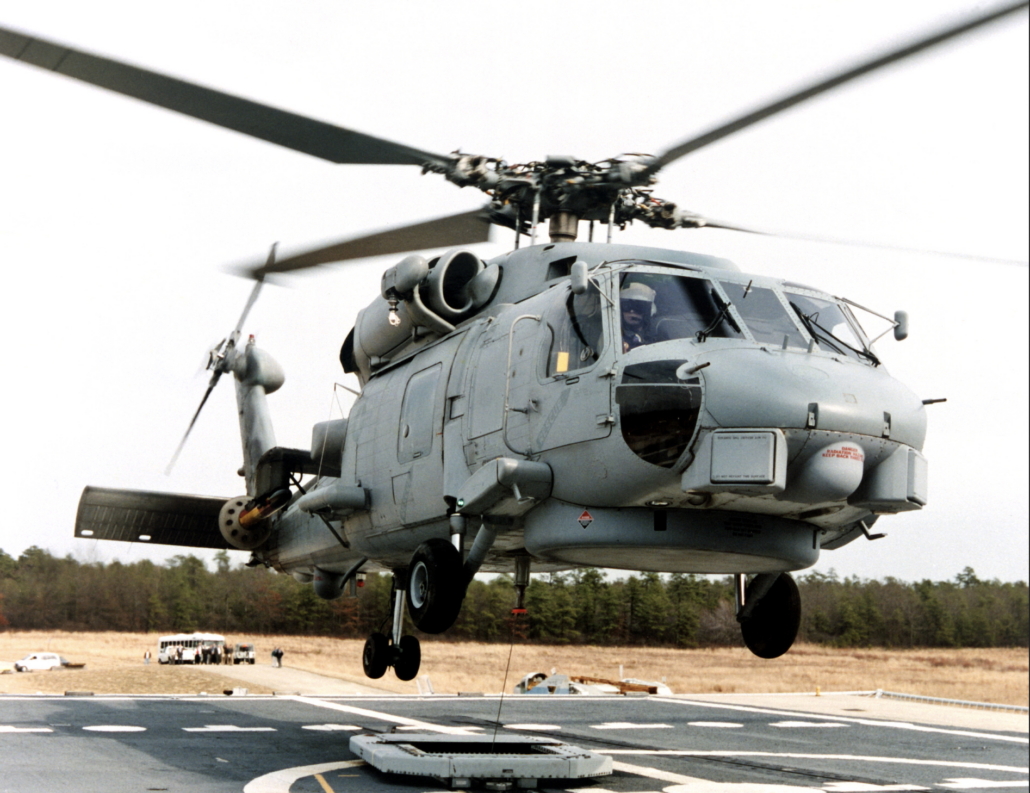
RAST on an elevated fixed platform. Note the cable coming from the aircraft center of gravity.
One example of the unusual work we encountered was the “Beartrap” helicopter landing system developed for small ships.
Canada originally developed the system to make helicopter operations safer on small ships operating in rough weather. The U.S. Navy and other nations later adopted the system after testing with various ship and aircraft configurations.
The concept was ingenious.
The helicopter lowered a probe while hovering above the rolling and pitching flight deck. The probe was used to capture a cable connected to a winch beneath the deck. The winch maintained constant tension on the cable.
The pilot then maintained a hover with positive cable tension—perhaps 1,000 pounds—allowing the helicopter to become, in effect, attached to the ship like a balloon tethered to a moving platform. As the ship moved beneath it, the winch paid the cable in and out to maintain constant tension.
When the landing signal officer determined the conditions were favorable, the helicopter was reeled down to the deck and captured by the landing system, known as the Beartrap. Once secured, the helicopter could safely be moved into and out of the hangar.
When I explain this system to museum visitors, I can almost see the doubt forming on their faces.
There is no way this could be true.
I recently told the story to a visiting Coast Guard pilot. Not only did he know about the system, but he confirmed that it is still in active use.
That validation may make some of my other stories more believable.
It also reminded me that successful naval aviation equipment tends to have remarkably long lives. Systems that work well often remain in service for many decades.
- What I Did During the Vietnam War, Part II - August 28, 2026
- What I Did During the Vietnam War—Part I - August 5, 2026
- My first and last flying road trip - August 2, 2024


Thanks for this…great stuff to a slightly older, retired, Aero Engineer/fellow-airplane-nut. Keep ’em coming!
Blimps!!!
I met Adm Siberlich who captained the 3W around the Atlantic
My adventures at NASA started when I was longer in the tooth at 36
My war was Vietnam also. I was working on M113’s and was on a team to investigate battle damaged vehicles.
The M113 was the wrong vehicle in the wrong war. It has been used in Ukraine. Another war it is the wrong vehicle for.
If you come up with a way to truly aerosolize jet exhaust and can distribute it, I’ll be your best customer! Nothing like the smell of spent jet!
My wife found a candle awhile back that was supposed to smell like jet exhaust. Not even close.