
Arrested on the Way to the Gulf War
|
Getting your Trinity Audio player ready...
|
 One night I was watching the news and saw that Iraq had invaded Kuwait. I didn’t really think anything of it because Iran and Iraq were always fighting. However, about 5 a.m. the next morning, I received a call telling me to pack a bag, with the added words: “FOR REAL.”
We practiced deployments all the time, so the “FOR REAL” meant we would be going for real. I woke up my wife and told her that it looked like we would deploy to the Middle East and I had no idea when I would be home. We woke the kids so I could tell them I loved them and to be good for their mother. Then I kissed my wife, said goodbye, and drove to the squadron.
At the squadron, we organized our flying equipment, made sure our passports and shot records were current, and took care of tons of other things. As the Air Force only has so many tankers, we were not scheduled to depart that day. So about 5 p.m., we were released to go home.
This went on for three more days. If you think saying goodbye to the wife and kids is hard, try doing it for four days. We requested that the bosses get us off the base, and it was arranged for us to fly to the East Coast and wait there for our turn with the tankers.
We were set up in a squadron that had already been deployed. On the duty desk, there was a letter signed by the local sheriff. It stated that if you were deploying for combat, the waiting period for guns was waived.
Let’s go back a step. Our home base deployed us with old six-shot .38-caliber revolvers while issuing new 9mm, 15-round magazine automatics to the Sky Cops staying home. About a third of the crewmembers took a copy of the letter downtown and got guns.
The next day, a call was made to the Security Police, and they took the guys to the gun range so they could learn the proper way to handle their weapons. They found holsters, extra ammo, etc. In a way, there was nothing too good for the men going off to war. In fact, the whole town supported us in many ways.
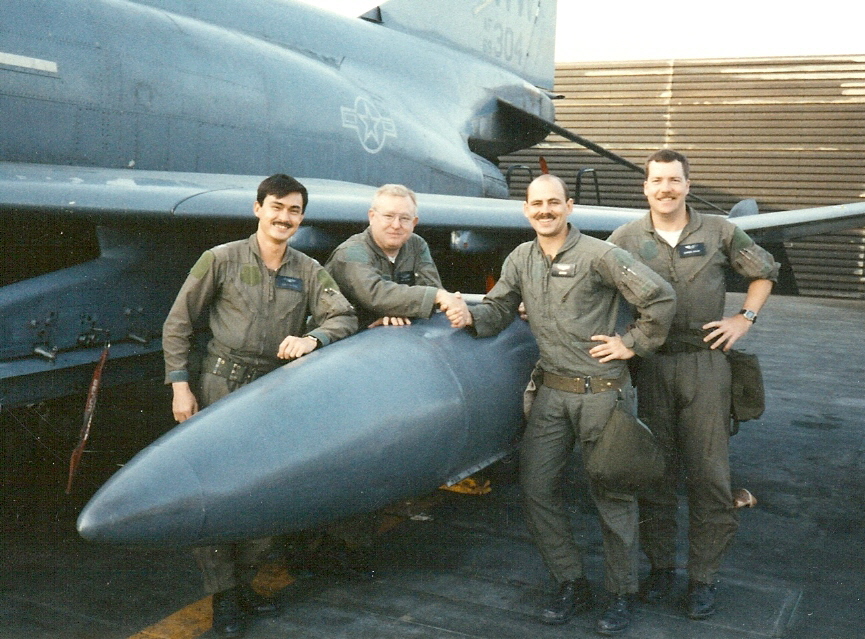
Finally, it was our turn. We launched and met up with our tankers. We had 24 F-4Gs, and we were broken into four six-ship formations, or flights, which each had their own tanker.
About halfway across the Atlantic Ocean, we had offloaded all the fuel our tanker had available for us, and we joined up on tanker number two. But then it happened. My wingman’s plane had developed an oil leak, and he would be unable to continue the deployment.
We always escort the emergency aircraft, so we diverted to the Azores as a two-ship flight.
Our problems started right away. Our planes are a “Class A asset,” which means that they need to be parked in a secure, guarded area. But they would not allow us to park near the local tankers because we had “Live Weapons” loaded on our aircraft.
I called the local Security Police and told them of the requirement to guard the aircraft and was told that we would drive by a couple of times a day.
Here is the problem with this: When we diverted to a “fighter” base, we would be parked in a secure area with 24-hour guards, and the only way in was a checkpoint where we would use a special badge that would allow us access to the flight line. That way, we could take off our flight gear, which included a survival vest with the guns and flares, and put them on the ejection seat, close the canopy, and be sure no one would bother them.
Instead, this required us to take all this equipment to the Visiting Officers Quarters, the military hotel.
As the ranking member, I was responsible for getting the plane fixed and looking after my men. The second day there, I was worried about having guns in our rooms and remembered how well the other Security Police had taken care of us. So I decided to take the guns to the armory so they could safely store them for us.
BIG MISTAKE.
Several hours later, two security policemen found me and told me that Captain Chain (spelling maybe wrong, but real name) needed to talk to me.
They drove me to his office, where he showed me the regulation that stated no personal weapons. However, I showed him that at the bottom of the page it stated you could have personal weapons with the approval of your commander, which we had, as he had signed the letters used to obtain the waiver for buying the guns.
He wanted to contact my commander to verify, but there was a major problem. We were deploying to the “Secret Base,” and I had no idea where it was or how to contact him.
Home base was no help, as they would not tell me where the base was over the phone and had no information about the waiver letters or the things that happened at the East Coast base.
There was a one-star general base commander, and he would not listen to reason and supported his security chief. It got so bad that we were advised to talk to the Area Defense Counsel, who is the guy who would defend you if charges were issued.
A deal was made: The personal weapons would be boxed up and sent home, with the idea that our home base would handle any charges or other issues when we got home. We were allowed to keep our old .38s.
Several days later, the plane was fixed, and we had a slot in the tanker flow, so we got ready to take off. I sent the guys to the armory to get the .38s, but the sergeant on the desk would not issue our guns because we didn’t have our gun cards.
Our cards were used to show our home base we were properly trained and were held until you returned the gun. I lost it.
I walked into the general’s office without his secretary’s permission and explained to him that we would not take off without our issued weapons. He could explain to the four-star general running the deployment of all the aircraft on the way to the Middle East why two F-4Gs were stuck in the Azores.
He wasn’t happy with me and later complained to my commander about my actions.
But we got our weapons, and we left the Azores.
You would think that nothing else could happen, but you would be wrong.
Two other F-4Gs had diverted into Italy and were to join us. But they were told the wrong time, and we had to orbit for two and a half hours until they could take off and join up on the tanker.
Then, to add to the trip, the wingman again reported an oil leak, and we diverted into Riyadh, Saudi Arabia. It was determined that the oil leak didn’t happen until about seven hours into the flight, so we filled the plane with oil, and I was told to fly the bad plane to the Secret Base the next day.
I still didn’t know where the base was.
I was told to fly east until I was over the Gulf and contact an unknown base on a frequency. After contact was made, I was to fly a heading and land on the runway in front of me.
I was at the secret base.
After landing, I was even told the name of the base.
As I walked to the hangar that had my bag (no room in a fighter), I was told that you could use this phone to make international calls. So I called home.
My wife answered as I clearly heard, “Would you accept a collect call from Bahrain?”
My wife said yes and asked where I was.
I said I couldn’t tell her.
The operator had clearly played this game a hundred times by now, so she stayed on the line and clearly said, “He is in Bahrain!”
My wife asked again, “Where are you?” And again, the operator stated, “He is in Bahrain.”
I finally said, “Listen to the operator!”
Once again she said, “He is in Bahrain!”
Then my wife asked, “Where the **** is that?”
The island of Bahrain is about 25 miles long and five miles wide. There is only one big city about 10 to 15 miles away. The secret base had 16 aircraft and took up the lower third of the island.
After we arrived, there were 75 F-4Gs and 75 Marine aircraft. Not much of a secret anymore.
When we had our fill of military food, we would get a big order together for pizzas and call downtown. In English, they would ask if we were at the secret base and would then know where to deliver the food.
So that is the way my war started.
The good news was that my squadron didn’t have any battle damage, and it was reported that when Weasels were on station, no friendly aircraft were lost to radar-guided missiles. Weasels attack radar missile sites.
Lastly, only two of the four of us got personal guns. I wasn’t one of them; I just had the issued .38. As the leader, you have to fight for your men.
They got their guns back when we got home, and nothing came of the issues from the Azores.

- Arrested on the Way to the Gulf War - September 11, 2026
- Close calls in training prepared me for Gulf War combat - August 23, 2023


You gotta love the military. You can be trusted with a weapons-loaded F-4 fighter jet, but not a handgun! I spent the Gulf War at Riyadh AB. My tanker unit supported the F-117s, and YES I carried my personal handgun the entire deployment.
Sounds about right. Not nearly as crazy, but when we deployed from Norfolk VA in 2002, we boarded a transport at Norfolk International and had to pass thru security, in full DCU’s and carrying M16s. The guns went thru xray machines (not really sure what they were looking for) but pocket knives were being confiscated. I threw away the M16 cleaning kit and smuggled my pocket knife in the buttstock.
Oh, GummiBear….so great to see your name again after all these years! Your story aligns so perfectly with similar stories I’ve read in the Warthog books…especially the deployment and arrival chapters. I continue to tell the story of the “Rocket Ride” you gave me over the cactus near Victorville….I missed the first roll completely because I blinked in panic, but I bravely asked you to do it again….AND YOU OBLIGED…!!! Thanks for a truly indelible memory..! Paul & I have been in Minnesota the last 10+ years and he is now building a Zenith Cruzer. We’ve both taken the “Rusty Pilot” class and hope to fly it within the next year, God willin’ and the creek don’t rise…and YOU. KEEP. WRITING……GREAT STORIES…!!!!!
Just found the poem you wrote about that flight. Good memories. Still have the Rocket and three years ago built an RV-12iS to fly as a light sport pilot. With new FAA rules can fly the Rocket again without the medical.
Nam was no better. I flew H23 helicopters @our base camp I was required to turn my 38 revolver to headquarters; Each morning I could pick it up , not before 0700
Early missions had to wait. Stopped soon when we refused to fly without a gun
Ugly story, well written, thanks!
As a 2LT flying a T-33 at Eielson AFB, AK, I learned that state law required the PIC of an aircraft be armed. I talked to my commander about it and he said that the security and storage requirements for firearms were more than he wanted to deal with but, if I wanted to carry my personal firearm, that was OK with him. So, I went to Montgomery Ward in downtown Fairbanks and bought a .44 magnum pistol with a 6-inch barrel and fashioned a shoulder holster from a gun belt holster and some leather straps.
When the day came to try it out, I strapped the holster and revolver on and put on my flying parka to fly a mission. When I strapped in to the ejection seat, the muzzel of the gun rested on my seat pack parachute and the butt was against my chin! No way… So I pulled out the gun and handed it down, butt first, to my crew chief and said, “Hey, Freddie, keep this for me until I get back. By the way, it’s loaded!”
I carried that gun all over Alaska for personal flying but never again in the AF. When I was flying T-39s up the east coast out of Eglin AFB, FL, I was required to be armed and so had to check out one of those S&W .38s before each flight. I was challenged by security at Andrews AFB but, presenting my gun card got me through.