
New Captain, Dark Runway

It was almost midnight and raining heavily. My first officer and I followed the checklist and thought we had it completed. We were in ground contact and could see some lights on the ground, but NO RUNWAY IN SIGHT as we approached minimums. We were about to initiate a missed approach!
This was my first flight as a brand-new “Diesel Nine” captain with an equally new copilot. Previously, I had been flying the right seat as a co-pilot/first officer for many years and was now on call waiting for my first trip as “El Supremo.” I had finished all my sim check rides and training, done my IOEs—or initial operating experience rides—with a line check captain, and was all signed off by the FAA and ready to take command of my own ship with my new four-stripe uniform and hat. I was king of the sky, or so I thought.
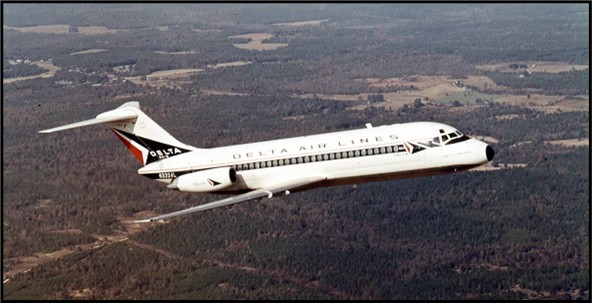
It figures that they would call me on a rainy, stormy night for my “baptism of fire.” The crew scheduler wanted to know how soon I could get to the airport, as they had a DC-9 waiting that was full of passengers who had been delayed and were anxious to get going.
The flight was from Atlanta to Augusta, Georgia, and not very long by airline standards—just under one hour on the schedule. I dashed out of the house and drove to Atlanta airport as fast as I dared. I made a quick check of the weather (it was raining with thunderstorms in all quadrants, but not below minimums), signed all the required paperwork, introduced myself to my new copilot, and briefed the flight attendants. We ran the checklist to make sure we covered all the preflight requirements as the gate agent slammed the boarding door and pulled the jetway back.
Years of flying for the airline make you very proficient and skilled at doing the same procedure over and over again. Ninety-nine times out of a hundred, we would be radar vectored to final for an ILS or a visual approach to the runway. This is an efficient way of handling traffic, and at most busy terminals, it’s both necessary and expeditious, but it lulls one into habit-forming complacency.
I had flown into Augusta many times and was familiar with the airport and the local controllers. It lulled me into the comfort that this would be just another flight like many before.
Yes, airline crews practice other approaches in the simulator, and I had done all types during my training and yearly check rides, but just ask any major airline crew when the last time was that they had to do an actual “procedure turn.” You will get some strange looks and answers.
Of course, most general aviation, commuter, and corporate pilots fly into different airports, both large and small, and many are uncontrolled. They routinely deal with multiple types of approaches and procedures. In most cases, they work a lot harder and are more proficient at this type of flying. They often are not flying the best equipment and may have even less experienced crews. They deserve a lot more respect than they get, and I applaud them.
On the other hand, scheduled airline crews often fly the same routes for months, maybe years on end, and you often talk with the same people day in and day out. The enroute frequencies and procedures become part of your memory, and you get to the point where you could do it all from memory without ever looking at an approach plate or chart. It becomes as routine as driving your car to the local market, and you certainly don’t need to study a chart or read a procedure to do that.
Now, give me a break here because I am writing this from my experience in the mid-1980s, and I know that crews nowadays don’t use paper in the cockpit anymore except to wrap their sandwiches in.
We had VOR/DME because that was all that was required, and airlines did not spend money on equipment that was “not required.” These were “finger on the chart” days, and that’s how you navigated. “Glass” was just coming in on the newest airplanes, but the majority of the fleet still had old “steam” gauges.
So, after a normal departure from Atlanta and being cleared direct to the Colliers VOR (remember, this is the mid-80s), we leveled off at cruise and started to plan our arrival. Winds were out of the north, so we planned on the ILS to Runway 35 at Augusta’s Bush Field.
Imagine our discomfort as we approached the VOR, which is about 20 miles north of the airport, when ATC said, “Radar service terminated and you are cleared for the approach to Runway 35 at Augusta. No other reported traffic. Call when you are on the ground.”
Yikes! This meant we would have to do the procedure turn and follow the whole approach plate exactly—not something we were expecting or used to doing. Yep, we were spoiled and lulled into thinking this was just going to be a routine, quick trip.
Once we acknowledged the clearance, the radio went dead silent, and we were scrambling to make sure we complied with all the details of the approach plate restrictions and minimums. Nobody to talk to, and that makes for a very lonely and uncomfortable feeling on a dark, rainy, stormy night.
So we carefully went through our approach checklist, cross-checked our procedures, and finally intercepted the ILS final for Augusta’s Runway 35. Everything was looking right, and we started to see some lights on the ground as we approached minimums—but still no runway in sight!
Suddenly, it dawned on both of us at about the same time that, with the tower being closed, we had to activate the pilot-controlled lights! Click, click, click of the mic switch and the whole world lit up at full brightness—with the sequence flashers and everything—and it just about blinded both of us. Fortunately, we dimmed it down, and I salvaged a smooth landing out of it, but it probably took a few more minutes for our heart rates and blood pressure to return to normal.
Just one more item to add to the “I was there” experience file, but one that neither of us will likely ever forget.

- New Captain, Dark Runway - June 1, 2026
- Fate and a Bond Stronger than Chains - September 10, 2025
- A Stearman, a POW, and the World’s Busiest Airport - April 28, 2025


Cal, Thanks for sharing what was surely a hair-raising for experience for you and your FO!
Thanks Boots,
Your comments and articles are always valued and a treat to read. Keep them coming!!
Thanks for the great story, Cal! Brings back memories of those unforgettable nights that many of us never forget . Hope all is well!
David Davidson
[email protected]
The same thing happened to me just recently: We were coming back from Tucson to Glendale, AZ (KGEU) “after hours.” Phoenix Approach took us west of the final to runway 01 to accommodate an inbound Airbus, and then turned us back east to the airport, descending into the pattern just south of Luke AFB and just north of the Goodyear airport (KGYR), both of which are practically on top of GEU. Closing fast on the airport and with the beacon in sight, Approach asked if I’d be able to switch to GYR’s CTAF and ask a “Varney” call sign (United’s “Aviate” training program) to come up on 119.2 Running the checklist and trying to make sure I didn’t lose the GEU beacon in all the ground lighting clutter, I should have responded, “unable;” but I jumped over, made the request in the blind, and jumped right back without waiting for a response. I told Approach I was back on, had the Glendale beacon in sight, and was canceling IFR. The controller thanked me and cleared me to Glendale’s CTAF (“keep the squawk until you’re safely on the ground”). As I announced my presence, lined up with the visual approach final, I was starting to worry that I couldn’t see the runway. Fortunately, my wife has always found pilot-controlled lighting both amusing and a minor miracle, so she had a ready response to my worry: “Did you turn on the runway lights?”
Happened to me one night at Orange County airport. No, not John Wayne Orange County Santa Ana blah blah blah airport, the little Orange County one out in the boonies in Virginia, The Commonwealth of. Flying VFR at night like a dummy, I saw what LOOKED like a runway. I remember thinking “Maybe it’s a parking lot or something,” and yes, it was a parking lot or something, because when I remembered to click the mic seven times, Orange County lit right up. Turns out it wasn’t anywhere near where I was looking. I suppose I would have figured it out if I hadn’t used the PCL, (“Pilot Controlled Lighting” being WAY too many keystrokes, so I have to use an acronym) when, after landing, there was a Walmart right next to me.
its even more fun when they wont turn on (palatka fl) or r reflectors (bethel me)
Hi Cal,
Been there done that which brings a smile. Always good to see you writing. Just had a two year grounding from cancer but now in complete response to treatment headed back to flying in the fall! Cheers Myles
Myles,
Good to hear from you and glad to hear your health is improving!!!
Hey Cal, Glad to see you’re healthy, still flying and even writing about it. You’ve sure got plenty of experiences to share. Seeing your name also made me think about our old friend Lee. Blue skies, PR Thomas
PR!!!
Wow, great to hear from you again and hope you are in good health and enjoying life. It’s only been about 50 years or so since Lee and I and you were skiing in Breckenridge? Right? I still think about Lee and really will never forget his loss. Let me know where you are these days as I am retired in Atlanta and still flying my Stearman plus some other fun airplanes. In fact, I leave Thursday for a Stearman Fly In at the Air Force Museum in Dayton which should be great fun with about 40+ Stearman biplanes milling about in loose formation!! Check Six old friend and let’s connect again
I had a similar experience flying on a moonless night into Las Vegas North (KVGT). I was getting vectors from the controller. Finally, my GPS was telling me we were 4 miles from the airport, and I couldn’t see the runway against the glare that is Las Vegas. The tower controller asked if I had the runway in sight. I replied, negative. She then said, “Oh, perhaps I should turn on the runway lights.” Bingo! (Ya think?) It was a lot funnier over drinks that night than it was in the moment.
Hey Cal, nice to see your name in print. When I saw it, I immediately recalled the fun trip we had with Roy J. I remember taking off out of Miami, heading north up Biscayne Bay in a 72 and you asked him if he could not smoke so much lol. He then promptly lit up a cigarette and blew the smoke in your face. That was a fun trip – Not.
Kern, good to hear from you. Yes, we seem to remember the unusual and occasionally unpleasant flights but thank goodness we had many more good times than bad ones.
Cal, it’s a long shot, but if you were flying Thuds out of Korat in 1972 and rode your bike into a ditch, I’m the dentist who stitched up your lip!
Either way, All The Best!
Stephen,
Thanks for reading my post. No, I was not the guy who crashed his bike at Korat but glad you were there to help one of my buddies. I flew Thuds out of Takhli in 1967 and made a few trips to Korat but not on a bike!!!!