
No Downside to Declaring an Emergency
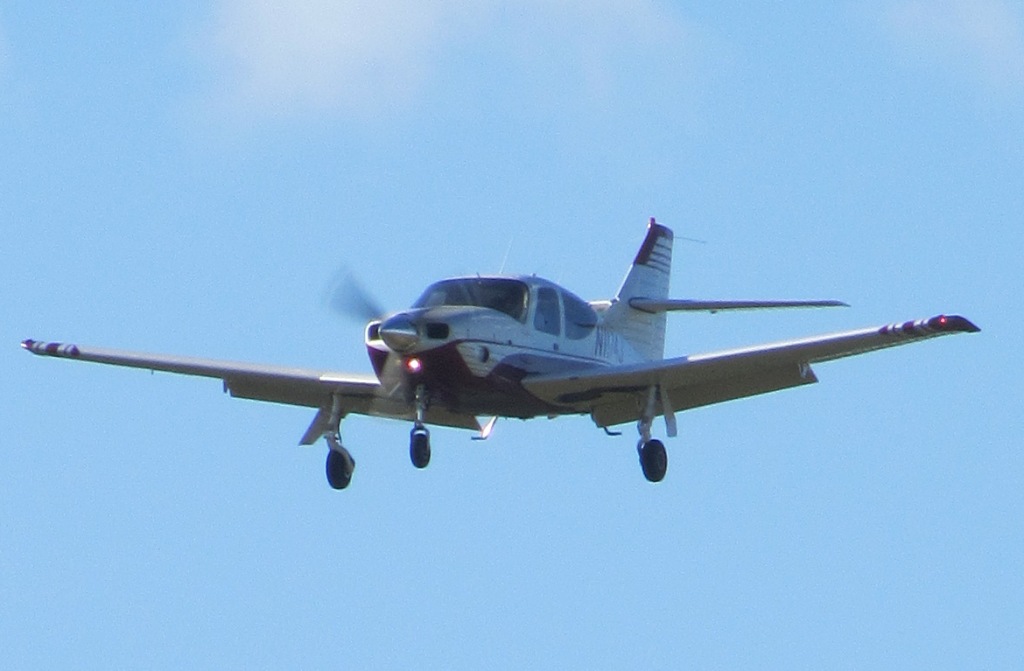
In 1986, my wife and I planned a Thanksgiving trip from our home near Dallas to visit her parents in southern Illinois. The closest airport was Harrisburg, Illinois, so we planned to depart from Addison, Texas, in a rented 1978 Rockwell Commander 114—an airplane I’d been checked out in a few months earlier and had flown several times since. I had also recently completed an IPC in it.
At the time, I had 322 hours total time—just ten of those in actual IFR since earning my instrument rating.
The Wednesday night before departure, I checked the weather. A widespread overcast stretched from west Texas through most of the Southeast. The briefer said ceilings would be 1,000 to 2,000 feet, with tops between 5,000 and 10,000 feet—no turbulence, icing, or significant precipitation. Our destination area was forecast to be around 2,000 feet by our arrival.
Harrisburg didn’t have an instrument approach, so I filed IFR from Addison to North Little Rock for fuel and a comfort stop, then on to Marion, Illinois. If needed, I could shoot the ILS there. If the forecast held, we’d cancel IFR and go VFR over to Harrisburg.
Thanksgiving morning, Addison reported 1,000 overcast and 10 miles visibility. The forecast hadn’t changed. We loaded the car with bags, our four-year-old son, and our small dog, and drove to the airport. Once there, I made one more call to Flight Service and completed a thorough preflight.
We departed Addison and soon entered the clouds. The climb was smooth. At 6,000 feet, we broke out on top—a brilliant white blanket below us, sunlit and peaceful. We continued to 7,000 and settled into cruise. It felt like we’d made the right call.
North Little Rock came and went without drama. I shot the localizer to Runway 5, broke out around 1,000 AGL, and landed. We took our comfort break. I attended to the fueling while my wife and son walked the dog. After fueling and checking the updated weather—still around 1,000 overcast but forecast to improve—we launched again.
Once more, we climbed on top at 6,000 and continued up to 7,000. I set the autopilot in smooth air. Solid undercast. Everything was steady and comfortable.
Five minutes after crossing the Cape Girardeau VOR, Memphis Center handed us off to Kansas City Center. My wife was a flight attendant for a major airline, where seniority is king. She commented that senior controllers probably bid to have Thanksgiving off and the junior controllers were working that day.
Almost on cue, the airplane started a slow bank to the left. I disconnected the autopilot and leveled the wings. As I turned to get back on course, I scanned the panel. There it was—the vacuum gauge sitting on zero, and the gyro instruments winding down. Just like that, we’d gone from a peaceful cruise to a partial-panel situation.
Most pilot stories start with “There I was…”
There I was—partial panel above a solid undercast, with my wife, son, and dog on board. At least the ceilings below were supposed to be decent.
I explained the situation to my wife. She nodded and said nothing. Fortunately, my son was napping.
I reviewed the options. Continuing to Marion no longer felt wise.
“Kansas City Center, 14N, is diverting back to Cape Girardeau. We’ve had a vacuum failure and are partial panel.”
The controller handed me back to Memphis Center with a quick, “Good luck.”
Memphis Center responded immediately. I explained the situation and asked for vectors to the ILS at Cape Girardeau. He gave me a heading and the weather: 1,000 overcast, 10 miles visibility, light winds. I opened my Jepp binder to retrieve the correct approach plate.
Then came the question: “14N, do you wish to declare an emergency?”
Instantly, the mental debate began.
Macho Me: “No, man, don’t do that. It’ll be a bunch of paperwork. You can handle it.”
Not-So-Macho Me: “Yeah, but why not take advantage of whatever he can offer?”
Macho Me: “It’s not like the engine is on fire. You’ve practiced this.”
Not-So-Macho Me: “You’ve got a solid cloud deck under you and your entire family on board. Knock it off.”
That internal debate took about three seconds.
“Memphis Center, 14N, yes, I’m declaring an emergency.”
As the controller cleared me to a lower altitude, I added, “Center, 14N, could I get no-gyro turns?” In for a penny, in for a pound.
I trimmed for the descent and we entered the clouds, with the controller calling the starts and stops of turns. There was a bit of light chop, but nothing significant.
Then the controller surprised me. “14N, would you like an ASR approach?”
An ASR approach—a radar-guided approach with controller instructions? It must be a quiet Thanksgiving Day at Memphis Center.
“Center, 14N, yes sir, that would be great.”
We continued that way, with the controller calling turns, descents, and level-offs, until we broke out on a five-mile final at 1,500 AGL. I never needed to look at the approach plate after we entered the clouds. I only had to focus on keeping the shiny side up. Still, once established, I kept an eye on the localizer and glideslope—just in case.
The Center controller told me to contact the tower.
“Center, 14N, thanks very much. We appreciate the help.”
“14N, thank you, too. I haven’t done an ASR approach in a while, and it’s always good to practice.”
I contacted the tower and landed uneventfully. Of course, there was no service facility open on Thanksgiving Day, so my wife called her parents to come pick them up. I found a ride to a nearby motel and checked in for the night.
The next day, I returned to the airport and found a mechanic. He replaced the vacuum pump, disassembled the old one, pulled out the broken impeller, and gave it to me as a souvenir. That afternoon, I flew on to Harrisburg to join my family.
That’s when my wife told me that when I explained the problem, my face was “white as a sheet.” She decided the best way to help was to stay calm, take deep breaths, and say nothing. I told her I appreciated that—a lot.
The flight home to Texas was in beautiful weather, with no surprises.
Could I have flown the partial-panel ILS without no-gyro turns and the ASR approach? I’m 98 percent sure I could have—but the reduced workload made a big difference. It certainly lowered my stress level.
Bottom line: There is no downside to declaring an emergency. You might be surprised how much help is available.

After the passing of his wife in 2015, Ron retired and, on a whim, attended an AOPA Rusty Pilot seminar. The experience reignited his passion for aviation and motivated him to return to the cockpit. He regained currency and purchased his first aircraft, a 2000 Tiger AG-5B. In the following years, he owned a 1977 Commander 114 and later a 2012 Vans RV-7A.
Now 74, Ron has come full circle and is content once again renting aircraft—flying purely for the joy of it.
- No Downside to Declaring an Emergency - May 13, 2026


Ron — what a great story! And something I will take to heart as a new pilot myself.
Was he talking with Memphis Center or Approach? Centers and approach controls use different types of radar. Centers don’t have the type of radar facilities for no gyro vectors or ASR approaches.
Center could certainly have handed me off to Approach. I don’t remember. Thanks.
But congratulations on your calm way of dealing with an emergency to a successful outcome.
I too had a vacuum failure in actual IFR with a student. I preached that this was an emergency and like Ron Dawes I debated with myself for about three seconds before. declared one.
Ron,
The title of your story caught my eye. I have always told anyone who would listen that same thing. The only thing you left out of your story is that I’ll bet you had no paperwork to fill out after the flight nor did it cost you anything (embarrassment, ridicule, criticism, etc) by declaring an emergency. There truly is no downside to pulling that emergency trigger. Great article.
Totally correct! No phone call, no paperwork. Just everyone happy that it worked out OK.
Good story and an excellent outcome.
One downside to declaring an emergency is FSDO follow-up.
Back when we had a landline phone at home, I declared a fuel pump emergency, landed successfully and went home, but somehow failed to let my wife know about the emergency.
A few days later our local FSDO called to see how the repairs were going, and my wife got the call!
Then, it really was an emergency! Live & learn. Better to fess up early.
Ron, that was a great story! I am a retire United Airlines 767 captain and have been a current and active CFI for the past 56 years. I write for both the Cessna and Piper Owner Magazines as well as for Sporty’s Airfacts Journal. One of my articles was on declaring and emergency, which I would love to share with you because it validates your decision to declare that day. In my 29 years of flying for the airlines, I have heard many supposed professional pilots who have a serious emergency yet not only will they not declare, but they for some reason absolutely will not tell ATC what their problem is. Check our my stories in Sporty’s and if you would like to read my tutorial on declaring an emergency, email me and I will send it along with some I have written on PIC authority. You did a great job that day under trying circumstances. Well done1 Joel