
An Air Force Student’s First Ride in the T-38A Talon
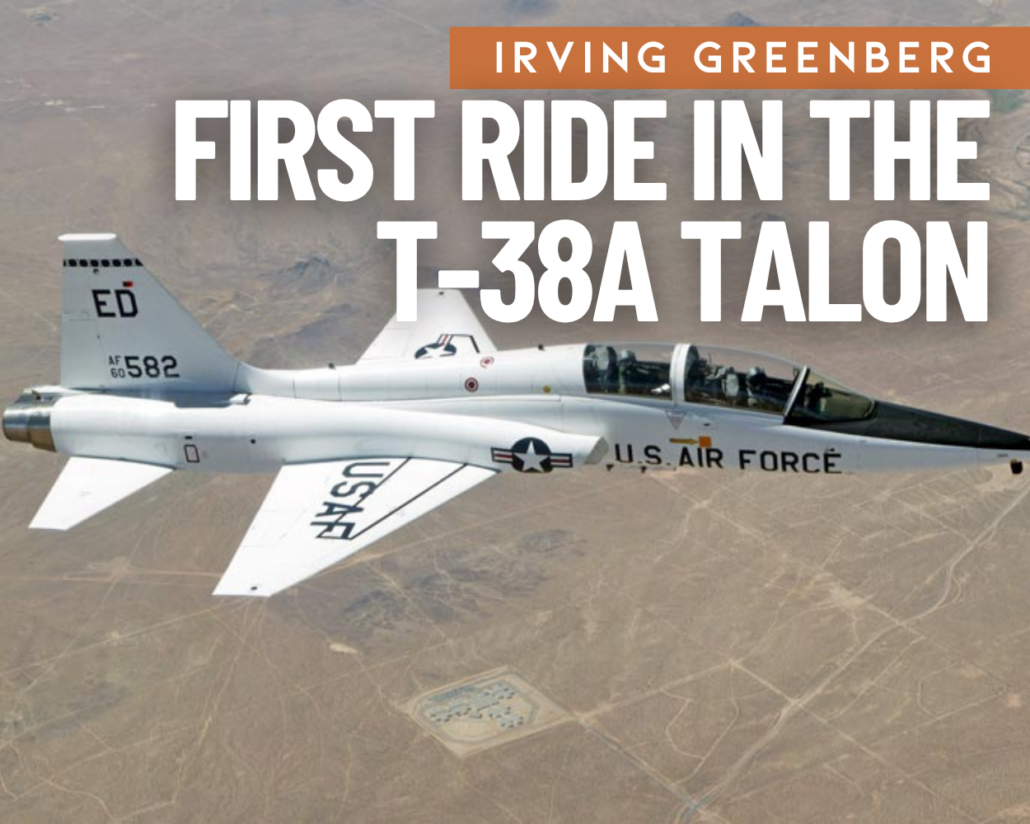
When I was an instructor taking a student on his first ride in the T-38A, this is how we introduced the airplane.
The twin-engine, two-seat, tandem-cockpit, swept-wing, supersonic T-38 Talon has served as the United States Air Force’s advanced jet trainer since its introduction in 1961. Over the decades, the aircraft has undergone multiple life-extension programs to keep it flying and its instruments and performance relevant.
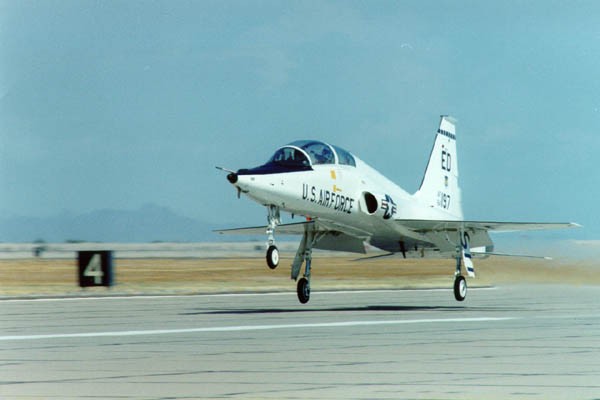
Powered by two General Electric J85 turbojet engines—originally developed in the 1950s for the ADM-20 Quail decoy missile—the T-38 benefited from an exceptional thrust-to-weight ratio. That engine also found its way into the T-38 and the F-5 Freedom Fighter. The Talon became the world’s first supersonic trainer and was adopted by several foreign air forces. In 1962, it set impressive time-to-climb records, reaching 30,000 feet in about one minute and continuing to 40,000 feet shortly thereafter.
Walking out to a T-38, you immediately understand how it earned the nickname “the White Rocket.” The aircraft is roughly 50 feet long, with a wingspan just over 25 feet. Its extremely thin, swept wings are mounted so far aft that they are not visible from the cockpit. Structurally, the T-38 is stressed to approximately +7.3 and -2.3 g. It is fully aerobatic, excluding spins, and capable of extremely high roll rates—up to two complete rolls per second.
The pilot sits well forward in the cockpit, with the rear seat slightly raised so the instructor can see around the front-seater’s helmet. Each cockpit has its own canopy and a complete set of controls and instruments. Instructors may occupy either seat depending on the type of training. Students fly from the front seat for formation, aerobatics, and landings, and from the rear seat for instrument and navigation training. In the rear cockpit, a canvas canopy curtain can be slid forward to cut off all outside visual references. Only the front seat is used for solo flight.
At the time, the T-38A was equipped with the original Northrop rocket-powered ejection seat rather than the later Martin-Baker system used today. Each pilot wore a Nomex flight suit, gloves, parachute, g-suit, and helmet. Ejection was initiated by pulling side-seat handles and squeezing triggers in the grips. The canopy jettisoned first, followed 0.3 seconds later by the seat firing. If the canopy failed to depart, a spike mounted on the headrest shattered the Plexiglas as the seat passed through it.

Once clear of the aircraft, explosive bolts separated the pilot from the seat. A strap known as the “butt-snapper” rapidly straightened the pilot’s posture before separation. A barostatic device delayed parachute deployment until passing through roughly 14,000 feet to prevent a fatal opening shock. A small oxygen bottle attached to the harness provided breathable air during descent from high altitude.
After taxiing onto the runway and aligning on centerline, I pumped the brakes and held them with all my strength. Advancing both throttles to full power, I watched the engine instruments stabilize. Even inside a helmet, the engines’ steady roar hinted at the power being restrained.
When cleared for takeoff, I released the brakes and advanced both throttles through the detent into full afterburner. Instantly, the aircraft surged forward as blue exhaust plumes formed behind us. The airspeed indicator climbed rapidly. Within seconds, we passed critical engine-failure speed, then refusal speed—the point beyond which stopping was impossible.
At around 160 miles per hour, the aircraft lifted smoothly off the runway, still accelerating so fast that the landing gear had to be raised quickly before passing 260 miles per hour to avoid structural damage. The flaps followed shortly thereafter.
Only seconds after liftoff, the airspeed approached 460 miles per hour. I raised the nose steeply, trading acceleration for climb. Initial climb rates exceeded 30,000 feet per minute, with the vertical-velocity indicator pegged. As the temperature dropped with altitude, the Mach indicator crept upward. At Mach 0.9, I adjusted pitch to hold that speed until 30,000 feet, then lowered the nose slightly to allow acceleration to Mach 0.95 while continuing the climb.
About one minute after takeoff, we passed 30,000 feet; roughly 30 seconds later, we reached 40,000 feet. To level off, because I was still climbing so rapidly, I rolled inverted and pulled the nose down to the horizon, then rolled upright and continued accelerating. The Mach needle hesitated briefly near Mach 1 as a shock wave formed and the center of lift on the wings and tail shifted aft. Seconds later, it passed Mach 1 and stabilized around Mach 1.1.
In supersonic flight, the controls became extraordinarily sensitive. Even small stick inputs produced dramatic pitch or roll changes. Unlike subsonic flight, supersonic airflow does not separate from the wing in the conventional sense, so there is no stall warning. Pulling too hard can overstress the airframe without any advance indication. Normal aileron deflection in a turn could slam your helmet against the side canopy before you knew it.
After a short demonstration, it was time to slow to subsonic speed and return before running out of fuel. Afterburner fuel consumption is enormous. A T-38 could go from full tanks to empty in around 10 minutes if the afterburners were left continuously lit at low altitude. Fortunately, the T-38 climbs rapidly and cruises comfortably above 575 miles per hour without afterburner at altitude.
Back in the pattern over the runway at 1,500 feet and 350 miles per hour, I executed a pitch-out to 60 degrees of bank, pulling 2 g’s. My g-suit inflated as my effective weight doubled. At higher g loads later in training, loss of color vision, tunnel vision, and eventually G-LOC (G-induced loss of consciousness) were ever-present risks—effects every Air Force pilot experienced in training to learn recognition and recovery.
On final, I slowed to about 200 miles per hour, raised the nose at around 50 feet in the middle of the overrun, and held the aircraft just above the runway until it settled on. Even after touchdown at over 150 miles per hour, careful aerobraking was required before gently lowering the nose and applying brakes.
This was the first flight every student experienced at the beginning of advanced training when I was a student pilot in 1967 and later a T-38 instructor from 1973 to 1977. Known as the “zoom and boom” ride, it gave students an immediate and lasting respect for the aircraft they were about to fly, and it remains one of the most exhilarating flights of my career.
- An Air Force Student’s First Ride in the T-38A Talon - June 3, 2026


As a T-38 IP at Vance AFB in the early 70’s I would occasionally take Air Force Academy cadets on their ‘3rd Lieutenant’ summer tours on a T-38 orientation flight. Since they were in the back seat on those flights, I would tell them that when we went supersonic, I wouldn’t be able to hear them since we were traveling faster than the speed of sound! As we went supersonic, I would ask them a question, and then not respond to their comments. My best friend, Frank, was a T-37 IP at Vance and he would tell the cadets that he flew with to take a ‘barf bag’ with them in case they got sick on their T-37 orientation flight. One cadet refused the advice saying, “I never get sick when I fly!” So, Frank flew mostly uncoordinated, with LOTS of acro AND spins and this cadet finally turned to him and said, “Sir, I’m gong to get sick, what should I do?” Frank told him to use one of his gloves, which he did. In fact, he ended up using both of his gloves. After they landed and were taxiing to parking, the cadet held up his two full gloves and asked, “Sir, what do I do with my gloves?” Frank reached into the pocket of his flight suit, pulled out a barf bag, handed it to the cadet, and told him, “Put them in here!”
I will never forget my first takeoff in the T-38 at Laughlin AFB in 1973. You had to step on the brakes with all your force to steady the airplane, and when you released the brakes and went into afterburner the acceleration was analogous to sitting on a rocket. It was one of the most exhilarating feelings that I have ever experienced. Also memorable were the Immelmann maneuver and the unbelievable rapid roll rate. What an airplane! The 6 months of training in the T-38 was one of the best times in my life!
On my dollar ride in the T-38, we experienced a canopy seal failure at FL450 just after the supersonic run. The emergency descent was a hoot, the ride was shorter than it should have been, and man oh man, was the pressure breathing difficult!
Irving,
Beautiful story. It took me right back to my first T‑38 ride at NTPS, NAS Pax River in the early ’70s — one of those unforgettable, impression‑making flights that stays with you for life. Your piece brought all those feelings rushing back.
Dale Hill,
You keep crankin’ out stories like that and the rest of us are gonna need to step up our game. You’ve got more good tales than a squadron bar on a Friday night. Always a damn fun read.
Check 6,
“Corkey”
I was a security policeman at Webb Air Force base in Big Springs Texas in 1971-72, They trained pilots with the T-38’s. My boss was a Major Karl and he was on his way to retirement. One day he brought a bunch of us down to the end of the runway and told us to wait. He proceeded to get in one of those T-38’s. As he came down the runway the nose gear lifted off the runway and the next thing we knew he was heading straight up into the sky. It was absolutely amazing to watch. They a fantastic jet.