
Towing Gliders in a Waco UPF-7
|
Getting your Trinity Audio player ready...
|
I taxied to the taller grass alongside the runway, then tapped the left brake to pivot the airplane 270 degrees on the left wheel so the tail pointed toward the cornfield next to the runway. With my back to the cornfield, I pulled the fuel mixture knob to off, and the engine slowly shut down as it died of thirst. I not only loved flying the airplane, but also loved sitting in it next to the grass runway between tows, with a cornfield at my back, grasshoppers and crickets singing in the grass, and listening to the exhaust ticking as it cooled, like a slowly diminishing clock. Ahh, memories. I was relaxed and at peace. I could have easily dozed off, but remained alert enough to see a signal from those preparing the next glider for flight. My rest and contentment would last a while longer when all the club glider pilots had found thermal currents to play in while staying away from the ground.
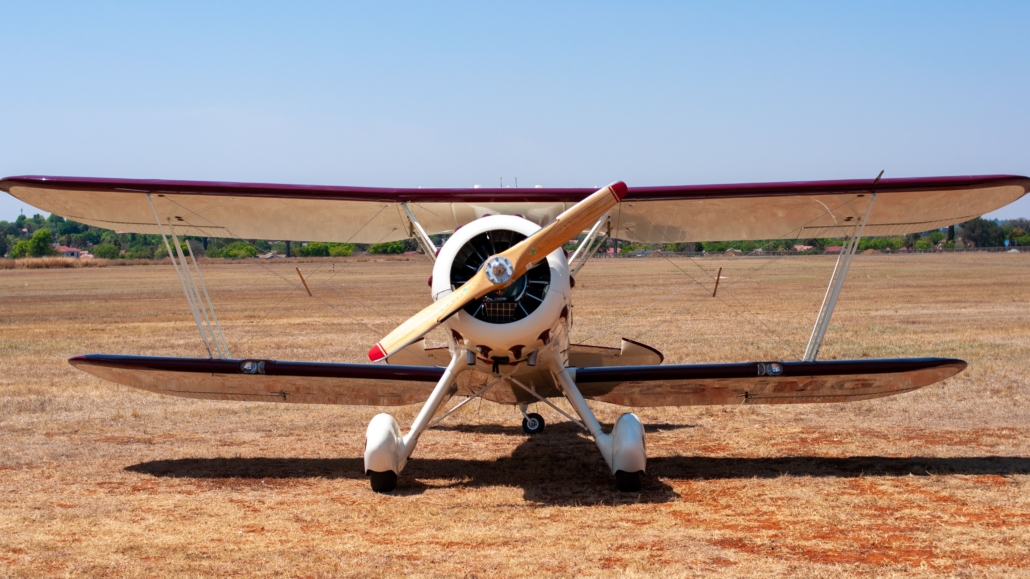
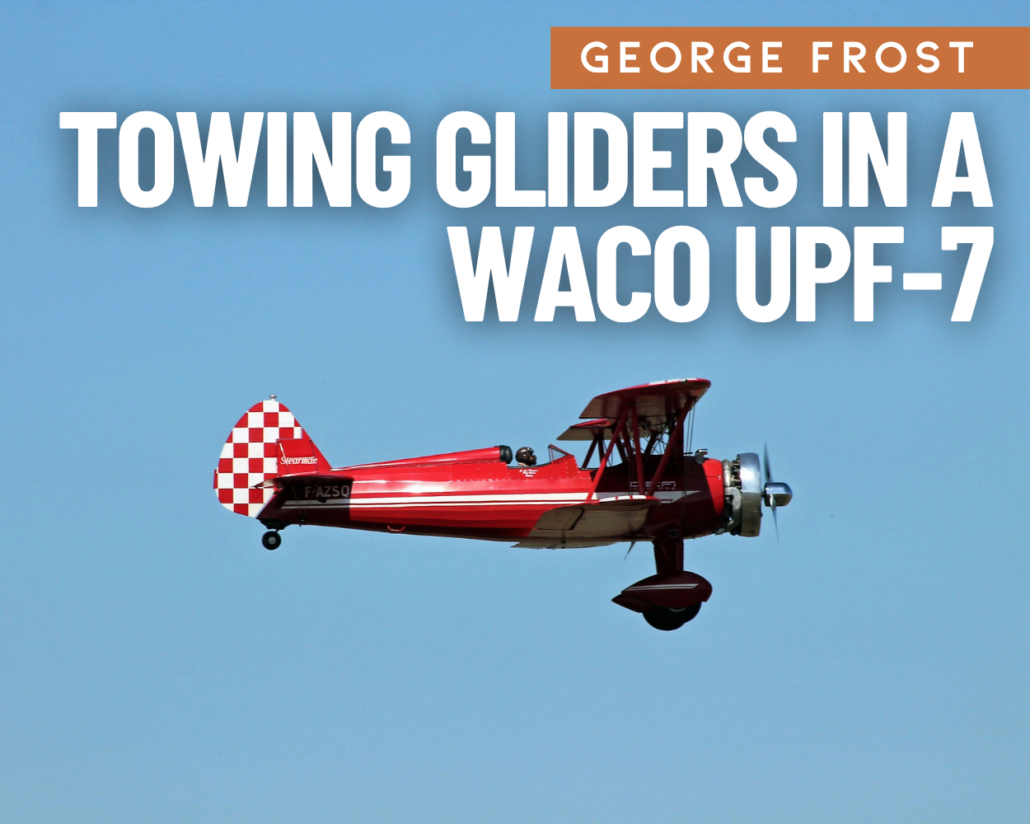
I would start the engine when I saw the arm of the person directing flight pointed upward and swirled in a circular motion, indicating engine start. I would taxi into position where the tow rope could be attached to the towplane’s hook behind the tailwheel. I could open that hook from the cockpit and release the rope if necessary. I would taxi far enough down the runway for the 200-foot tow rope to be almost fully extended. Only when the glider pilot was ready would the other end be attached to the glider’s nose hook. That hook could be controlled from the glider cockpit to release as well. I would then taxi slowly forward until the rope end was loosely near the glider’s nose. In this airplane, a Waco UPF-7, an open-cockpit biplane with a rearview mirror, the operation was clearly visible.
When the pilot of the glider had completed the checklist, the tow rope was attached, and the pilot would signal readiness with a thumbs-up to the person standing next to the wingtip, which was resting on the ground. The glider had a single wheel under its center, and only a person or airflow would lift the wings level. The wings would be lifted by the person at the wingtip, called a wing runner, who would then signal by swinging a downward-pointing arm or flag like a clock pendulum to take up the remaining slack in the tow rope. The towplane moved forward until the rope became taut and lifted off the ground. The wing runner’s circular, propeller-like arm or flag motion then indicated full towplane power and the beginning of another flight. The wingtip would be supported by the wing runner, who would run a short distance with the glider until airflow transferred control to the pilot.
Unlike most flat-opposed engines in general aviation aircraft, which would indicate about 2,500 RPM, the radial engine in the UPF-7 would be at 1,800 RPM while towing. A clear view of the glider could be seen in the towplane’s mirror, or you could turn your head for an even better view. Care should be taken to stay behind the windshield or the slipstream would snatch loose items. I once forgot and watched a pair of sunglasses seem to sail off into infinity. They were not prescription and probably only cost a dollar at the time, before the fashion term “eyewear” became common. They were just dollar sunglasses then.
When towing, you would try to have the glider in thermal lift at 2,000 feet, the normal release altitude. As a glider pilot yourself, you had a pretty good idea where this would be. A puffy, billowing cumulus cloud was a good indication. There were ground indications as well, which varied depending on the time of day. Ground surfaces heated the air to produce thermal currents at different rates throughout the day. Thermal current or not, the glider would usually release the tow rope at 2,000 or occasionally 3,000 feet above the ground.
For the tow pilot in the UPF-7, a biplane reminiscent of World War I fighters, the flight of imagination began. You, in the open cockpit, would assume the identity of your favorite World War I ace, if you had one, from reading many cheap aviation history books as a kid. It usually depended on your ancestry. For Brits, it was Mick Mannock, or Billy Bishop if Canadian. For those of French ancestry, it could be Georges Guynemer or Charles Nungesser. My dilemma was my mixed Swiss and German ancestry, and I alternated between Eddie Rickenbacker and Manfred von Richthofen. I think, for everyone influenced by Peanuts and Snoopy, it was hard to avoid becoming the Red Baron. It sometimes caused me to sing in German, without being heard, of course, and later go to Plank’s Beer Garden in Columbus, Ohio, to drink beer and order Sauerbraten. I had to wait until Wednesdays for that. A receptionist at Lane Aviation, where I was employed, bought me a flying helmet to wear in the airplane. It had a small stuffed Snoopy in flying gear on top. I definitely used the helmet, but removed the Snoopy to be displayed in my car. In the cockpit, the drag on the stuffed Snoopy would have pulled the helmet loose.
I’m 93, and many things in my life have been pulled away from me like the stuffed Snoopy would have been if it had not been secured elsewhere. However, time has brought back friends I never thought I would hear from again. Through the internet, I recently reconnected with my college roommate and my best friend from grade school. He and I were from groups who were not expected to get along. We did not know about that. He was my best friend then, and the emails we have exchanged indicate nothing has changed. To my great surprise, he recently sent me a very faded picture of himself, possibly taken during a winter in the 1950s, wearing a heavy flight suit and standing next to an airplane, likely ready to climb into the open cockpit of a Waco UPF-7. We continue to connect. It would be good if everyone could.
- Sideways - September 28, 2026
- How Did We Ever Get There? - August 31, 2026
- Towing Gliders in a Waco UPF-7 - July 27, 2026


I fondly remember the sound of crickets in the early mornings during the summer at airfields around Fort Rucker, AL. To this day I love being at the airport and hearing the crickets before a flight. The small experiences that adjoin flying are strong triggers that make flying such an immersive affair. Thanks for such a vivid story.
Thanks for your Waco tow pilot memories, George.
As a child of 8 I became a line boy at Batavia Airport, NY, a 3000 ft grass field.
My first job was filling Coke machines and making coffee.
My Dad was the prime Flight Instructor for the Rochester Soaring Club, so my weekends were spent at the field.
The owner of the airport, GIL Chappel towed the gliders with his Waco UPF-7.
As time went by my next chores were mowing the grass around the tiedowns and finally at the advanced age of 12 fueling all the airplanes and mowing the field with a pre-war Alice-Chalmers tractor with a side cutter. My reward was the last tow on Sunday I got to sit in the front of the Waco and ride.
It always included a wingover and a low pass to drop the towrope at the other end of the field with a great turning pullup.
A good thing too, as at 12 I could only see out during the turns.
I soloed gliders there at sunrise on my 14th birthday and was still a line boy there until I left for Collage.
Like you pointed out time didn’t stand still as when I grew up all I really wanted to be was a tow pilot flying that Waco. I was soon a tow pilot, but now in super cubs, Citribias and Pawnees.
Flash to 35 years later and I’m flying corporate jets with a layover in Modesto. CA. I rented a car to go visit Yosemite Park and on the way there saw a Waco doing rides about to land nearby. Ops, forget Yosemite, I stopped by the airport, I Didn’t say to the pilot that I was also a pilot, just bought a ride.
Great ride. As he brought the power back to idle for landing, the hot oil odor of that radial 220 brought back all the best memories of my life as a line boy, pilot, those Sunday flights. my dad teaching me to fly, mowing the grass runway, lighting the flare pots at night and all the people helping me make my life as a pilot. I bought that Waco 10 minutes after landing and still have it.
http://www.biplanedenver.com
I gave free rides to WWII veterans for the next 25 years until I ran out of them after Covid.
Still a glider pilot and enjoy teaching, as my dad did. Have 2 boys, Airline pilots and also teaching.
My dad said if you love flying you should teach it and made us all promise to do so.
http://www.gliderpilotsgroundschool.com
Best Regards,
Dave Seymour