
Impromptu Rescue Efforts
February 26, 1990, was the first leg on the first day of the Tiger Moth Club’s North Cape to Bluff vintage air rally, an officially recognised sesquicentenary event. (New Zealand dates its start from the February 6, 1840, signing of the Treaty of Waitangi between the early colonial officials and the indigenous Māori tribes. The precise translation and interpretation of that founding document are still being debated.)
I was the main organiser of the rally, which involved several dozen vintage aeroplanes flying the full length of New Zealand during an ambitious—given this country’s reputation for fickle weather—five days. The idea was to retrace the basic route flown by 22-year-old E.F. (Ted) Harvie, who, along with 18-year-old Trevor Hunter, one of this country’s pioneer airwomen, on December 1, 1933, in DH60G Gipsy Moth ZK-ABP, became the first to see both extremities of New Zealand in one day. That record stood for 29 years.
The rally’s first leg started at Kerikeri and involved flying up to North Cape, usually considered the northernmost mainland spot, past the 650 ft Hikura/de Surville Cliffs, which are actually slightly further north, then westwards across the northern tip of the country to round the Cape Reinga lighthouse, where State Highway 1 begins or ends, depending on your point of view. Then it was back south along Ninety Mile Beach to Kaitaia, which was Harvie’s 1933 starting point at 2 a.m., before he flew north in the moonlight, far enough out to sea to be beyond North Cape’s latitude.
I was flying Auster J5 ZK-AXJ, which I part-owned. My passenger/copilot/navigator was Mike, a retired airline captain whom I’d just met for the first time—my original copilot having had a better offer for the week in the front cockpit of a Tiger Moth. Mike had flown Austers in his English youth, although he hadn’t sat in one for decades and was about to experience some of the type’s more endearing low-and-slow characteristics. Both tanks were filled to the brim for a comfortable three-hour endurance.
Having passed across the broad Spirits Bay and its Te Horo Beach, and starting to converge on the rocky shoreline approaching Cape Reinga, I became aware of some aerial commotion at my 11 o’clock low. A couple of aeroplanes were buzzing around something on the water a couple of miles off the rocky shoreline. This turned out to be one of our participants, J-3 Cub ZK-ARG. It was undoubtedly serious stuff, so my first thought, as a photojournalist, was to grab my camera to record this rare (I hoped) occasion, followed by wondering how I could help. The Cub’s occupants had obviously survived the ditching, as they were sitting on the fuselage top, but they didn’t look entirely comfortable.
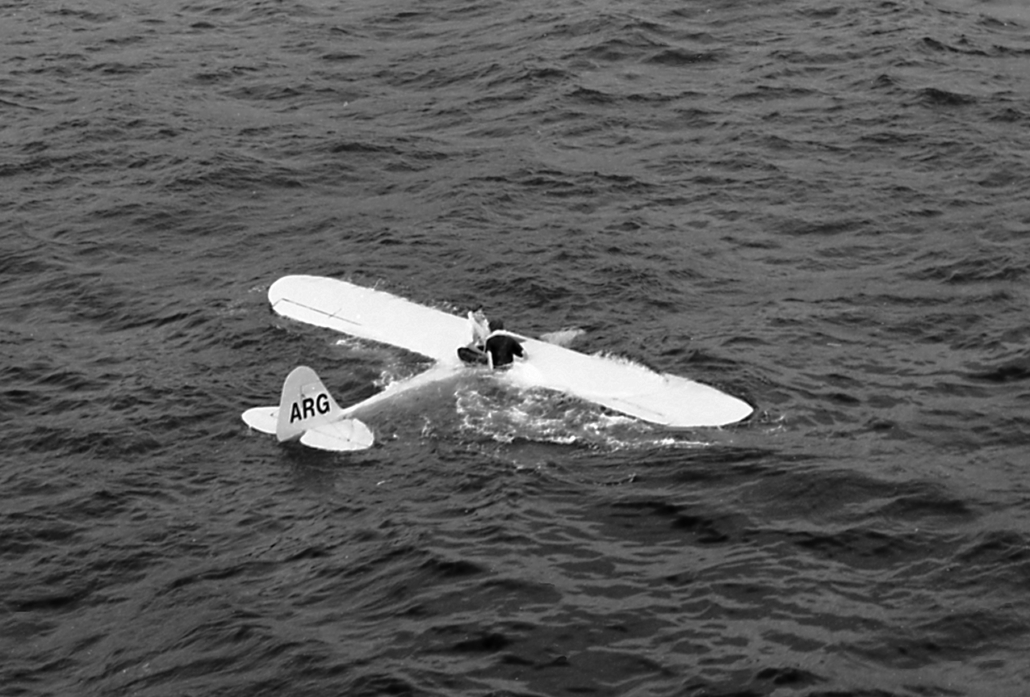
Piper J-3 Cub ZK-ARG shows a distressingly apt registration after ditching near Cape Reinga, New Zealand, on 26 February 1990; the occupants swam safely to shore.
What followed was an interesting exercise in independent rescue efforts. The Tiger Moths, with endurance to Kaitaia already at their limit, couldn’t hang around and had to keep going, and many vintage aeroplanes, including my Auster, lacked radios, flying NORDO around the country and avoiding control zones. Grant, in a 90hp Super Cub with the ink barely dry on his new PPL (his aero club instructor had needed some persuasion to let him take part in our major expedition), climbed to several thousand feet so he could radio a Mayday call to Auckland Control. Bruce, in another 90hp Super Cub, circled low over the ditched pair, shouting encouraging words out his open door.
I recalled having passed a fishing boat anchored in a rocky cove the other side of Spirits Bay, so the obvious thing was to persuade it to come to the rescue. The convention for a pilot to get a surface vessel to do something in a maritime country such as New Zealand is to attract its attention by revving the engine and flying out along the desired course.
Mike flew back eastwards while I rummaged in my rally organiser’s stuff, writing PLANE IN SEA in black marker pen on an A4 piece of white cardboard I just happened to have handy. Working together, with frequent changes of hands and feet on the controls, we circled the boat at rather less than legal height, revving the Gipsy Major and holding up the sign in the window, then flying back in the direction of the stricken aviators. After a couple of efforts at this, plus adding an SOS cardboard, I was encouraged to see somebody looking up with binoculars, followed by an anchor being weighed.
More engine revving, more flying westwards in a racetrack pattern—only by this time there was no Cub to be seen, just a pair of swimmers with arms linked, kicking shorewards on their backs. The boat was established on the desired course, and there wasn’t much else we could do, so, with a calculated amount of fuel to reach Kaitaia, we flew south along Ninety Mile Beach (actually only 90 kilometres long, but you know how those early mapmakers liked to exaggerate) under low cloud, passing a northbound JetRanger along the way.
A couple of my fellow Auster owners, flying a Tiger Moth, seemed unusually relieved to see us. Knowing its endurance, they’d been a bit concerned at our 3 hours 25 minutes from takeoff, but I assured them we’d spent a fair bit of time at low power, and there was still 5 gallons showing on the gauge. No sweat.
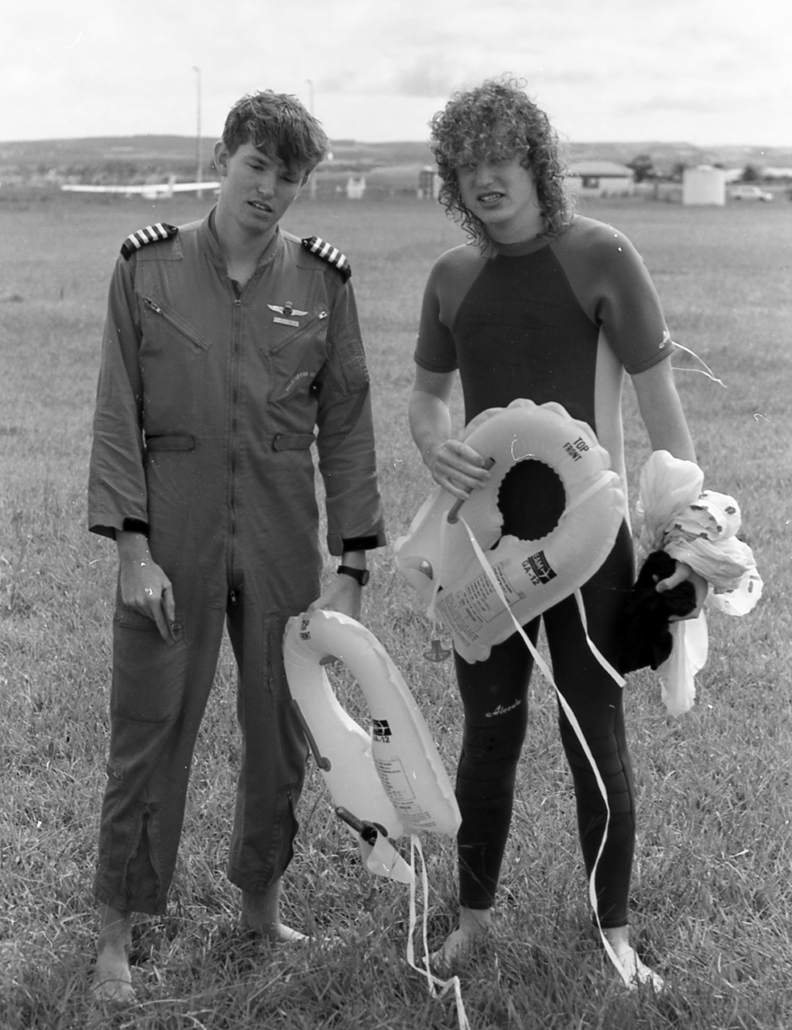
Don McKenzie (left) and Mike Carden, still holding their inflated life jackets, stand in borrowed clothing on Kaitaia aerodrome after their helicopter ride from Spirits Bay. They had to swim ashore when their Piper J-3 Cub ditched near Cape Reinga after engine stoppage.
The JetRanger duly arrived at Kaitaia, bearing a bedraggled pair in borrowed clothing. The Cub’s engine had stopped, for reasons never really determined, with no hope of gliding to shore. Once they were out of the submerged cabin and established on top, pilot Don dived back inside to retrieve the life jackets they should have been wearing all along, and when the Cub sank beneath them, they started swimming. Their only injuries were some cuts from the rocks when they finally made it to land under their own power.
The first rescuers on the scene were aboard a game fishing boat from near the Three Kings Islands off to the northwest, which had responded to the original Mayday call and picked them up from the rocks, carrying them to Te Horo Beach, where the JetRanger landed. My gallant fishing boat arrived too late to do much, but it was nice to know that its crew knew what I was trying to tell them.
Don continued the rally in a modern Grumman Tiger, while his passenger Mike remembered all those other things he’d meant to do at home that week. The Cub was later retrieved, but it had become entangled in craypot lines in the fierce currents where the Tasman Sea meets the South Pacific Ocean. About the only recognisable part was a mainwheel, although the propeller could be made out if you squinted a bit and knew what you were looking for.
The vintage air rally continued, less one Cub, to duly round Bluff at the southern tip of New Zealand, with something dramatic taking place on each of the five days. I’m still not sure if losing an aircraft entirely was more serious than a midair collision over RNZAF Base Wigram, Christchurch (don’t ask), but despite three aircraft being harmed during the course of this vintage air rally, everybody seemed to enjoy it.
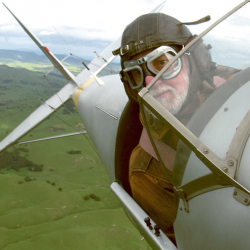
His biggest aviation adventure was helping fly a Cessna 195 floatplane from an upstate New York lake all the way to Seattle, WA in 1984, taking in Oshkosh along the way and briefly flying in formation with an A-10 Warthog.
As well as editing the quarterly Sport Flying for more than 20 years from 1997, he edited the monthly New Zealand Aviation News from 2008 until it ceased publication shortly after its 2021 takeover and conversion to paywall online.
Rising costs, bureaucracy and the lack of time and ready access to an aircraft for staying current led to John’s hanging up his headset in 2008. In his retirement he now edits the NZ Aviation Historical Society’s quarterly journal The Aero Historian.
- Impromptu Rescue Efforts - April 13, 2026
- Out of Options—Pinned in the Pass - December 15, 2025


Leave a Reply
Want to join the discussion?Feel free to contribute!