
The Great Court Case
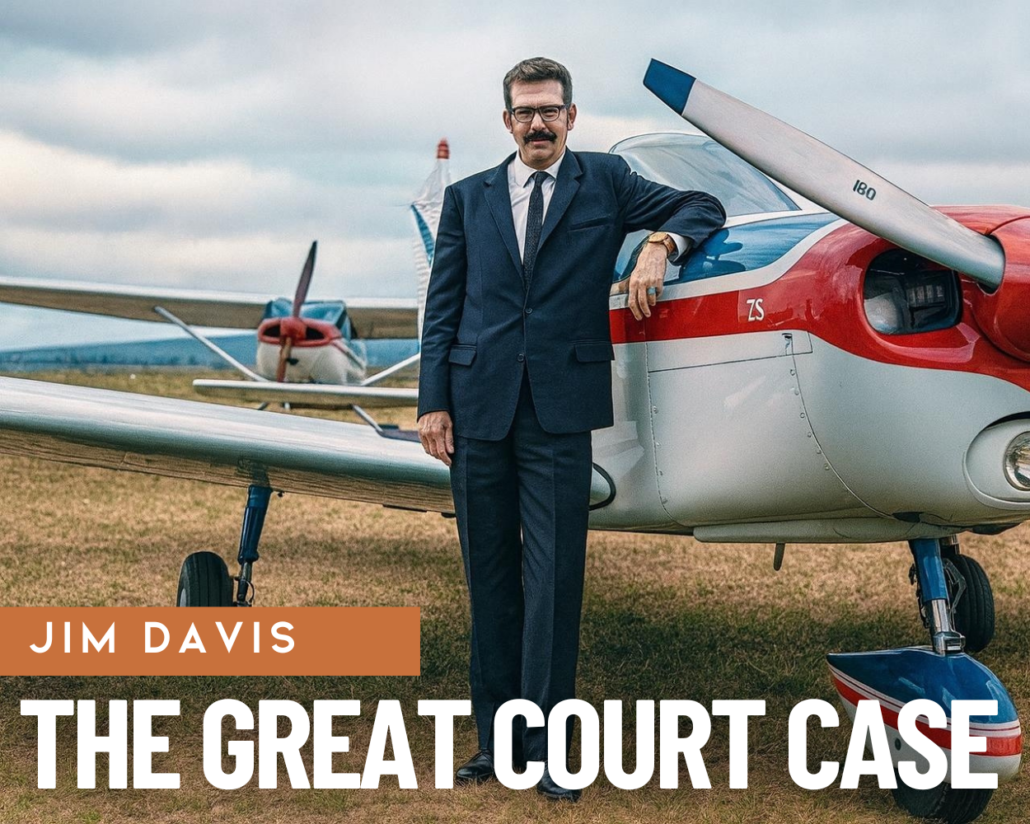
It’s the mid-sixties and aviation is booming. We fly round Southern Africa waving the Piper flag, drinking with the boys in the flying clubs, and we usually come back with a couple of sales.
On this trip round South West, Mike Schoeman and I were flying an exciting new 140 Cherokee, in convoy with Zingi, Dronkie Lombard, and the remarkable Erik Winson—all in fancier aircraft. The Cherokee was exciting because it had just replaced the Tri-Pacer. Hell, at that time we were still selling brand new Colts.
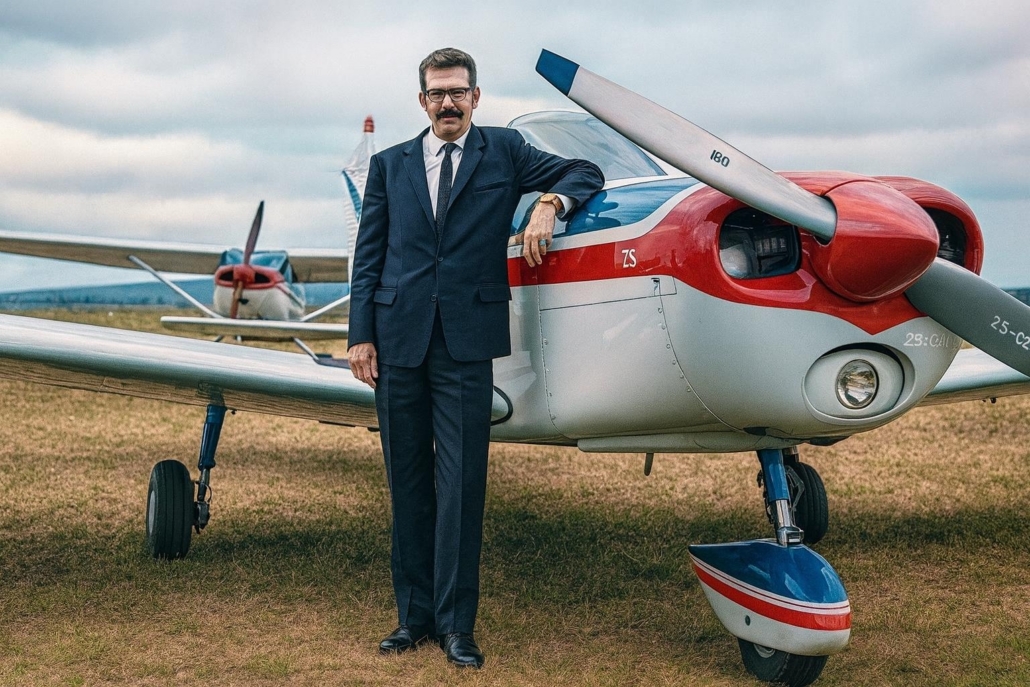
Dronkie Lombard
It’s 6 o’clock on a Sunday morning. I can’t raise the guys in the tower at Eros (Windhoek). Even our magnificent Narco Omnigator is unable to arouse them. No matter—radios are not compulsory.
I taxi out and stop in front of the tower and wait for a light. Nothing. Then I stop at the intersection and wait for a light. Again nothing. So I enter and backtrack to the threshold. I do a run-up and my takeoff checks. Still no lights and no reply to my calls, so I take off.
As we climb through about 1,000’ AGL, Mike says, “We are getting a flashing white light. What’s it mean?”
“Nothing. It’s only for aircraft on the ground, and it means taxi back to your starting point.” We think nothing more of it.
We go down to the coast and drink with the boys in Swakopmund and Walvis Bay. Then we head inland for Otjiwarongo, Grootfontein, and Tsumeb, spreading charm, goodwill, and alcohol as we go. We get back to Eros a week later. To my amazement, the controller asks to see me in the tower.
I shoot up the stairs all smiles and benevolence, to be greeted by a fat, perspiring human being named Willemse—I don’t think his mother gave him a first name. He wants to know if I was the idiot who took off in the Cherokee on Sunday morning.
I tell him no, I was in fact the pilot-in-command—not the idiot.
He says in that case he is going to report me for taking off without permission.
I ask him if he was on duty at that time and he confirms that indeed he was, and that he personally witnessed this outrage.
I counter this by telling him it is my belief he should not be an air traffic controller if he can’t control one aircraft on the ground, on a Sunday morning, with an Aldis lamp. I say that I, in turn, will be reporting him.
With that I slither down the steps and set off to find Zingi and the boys—I want to help them force down some more Windhoek Lager. I never give another thought to the sweaty Willemse.
Now we fast-forward about two years. I have my own little one-man-one-aeroplane flying school in George. One evening a uniformed representative of the South African Police Force bangs on my door, hands me a bundle of papers, says he wants a signature, and disappears into the night.
I am much puzzled. As a fairly recent immigrant from Kenya, my Afrikaans is not up to decoding legal documents, so the next day I take this bunch of papers to a mate of mine and enquire as to their contents.
I am dismayed to hear that Comrade Willemse has put the wheels in motion to have me locked up for five years, and/or fined a total of R10,000 for my misdemeanours.
Now, R10,000 in the early sixties was what? Maybe a million now? I don’t know, but to give you an idea, an evening meal at a country hotel cost about 75 cents then. Anyhow, there were five charges, each worth R2,000. So you could say that I was somewhat dismayed.
The documents also contained a second-class train ticket for the five-day journey to Windhoek to attend the court case.
I was still pondering this when the phone rang. “Davis, you silly bastard, do you know what you have done to me?”
I was delighted to hear Zingi’s voice, even though his manner seemed a little cool. I hadn’t seen him for six months and was seriously puzzled to know what I could have done to cause this display of pique. He soon enlightened me. It seemed that he, Dronkie Lombard, Eric Winson, and Mike Schoeman had been subpoenaed by the South West Government to be state witnesses and give evidence against me in the forthcoming quarrel.
Zingi told me, with some vigor, that they had all received second-class rail tickets to take them to the venue. I gathered he was not greatly enthusiastic about the impending expedition.
In the end we shunned the SA Railways & Harbours’ invitation to travel second-class. I flew to Wonderboom, and then all five of us squashed into a 235 Cherokee and set sail across the desert.
I was not the most popular guy on board. In the sweaty confines of Delta Uniform Echo, Zingi didn’t hesitate to remind me of my shortcomings as a member of the human race. The others nodded their agreement and twisted uncomfortably to accommodate my 6 ft 4 in frame in the non-existent middle back seat.
When we landed at Eros, Zingi taxied behind a hangar so that the wretched Willemse could not witness five of us dismounting from a four-seater.
I’ll skip the nauseating details of finding a legal guy and briefing him, and go straight to the morning of day one of the Great Case.
The five of us were standing outside the courthouse, trying to keep warm as we idly kicked the frost off the grass, when Mutt and Jeff, in the form of two uniformed cops, approached us.
“Wie is Meneer Lombard?” asked the large one.
Dronkie leapt forward and introduced himself. He had his shoulders back and his shoes gleaming. He was obviously proud to be called as the first, and presumably most important, witness for the prosecution.
“Are you now Meneer J. J. Lombard of 44 Petrus Straat in Pretoria North?” rumbled the officer.
“Ja, that’s me,” Dronkie affirmed.
The officers simultaneously stepped forward and each grabbed one of Dronkie’s arms. “I sommer put you under arrest,” said the smaller, rat-faced custodian of the law. “And the sergeant will put a charge up you.”
Later we found that the police in both countries had been looking for Dronkie for two years in connection with some alcohol-related felony.
After that it went all boring for the first three days of the proceedings. Everyone tried to establish whether the South African Air Nav Regs applied in South West. Eventually they all agreed that they did. So now they were ready to nail me.
The list of crimes was read out by the prosecutor. The most serious one read, “Taking off in an aircraft without the permission of the controller on duty.”
It seemed that I was guilty as hell—I had done exactly that.
Meneer Willemse was already waddling to the witness box to tell the court the unsavoury details of my loathsome crimes, which he did extremely well. I could imagine the 235 going back with only three on board, while Dronkie and I languished in a cockroach-infested Windhoek jail.
My legal guy, all dressed up in a black gown and silly wig, wasn’t intimidated. He asked Willemse how I was expected to establish whether the controller was in his tower. They quickly ruled out phoning—no public phones on the aeroporto—and going up to the tower—“No entry to unauthorised persons.” It seems a pilot is not an authorised person.
“Does the state expect my client to stand on the tarmac and throw pebbles at the control tower window until the controller responds?”
Embarrassment and shuffling of fat feet.
Now, I know nothing about the law, but this I do know—when someone starts building you up in court, you must expect to have the shit kicked out of you very soon.
This was indeed the case. My guy leads Willemse, step by step, through his very prestigious career. They discuss his length of service, the exams he has written, and his various promotions. Eventually pride moves his stomach to his chest. He is the Einstein of the Air Traffic Control Organization. As he reaches the pinnacle of self-admiration, he gets the ground hacked from under him.
My guy: “Goodness, Mr Willemse, the court is impressed with your experience and qualifications. Perhaps with your impressive background and your vast knowledge you could help the court with a small matter?”
Willemse: “Ja, with pleasure, Meneer.”
My guy: “Would you mind explaining to the court the meaning of a flashing white light when directed at an aircraft in flight?”
Willemse, now looking at his shoes: “Mumble, mutter, mutter.”
My guy: “Please speak up, Mr Willemse—the court can’t hear you.”
Ultimately the state acquitted me on all charges, paid my lawyer, and denounced Meneer Willemse as an unreliable witness.
I have to admit that Zingi and his cohorts may have had their fingers crossed while giving evidence in my favour.
So justice was served. Sort of.

Jim's other passion is writing, which he studied for five years at Rhodes University, SA (BA), and Curtin University, Australia (MA). He has authored two international best-sellers: PPL, a standard text in Australia and SA, and Flight Tests, which has helped thousands pass their reviews worldwide. Jim has also written more than 1000 articles for flying magazines.
Jim loves Harleys, horses and cats.
All his flying books are available at www.jimdavis.co.za and at https://www.pilottrain.com.au
- Piet and the Passporto - October 12, 2026
- The Bug - June 29, 2026
- The Great Court Case - March 18, 2026


Good stuff. What a different place and time sir!
Loved the story. The writing style is clear and easily paints a picture of the characters. Jim, your are honest and full of ego at the same time.
If anybody asks if you are the idiot that did something illegal in a plane; the correct response is, “no, sir.”
The foul language wasn’t necessary.
Your friends sounded like they were trouble.
Drinking & flying don’t mix.
Wasn’t impressed.
Not to mention overloading the airplane.
It does sort of fit in with a prior story here about Mr. Winson, who apparently defrauded a fair number of ranchers of their cattle.
Great story! If it’s mostly true it’s even better!
What happened to Dronkie?