
|
Getting your Trinity Audio player ready...
|
Foreword: The Way We Were
Please understand that when this incident happened in 1976, few of the smaller airports with a control tower and an approach control were equipped with radar. Also, en route center radar coverage in the Midwest was nonexistent below about 5,000 feet. This meant we operated mostly in a non-radar environment, which added to the difficulty of flying in those days.
All of our airplanes were equipped with analog instruments, as there was no such thing as GPS. Our compasses were called directional gyros, or DGs for short.
Since there was no external input, directional gyro compasses had to be manually set using a knob to match what was seen on the magnetic compass. And on cross-country flights, the pilot had to occasionally reset the DG to the magnetic compass. That was due to the fact that DGs would sometimes drift off the heading that was previously set, especially when flying in turbulence, a phenomenon known as precession.
I was a pilot for Skyway Airlines, a small but vibrant commuter airline that was based at Fort Leonard Wood in the Ozarks of southern Missouri. I had climbed the ladder at Skyway Airlines from copilot in 1973 to Chief Pilot, Training Officer, and Company Check Airman in 1976 on all of our airplanes as a 26-year-old.
Skyway had a satellite operation at Columbia, Missouri, where we had two Cherokee Sixes and two pilots based.
I would routinely board one of our Cherokee Sixes, fly by myself to Columbia, then conduct training flights with the two pilots based there, Ron Arnett and Andy Baughman. Both pilots had made good progress during the arduous task of getting them checked out.
Once the training flights for the day were completed, I would then fly the Cherokee Six back to Fort Leonard Wood solo. And it was on one of these flights back to Fort Leonard Wood that I experienced a dramatic chain of events that seriously challenged my flying skills as well as my decision-making skills. And it all began when I said to myself, “All I’ve gotta do is…”.
“All I’ve Gotta Do Is…”
December 28, 1976, was clear and cold in Columbia, where I had two training flights scheduled, one for each of the Columbia-based pilots. After the training flights, Ron Arnett would fly Flight 65, a scheduled passenger flight, in the left seat to St. Louis, and Andy Baughman would then fly Flight 66 in the left seat back to Columbia. I would occupy the right seat as a safety pilot on each leg, thus giving both of them some supervised real-world operating experience.

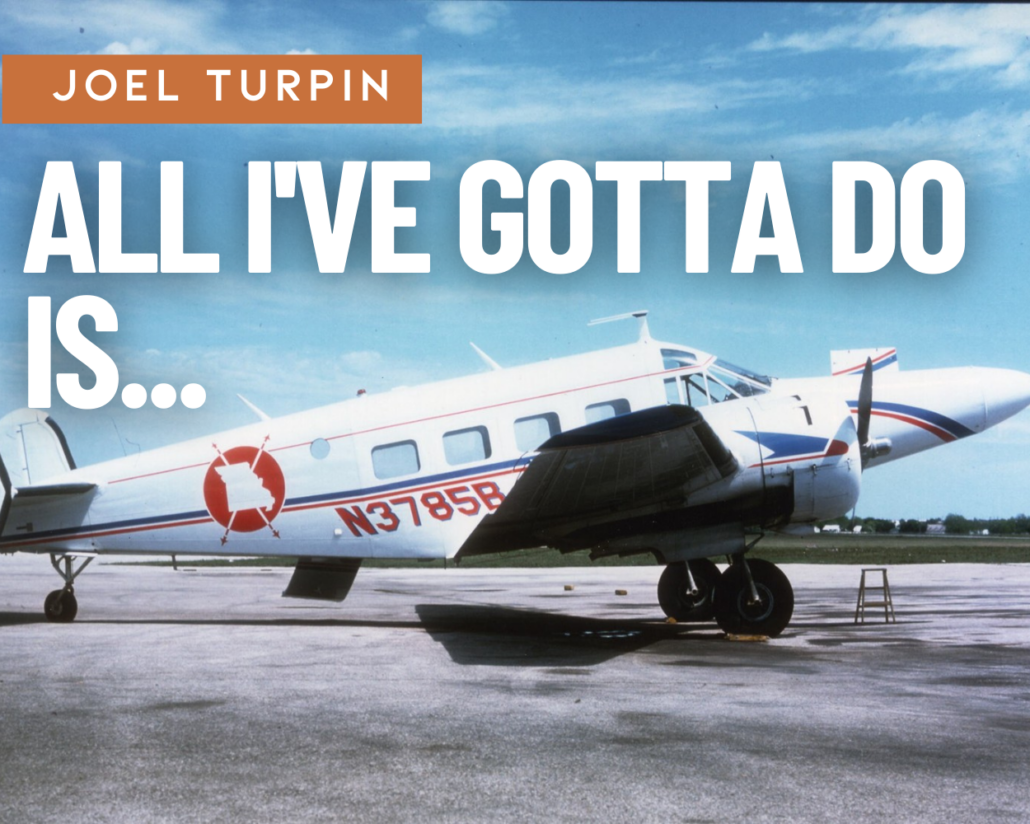
The Beech 18 the author was preparing to fly from Columbia, Missouri to St. Louis. This was the airplane used on training flights in this story.
The weather forecast indicated a major snowstorm was expected to affect Columbia at our arrival time on the night flight from St. Louis. This was due to a cold front that was rapidly moving down from the north.
Our IFR flight plan from St. Louis to Columbia had us flying on a Victor airway westbound that passed about 20 nm north of Columbia. We would remain on the airway until intercepting the localizer back course for Runway 20, then fly it to the airport.
As we cruised along westbound at 4,000 feet in perfect VFR weather, the leading edge of the cold front overtook us from the north, and consequently we flew into snow. At that point, we had unlimited visibility to the south, but not to the north due to the snow. Soon, the snow intensified and we found ourselves flying on instruments in heavy snow, and the good visibility to the south had disappeared.
Since we were approaching a point almost due north of the Columbia airport, we had our #1 Nav set to the localizer back course and used the #2 Nav to fly the airway. Soon, the localizer indicator began to move and we intercepted the back course and flew it toward Runway 20. After flying the back course on a heading of 222 degrees for about one minute, we flew out of the snow and into perfectly clear skies. This meant the snow line was just 20 nm to the north of the Columbia airport and rapidly moving south.
Since I still had to fly the Cherokee Six back to Fort Leonard Wood that night, it would be a race against time. I said to myself, “All I’ve gotta do is take off from Columbia on Runway 20 and make a slight turn to the south before the snow begins.”
We landed the Beech 18, and since time was of the essence, I instructed Andy and Ron to secure the airplane for the night, leaving me free to get the Cherokee ready to fly back home. However, as I was doing my preflight, I discovered that I had forgotten to have it refueled when I had parked it many hours earlier. I quickly called for the fuel truck, and as the fueler was topping off my tanks, it began to snow. This meant I had lost the race with the rapidly moving cold front.
With this new development, I said to myself, “All I’ve gotta do is take off on Runway 20, then fly as fast as possible to the south, and I will quickly outrun the storm and be in the clear in about five minutes.”
Once the fueling was complete, I started the engine and checked the ATIS. The wind had shifted to the north with the passage of the cold front, and now Runway 2 was active. That meant taking off into the storm, flying north, the exact opposite of what I had planned.
But I said to myself, “All I’ve gotta do is take off to the north and request an immediate right turn to the south.” That way I would only be flying in the snow for a short time before I outran it and flew into clear skies. Once I got to the end of Runway 2, the weather had worsened to a ceiling of 100 feet obscured, visibility of 1/8 mile in heavy snow.
I was not concerned with icing, as we had not picked up any when flying in the snow in the Beech 18. Plus, you almost never get wing icing when flying in heavy snow because all of the supercooled water droplets in the clouds that turn to ice upon impact with your wings had condensed into snow. With this thought, I was cleared for takeoff on Runway 2 with instructions to contact the non-radar approach controller once airborne. While I would not normally have departed into such vile weather, I did so thinking I would quickly outrun the storm and be flying in clear skies in just a few minutes after takeoff.
Prior to takeoff on Runway 2, I reset my DG to 022 degrees, the heading of the runway. Once cleared, I made the night takeoff into the teeth of the storm and was met with zero forward visibility along with moderate turbulence. I contacted the approach controller and, as per my plan, requested an immediate right turn to a heading of 180. His reply was a shock.
He said he could not clear me for a turn to the south because he had one airplane on the ILS approach to Runway 2 and another plane in the holding pattern over the outer marker. After all, he was working without radar, and a heading of 180 would not guarantee traffic separation. What to do now?
I quickly came up with a new plan when I said to myself, “All I’ve gotta do is fly due east until intercepting the 360 radial of the Jefferson City VOR (located 15 miles southeast of Columbia), then fly it southbound and outrun the storm that way.” I made this request to the Columbia Approach controller, and he cleared me as requested.
While flying due east at 3,000 feet in heavy snow, I selected the 360-degree radial of the Jeff City VOR on my #1 Nav and waited for the indicator to move. When it did, I would simply turn right to the south and track it to the Jeff City VOR and outrun the storm.
While flying a heading of 090, the turbulence increased, making instrument flying difficult. I checked my magnetic compass and it showed 105 degrees, while the DG indicated 090 degrees. I reset the DG to 105 degrees and turned left back to a heading of 090. I reasoned that it had precessed due to the turbulence.
A few minutes later, my DG once again did not agree with the magnetic compass, as the mag compass was showing 110 degrees. So I reset the DG to 110 degrees and once again turned left to 090. This happened several times, and I was always turning left to make the DG agree with the magnetic compass. And when will that VOR needle ever move, indicating that I had intercepted the 360 radial off the Jeff City VOR? I was starting to sense that something was amiss with my gyro compass when I was startled by a loud CRACK!
It was caused by a 6-inch-long spark that jumped from the inside of my windscreen to the top of the instrument panel.
I had never seen such a thing! Then I caught sight of a living web of electrical sparks crawling on the outside of the windscreen. It was St. Elmo’s Fire, a phenomenon caused by a buildup of static electricity on my airplane from flying through heavy snow.
I then discovered that the magnetic compass, which was mounted on the post that separated the two windscreens, was spinning wildly due to the magnetism from the sparks on the windscreen. That solved the mystery of why my DG had supposedly precessed so badly.
The DG heading had been correct all along, and I had been resetting it to a magnetic compass that had been lying to me due to the influence of the electrical sparks on the windscreen. So I had not been flying due east, which was why I never intercepted the 360 radial off the Jeff City VOR. Then a scary question arose in my mind: If I had not been flying due east, then where the hell am I?
Since I was operating in a non-radar environment, a simple call to the approach controller to give me a position report was out of the question.
At that moment, my engine began to run rough. I checked that the carburetor heat was on, checked both mags, and saw that all engine gauges were in their green arcs, but could not solve the problem of the rough-running engine. However, it was producing enough power to maintain altitude and a normal cruise airspeed, so I put this new problem out of my mind.
Being lost while flying in a snowstorm at night without a reliable compass was more than concerning—it was terrifying! Without a reliable compass, you cannot track a VOR radial, so simply centering the needle on the Jeff City VOR and flying direct to it was not an option.
But then a plan for salvation emerged in my brain. I said to myself, “All I’ve gotta do is take a cross-bearing check between the Columbia VOR and the Jeff City VOR. Where the two VOR radials meet is where I am.” This I did in quick order and found that I was well northeast of Columbia instead of due east. I needed to fly south to outrun the storm, which meant I had to find a heading to fly using a DG that was set in error and a useless magnetic compass.
I did the math and found that since I was northeast of where I should have been, I first needed to turn right about 60 degrees to have me flying due east. Then I had to turn right another 90 degrees to fly south—a total heading change of 150 degrees. I looked at the erroneously reading directional gyro, counted off 150 degrees to the right from what it was currently showing, then flew whatever heading that was.
Once I had made the 150-degree heading change to the right, my plan was to hold it until I outran the storm, along with the St. Elmo’s Fire that had rendered my magnetic compass useless. Now all I had to do was wait to see if my math was correct and if I truly was flying due south.
Suddenly, like an apparition, the skies below me began to brighten. My heart was racing when I realized what had caused the skies to brighten through the snow below me. It was the city lights of Jefferson City! Soon thereafter, I flew out of the snow and into clear, but very dark, skies. The plan, and my math, had worked to perfection.
The rough-running engine smoothed out. At the same time, the St. Elmo’s Fire disappeared, giving me back my magnetic compass. I quickly reset my DG to the magnetic compass, and everything was totally back to normal.
I reasoned that the heavy snow might have caused one or more spark plug ignition wires to arc, resulting in the rough-running engine. It could also have been due to the incredible amount of static electricity that had built up on my airplane, which could have affected the magnetos.
But then a new problem arose when I made contact on the company frequency with another Skyway plane, a Beech 99, that was flying into Fort Leonard Wood from Kansas City. The captain told me that the winds at Fort Leonard Wood were 180 degrees at 20 knots, gusting to 30 knots.
The single runway at Fort Leonard Wood was Runway 14/32. That meant there was way too much crosswind to land a Cherokee Six at Fort Leonard Wood, so I diverted to our maintenance base at Vichy, which served the city of Rolla. Vichy was about 40 nm south of Jeff City.
After landing, and as I was putting my flight bag into a company car that I would drive to Fort Leonard Wood, it began to snow.
Postscript: Fate Is Still the Hunter
The mystery of why the Cherokee Six I was flying that night had accumulated so much static electricity was solved when I returned to the Vichy airport a few days after the snowstorm had abated. I was supposed to ferry the Cherokee Six back to Fort Leonard Wood solo as a positioning flight.
While doing my preflight inspection in bright sunshine, I discovered that both of the bonding straps that connected the wings to the ailerons were broken. These braided steel straps were designed to bleed static electricity from the wing to the ailerons and then to their sharp trailing edges, where it would be dissipated into the slipstream. This setup was used in lieu of static wicks, which did the same thing, only more efficiently.
With the straps no longer connected to the ailerons, static electricity on the wings could not be bled off. This is what caused the giant spark that leapt from the windscreen to the top of the instrument panel and the St. Elmo’s Fire to occur. Fate is still the hunter…
His professional credentials include 5 years as captain, training officer, and chief pilot for a commuter airline where he flew the DC-3, Beech 18, and Beech 99 in scheduled passenger operations, and 6 years as Director of Training for both FlightSafety International and Simuflite’s King Air Division. In addition, Joel flew the King Air 200 as a corporate pilot for 2 years in the DFW area.
Turpin was subsequently hired by United Airlines in 1986 where he flew the Boeing 727, 737, 757 and 767 in both domestic and international operations including 100 oceanic crossings, and several equator crossings. Turpin retired in 2015 at age 65 and currently has some 30,000 hours in his log book.
He is currently employed as captain and chief pilot flying the Pilatus PC-12NG for a company in Pennsylvania. Joel has been a current and active flight instructor since 1970 and teaches instrument flying in a variety of single engine airplanes. Turpin also writes technical articles and conducts seminars for general aviation pilots with an emphasis on instrument flying and airplane systems. In addition, Turpin also writes flying stories based on his personal experiences as a pilot.
In 2016, Joel Turpin earned the FAA Wright Brothers Master Pilot Award for 50 years of flying accident and violation free, and for his contribution to aviation safety for all those years. His professional qualifications include:Airline Transport Pilot License, Certified Flight Instructor with Instrument and Multi-engine ratings, Turbojet Flight Engineer, Advanced Ground Instructor, Type Ratings in the DC-3, B-737, B757 and B-767, and the FAA’s Wright Brothers Master Pilot Award.
He currently lives in Punta Gorda, Florida with his wife, who is a United Airlines flight attendant. While Joel has had an amazing career in aviation spanning over six decades, he still considers himself to be just a general aviation pilot who got lucky.
- All I’ve Gotta Do Is… - March 13, 2026
- Breaking the Chain: Recognizing the Links Before Disaster - January 14, 2026
- A Very Close Call - December 10, 2025

Leave a Reply
Want to join the discussion?Feel free to contribute!