
|
Getting your Trinity Audio player ready...
|
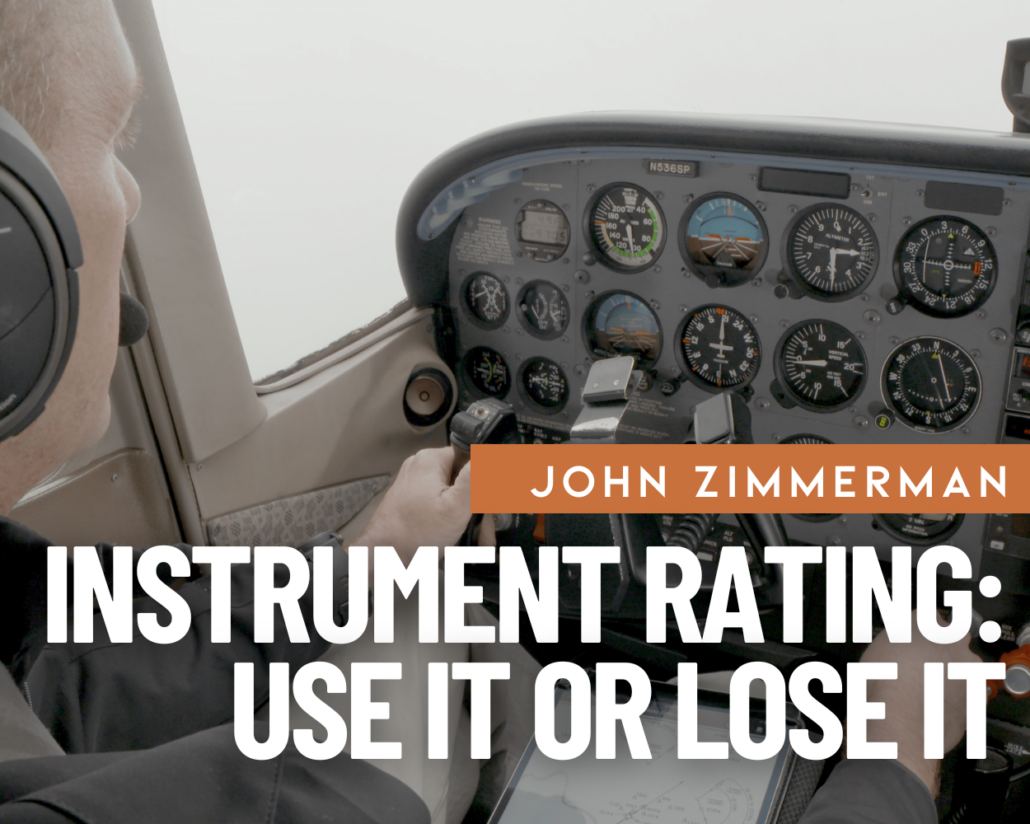
One of the saddest things in aviation is a pilot with an instrument rating who’s afraid to use it. They look at a 1500-foot overcast and realize their $15,000 investment has become nothing more than a souvenir. Maybe they used to fly in the soup all the time and simply fell out of the habit; more likely, they can recite the holding pattern entries from the textbook but have never seen the inside of a cloud. Either way, it’s a waste of money and a missed opportunity.
To be clear, I’m not criticizing these pilots for choosing not to fly IFR when they don’t feel up to it. As Paul Craig says in The Killing Zone, “flying in the clouds is the major leagues,” and ATC expects your single engine piston airplane to operate just like a Boeing with two ATPs up front. If you aren’t confident you can hit that standard, you shouldn’t fly.
But often the confidence fades much faster than the skills do, or it was never there in the first place. This is not a pilot certification problem, it’s a pilot experience problem. Fortunately, that means this is also a solvable problem. With a few good habits, regular GA pilots can build IFR confidence, stay proficient, and enjoy all the benefits of that hard-won rating.
Going beyond the ACS

If the thought of flying IFR in a cloud elicits fear, you’re not alone.
It’s important to define the goal, because the Airman Certification Standards are not enough. To me, having a functional instrument rating means feeling confident enough to make a flight in IMC, probably of more than 150 miles, and maybe with family or friends on board—what many pilots would call “a mission.” It sounds simple, but it’s not, because (as with so much else in aviation) legal and safe are not the same thing. You can pass the checkride and even check the box on currency, but still have no idea how to actually use an instrument rating. That’s especially true if you stay current by shooting six approaches in six months, all under the hood and all in good weather. Sure that counts for FAR purposes, but flying in actual IMC is a totally different sensation.
I believe pilots in this “legal but not proficient” status are actually more at risk than a proficient VFR pilot, because they are more likely to attempt a flight they can’t handle, like blasting off into a 300-foot overcast because it’s a “must-do” trip. Pilots in the “neither legal nor proficient” are hardly better. Remember that one third of VFR-into-IMC accidents take place with an instrument rated pilot on board; my guess is most of those instrument pilots were neither current nor proficient. Quite simply, if you’re going to get an instrument rating, you owe it to yourself to keep it.
How to get started
If you earned your instrument rating at a flight school that never made you poke your airplane’s nose in a cloud (a shockingly common practice), step one is addressing that shortcoming. But ease into it—there is no extra credit for making your first trip into the clouds on a low IFR day with rain and gusty wind. Instead, start small and slowly expand your objectives for each flight with these three profiles.
- The two-pilot flight. For your first few flights in the clouds, take another IFR pilot along—not as an instructor, but as a safety pilot and a confidence booster. If you start to feel overwhelmed, pass the controls to your right seater or at least ask them to check your flying. You may never need them, but simply having another pilot can put your mind at ease and help you overcome your fears.
- The VFR-on-top flight. When you’re ready to fly solo, don’t start with a low approach, or any approach at all. File IFR on a clear day to get used to the system, then on a day with a thin layer to get used to climbing through a cloud deck to find the sun on top, then on a day with high ceilings but with most of the cruise portion in the clouds. This slowly builds confidence in your instrument scan but removes the stress of an instrument approach.
- The approach-only flight. To hone your approach skills, go up on a day when you can fly an approach in IMC, but not all the way to minimums. The ideal day for this is one where the weather is VFR at your home airport, but you can fly somewhere within 50-75 miles to shoot some actual approaches, maybe with an 800-foot ceiling. This gives you a bail-out option of returning home if you need it.
Stacking these three flights will grow your IFR confidence, but in a building block way. Once you know you can keep the wings level in the clouds and you can shoot an approach in the clouds, it’s time to put it all together and go fly a trip.
How to stay proficient

Home simulators are definitely realistic enough for instrument proficiency.
If you’ve earned the rating and learned how to fly in the clouds, the next step—and the one that most pilots struggle with more than anything—is keeping your instrument skills sharp. There is absolutely no shortcut here, and the “secret,” if you even want to call it that, is simply to fly more often. Recency of experience is the key metric to track and it’s measured in days, so forget about six-month IPCs or 24-month flight reviews. In fact, I’m going to suggest a much more rigorous standard, along with some other habits that can keep you sharp.
- Every 30 days. A good stretch goal is to never go more than 30 days without “touching the system,” even if it’s just a practice approach in VFR conditions. If that sounds impossible, get creative: maybe you can’t fly in the system that often, but you can ride along with another pilot who does, listening to the ATC chatter and watching the needles move. This second-hand exposure can be remarkably helpful, whether you can log it or not. I know how hard this 30-day rule is—due to terrible winter weather and illness, I recently went 45 days without an IFR flight. That’s not a long time, but the subtle erosion of my instrument scan was noticeable on my first flight back (fortunately, with a co-pilot and in VFR conditions). We simply have to face reality, and going 90 days between IFR flights is too long. Physics and Mother Nature just don’t care about our busy schedules.
- Master your avionics. Proficient instrument flying requires a variety of skills, from basic instrument scan to ATC procedures to weather. Most of these require time in the left seat with the Hobbs running, but not avionics proficiency. A variety of tools, from simulator apps to online courses to illustrated manuals, make it easier than ever to know your panel cold. If you have the “buttonology” figured out before you ever step into the airplane, you’ll spend less time head-down and more time practicing the application of all those button pushes. Autopilots deserve particular attention, because they can be a huge safety enhancement for single-pilot IFR but they can also become a liability in the hands of an untrained pilot.
- Use home simulators. These are simultaneously overrated by some boosters and underrated by most curmudgeons, but any objective pilot has to admit that a decent home sim absolutely has a role to play in maintaining instrument proficiency. Besides, this isn’t an either/or situation: just like a patient with high cholesterol will probably be told to change their diet and take statins, a pilot trying to improve their IFR skills should fly sims and real airplanes. The latest version of X-Plane or Microsoft Flight Simulator still aren’t very good for for crosswind landing practice or upset prevention training, but they are excellent for practicing cockpit flows, instrument scan, and IFR procedures. Even better, add simulated ATC (from services like PilotEdge or VATSIM) to make your sim flights even more realistic. If you don’t have a home simulator, most flight schools have one and they are usually quite affordable.
- Keep your head in the game. While nothing can replace time in IMC with your eyes scanning the panel, there is value in keeping your instrument decision-making skills engaged when you can’t fly. As a young pilot I religiously read IFR Magazine for just this reason, and while that magazine has faded away, there are plenty of new options that are either free or very inexpensive. I’m also a huge fan of the IFR Mastery series from PilotWorkshops, which delivers a new instrument scenario every month that really makes you think about weather, risk management, and airplane performance. If nothing else, try to read an aviation weather forecast every week and exercise your go/no-go muscles.
Again, these habits work in a building block manner. If you are constantly practicing decision making, communications, avionics, and instrument scan—even if each one is done at a different time—it prevents rust and makes your limited time in the airplane more efficient.
The benefits of IFR proficiency
After a to-do list like that, it’s natural to wonder whether an instrument rating is really worth it. My answer is an unqualified yes. While it may sound counterintuitive, flying IFR is actually a stress reducer, not a producer. Filing IFR on a VFR day makes the flight easier: ATC is watching over you, routes are well defined, there is no temptation to scud run, and you have far more flexibility to manage changing weather. If it’s an IFR day, the benefits are even more obvious.
That doesn’t mean an instrument rating eliminates weather cancellations, but even then it still helps. A pilot who is comfortable in the system is better at saying no to a flight, because they understand exactly what the weather is asking of them. That matters, because saying no is the single most powerful safety tool we have in general aviation.
So many pilots treat their instrument rating as an “insurance policy” they hope never to use. I think that’s backwards. It should be a passport to personal adventure and unique travel experiences, a tool that keeps your mind sharp and your airplane active. Besides, an instrument rating that is never used is not much of an insurance policy—it won’t be ready when you need it if you haven’t been paying your dues.
If you earned the rating but don’t know what to do with it, don’t overthink it. Grab another pilot, file IFR, and go find some gray.

- Use it or lose it: the instrument rating is not an insurance policy - February 18, 2026
- Go-arounds don’t have to be hard - December 8, 2025
- Guard frequency in the age of social media - October 13, 2025


I am a retired airline captain with over 32000 hours. I retired off the A-350 ,doing CAT111C appoarches . That means I did not see the runway until the nose gear touched the runway. That being said there is no way I would fly hard IFR in a single engine light airplane or light twin. I fly my RockWell Commander often , my self imposed minimums are 1000 and 3. If I don’t have that I don’t go , or I am riding in the back of the airliner.
This reply is valuable and I’d like to hear from more similar high time professionals on the subject. I was at one time an amateur business owner pilot owing and flying singles and twins up to and including a Beech D-18. Had an instrument rating but as the article pointed out was not confident enough to use it. VFR over the top was the best I could ever do. 1000 and 3 was also my limit and kept me alive over the 35 years of active flying. Maybe that’s still good advice unless one is intent on a professional pilot career.
I think that is good advice – the number of days when the weather is below 1000 and 3 is pretty low, so that’s a good way to use an instrument rating but not push the envelope.
My only hesitation is that such personal minimums require great discipline. Mother Nature does not know what your personal minimums, so you either need the ability to fly an approach below 1000 feet or you need really solid divert options. Otherwise you can find yourself trapped by fast-changing weather.
Not as high time as ATP, but enough TACAIR time to not want to do IFR in a single piston eng, vacuum gyro at nx/bad wx single pilot…flew more than enough when fatigue was a real threat to not want to do any of the above when flying for fun. As far as 1000/3 (personally prefer 1000/5+) an absolutely clear below clean 1000′ is a much more benign scenario than a scraggly 1000′ ceiling or any few/scattered below the 1000′ ceiling…I’ll take a look with a clean 1000′, won’t touch same ceiling with few/scattered below, those are too random and will trap you with no good options.
Every instrument pilot has to have personal limits, and ideally they will adjust with currency and equipment (lower when very current and proficient, and higher as recent IMC flight recedes). It is truly freeing for personal travel.
But you must practice down to minimums! Remember, no matter what the forecast, what you see out the windshield is what you get.
I flew home from Texas to Alabama, and saw the expected layer below me over Louisiana and Mississippi, but it extended well into Alabama. The forecast at home was scattered 25,000, and as I approached Montgomery, the edge of the clouds were visible. When I got there, a lower dark gray layer was apparent, and home was calling 400 feet, 2 miles in mist with light rain. Auburn was a short deviation, with 1000 feet, unlimited visibility and an ILS. I went there, and broke out just above 600 agl with excellent visibility on GPS 18 (the ILS is only for 36, but the winds were wrong . . . ). At the end of a flight stretched to 4-1/2 hours by five ATC reroutes, I took the easy out and waited an hour for my wife to pick me up.
…and be careful about that second pilot you choose, a current, proficient pilot you can trust is an asset, one who isn’t is like an anchor for a lifejacket, will take you down with them when you need them most.
On October 16, 1972 a C310 left Anchorage in VFR weather with some less then VFR weather in the distance areas.
Ice was forecasted 45 miles away in opposite direction well above FL 12 period.
The pilot was very current and amount to over 17k both VFR and IFR. Not a week went by he didn’t fly bothVFR and IFR. He was the author of “Ice without Fear “ in flying magazine. Don Jonz was the sole pilot on board plus two congressional and one administrative type. Vanished never to be found. Yet!
Do not judge this article from others opinions actually download it and read it yourself! Very closly! I did years ago and carry it in my flight bag. Very accurate .The famed author (Richard Collins) of the time agreed with me. Hmmm wish he got a IFR pick up and RTB back to PANC 33 nm away!
I certainly agree with staying current for IFR–and even a VFR flight using your avionics is worthwhile. An IFR flight with actual instruments is also very valuable–with maybe 1000-1500 ft ceilings and 3 sm visibility. But I agree with earlier posts that hard IFR in a single-engine (or even a small twin) airplane is not a goal. Being current in case you need to fly in IMC is the goal.
I am an active flight instructor and push my private students to earn an instrument rating. I do this not for them to fly instruments, but so they can do it if they get caught by the weather. It is also useful on a dark night–JFK, Jr. comes to mind.
So, there are LOTS of good reasons to get an instrument rating and stay current, but flying in low weather isn’t one of them.
Best
Vince Massimini
Kentmorr Airpark (3W3) MD
Good article and especially the advice to fly more often. It is important to file constantly regardless of the wx. You will get familiar with ATC terminology and learn how much of it is standard. I try to fly at least 6 approaches per month in actual and find myself still making mistakes on repeated approaches. Thus fly, fly, fly. It is the only way to get comfortable in IMC. 1000 and 3 is a good rule, but what are your options when wx deteriorates on you unexpectedly?
I don’t fly that much anymore. At least not to justify the added fees and expenses of getting an IFR rating. Getting old and dealing with medical issues will change ones priority really fast.
Phenomenal article John, as usual, and couldn’t agree more. Fly as much as possible. If you’re not able to confidence starts to erode and you will find yourself not flying even more. Have spent way too much time and money not to use this wonderful skill set to see and go other places. Thanks again.