

|
Getting your Trinity Audio player ready...
|
It can be extremely hard—nigh impossible—to avoid the constant deluge of digital dopamine hits that bombard your screen every day. So disconnecting by reading an actual book in the new year can not only be good for your mind, but also your soul.
But when it comes to reading lists for pilots, you typically see the same half-dozen classical books on them. Yet there can be plenty of wisdom for pilots found in some non-traditional aviation texts as well. Here are five books all pilots should read that have absolutely nothing to do with flying:
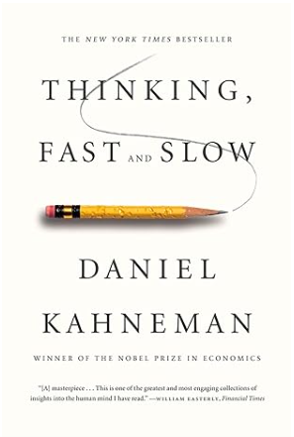 Thinking, Fast and Slow by Daniel Kahneman
Now over a decade old, Kahneman’s Thinking, Fast and Slow is one of the best-selling behavioral science books of all time. In his seminal text, Kahneman details how our brains make decisions, delineating two modes of thought, which he terms “System 1” and “System 2,” and explains why, even with these two different modes, we still have a tough time thinking statistically. System 1 is our unconscious, snap decision-making machine that is automatic, emotional, and always on. System 2 is our deliberate, slow, calculating apparatus that can be triggered either when System 1 fails outright or when we make the conscious effort to turn it on.
Ever hear the expression in an inflight emergency to first “wind the clock,” or something similar? That’s supposed to enable System 2 so your next action is more deliberate instead of a knee-jerk reaction. And even though some of the conclusions the book makes suffer from a reproducibility problem, it’s still worth a read as a deeper dive into the gray matter behind ADM.
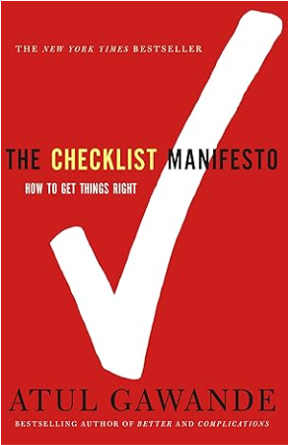 The Checklist Manifesto by Atul Gawande
I already mentioned this book in my article, Checking the Checklists Checks, where I discuss how we are all told to blindly use a checklist yet rarely ever have access to a good one. Dr. Gawande faced a similar dilemma in his surgical practice, where missing a pre-op step can be a matter of life or death—literally.
It’s a fun read in which we follow the good doctor on his quest to write a simple but effective checklist for his practice. He quickly finds out, however, that it is a lot harder to do than it sounds, and even harder to actually follow. The book is an entertaining account of just why checking the checklists sometimes—well—doesn’t always exactly check out.
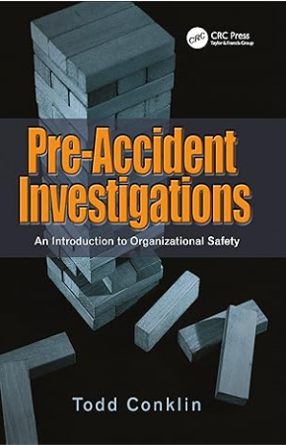 Pre-Accident Investigations by Todd Conklin
A lot of my angst against most YouTube accident video channels can be attributed to reading Dr. Todd Conklin’s Pre-Accident Investigations, which is a practical guide for professionals on how to bake safety into any high-risk work environment. In it, he outlines the Human & Organizational Performance (HOP) framework, which is built on a few basic principles for understanding, dealing with, and learning from failure.
Recently, Dr. Conklin was interviewed on the Aviation News Talk podcast, where he delved into HOP and how many of its teachings can be applied directly to general aviation. To just whet your appetite for a book about safety (I know, I get it), here is just one of the many insights Dr. Conklin offers that we as pilots should internalize on every flight: “Safety is not the absence of events; safety is the presence of defenses.”
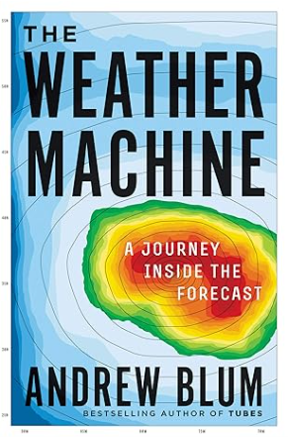 The Weather Machine by Andrew Blum
One of the more recent revelations for pilots is the advent of the Model Output Statistics (MOS) forecast, which has become an invaluable tool in the go/no-go decision-making process. And Blum’s non-technical yet extremely informative book chronicles his journey in understanding how modern-day forecasting works—from visiting old weather stations that provide critical regional observations, to witnessing weather satellites blasting off, to interviewing the teams behind the supercomputer-powered models behind, you guessed it, the MOS.
What blew my mind was that both the U.S. and European models are simulating the climate in real time, and that the forecast we receive is just a point-in-time snapshot of that simulation (basically The Matrix). They even have a way to backtrack real observations against what the model predicted to understand how the two diverged. Weather ground school was never this fascinating. Trust me.
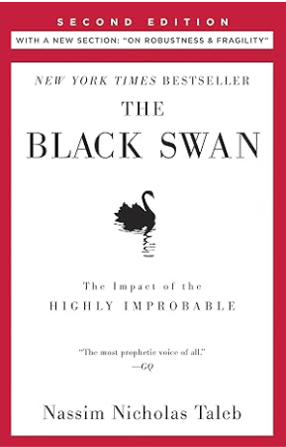 The Black Swan by Nassim Nicholas Taleb
Taleb’s The Black Swan is one of the most influential books of the 20th century—whether you agree with it or not. His book explains what he calls Black Swan Theory, which is our tendency to inadequately rationalize catastrophic outlier events in hindsight. Put simply, it gets to the true nature of statistically improbable events (think engine failure on takeoff), why these events are so consequential from a historical perspective, and why, depending on your frame of reference, they aren’t actually so improbable as they first seem.
As pilots, we wrestle with Taleb’s theory every time we take off. And like Conklin’s book formalizes, our response shouldn’t be to bury our heads in the sand to the existence of black swan events, but to build robustness against them—whether that be in hardware (the plane) or software (the pilot) is up to you.
It’s All About Perspective
I can’t claim that any one of these books will make you a better pilot. I can’t even claim you will agree with a lot of the teachings found in them. What I can guarantee, however, is that they will certainly broaden your perspective about life in general and maybe—just maybe—make you think about flying differently. Happy New Year!

- Five Books Every Pilot Should Read (That Have Nothing To Do With Flying) - January 5, 2026
- Is GA Getting Safer? - December 3, 2025
- Generally Affordable? The Truth About Flying Costs - October 6, 2025


Great list Alex!
I’ve read #1 and #3, and will surely put #2 and #5 on my list!
Todd Conklin is my absolute favorite safety guru!
Thanks Peter! Come back here and give your take on those books when you’re ready!