
|
Getting your Trinity Audio player ready...
|
Have you ever been reduced to zero options apart from the increasingly unpleasant need to try to keep flying? I have, and it’s not an experience I’d recommend to anybody.
March 1994: I was flying the Auster J5 I part-owned — an early postwar British fabric-covered high-wing four-seater developed from the Taylorcraft series, powered by a 130hp DH Gipsy Major — from my base in Auckland to Mandeville in the far south of New Zealand. The plan involved a Tiger Moth Club fly-in at Mandeville, followed by a spot of touring the southwestern South Island before Easter weekend’s major Warbirds Over Wanaka airshow.
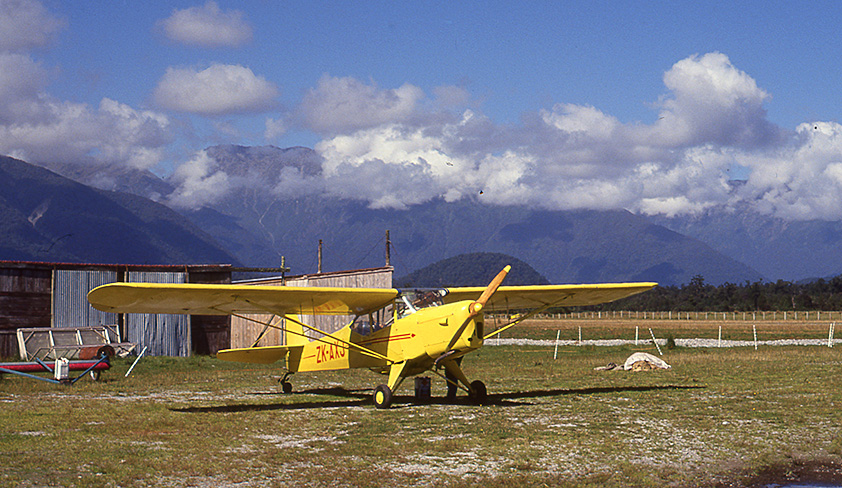
Refuelling the Auster J5 ZK-AXJ at Haast, South Westland.
My passenger was Ross, the editor of New Zealand Wings magazine, at the time one of the country’s only two monthly aviation publications, and I was his assistant editor and chief photographer on a freelance basis. We set off that morning from Paraparaumu, the nearest major aerodrome to his home, across Cook Strait to a brief landing at Kaikoura to shed life jackets, and onwards to a friend’s private airstrip on the Canterbury Plains to top up the tanks and continue south.
With its low compression ratio, the Gipsy Major ran best on 91 octane mogas, and the Auster had two fuel tanks: one of 10¾ imperial gallons above the occupants’ legs between the panel and firewall, and a 13½ gallon external tank beneath the cabin. Only the front tank had a fuel gauge, a rotary device resembling a compass with numbers 1 to 10, but with its “E” representing something more attention-grabbing than East. Standard practice was to take off on the full front tank, fly on that for 10 minutes to reduce the level by a gallon and lessen the tendency to slop fuel out the filler in bumpy air, then select the so-called long-range tank for cruise, switching back to the front tank for landing or when the noise started to splutter — whichever came first. Anything much more than three hours started to rotate the gauge below mid-single figures and eat into reserves.
My printed official meteorological forecast, which I kept water-damaged for some years afterwards, blithely mentioned a weakening front brushing Banks Peninsula, east of Christchurch, around mid-day. New Zealand, being halfway down the lower half of the globe, generally has its more serious weather approaching from the southwest — the planned direction of flight that day — but when we took off from Canterbury in the late afternoon, there was no sign of it. Visibility beneath the high overcast was the usual 50-plus miles, and there was little noticeable wind.
Eyrewell to Mandeville — a couple of hundred miles at 1,950 rpm and 80 knots — is a reasonably straight line across the southern Canterbury Plains, skirting the hills near Waimate and crossing the 5,400 ft Kakanui Mountains via Danseys Pass, clearly marked on my up-to-date aeronautical chart as 1,630 ft, before crossing the Maniototo, one of my favorite parts of the South Island, and more hills into Southland and the private grass sward of Mandeville. No sweat.
But by the time we’d climbed to 3,000 ft approaching the Kakanuis, the tops were shrouded in cloud, down more or less to our level, and the increasing turbulence suggested we were in their lee as the expected southerly had arrived. Never mind — there’s plenty of height in hand for Danseys Pass, so we’ll slip through and carry on. No sweat.
The landmark road and set of power lines — only one of each around here — came into view as advertised, but around the next hill everything merged into the dark grey cloud base ahead. In my last good decision of the day, made very rapidly, I executed a swift about-turn and bounced back out of the hills, then turned eastwards down the Waitaki River, weathering the leeside turbulence toward the coast and the low-level route to Taieri, the alternate for the day.
The multiple runways of Oamaru, near the Waitaki River mouth, would have been wiser, but that aerodrome was a long way out of town, so I pressed on into increasing dark and wet conditions with a stiff headwind. The day’s five hours behind a noisy Gipsy Major vibro-massage unit were starting to take their toll, and get-there-itis was insidiously rearing its ugly head.
Before long, I was regretting my Oamaru decision, with no more airfields this side of Taieri, the rain increasing, and all the farm paddocks or topdressing airstrips even slightly into wind looking very wet and therefore soft. If I landed anywhere, it might be days before I could take off again.
Otago Peninsula, a drowned volcanic remnant with Dunedin at the head of its harbour, was not its usual pretty sight. This was obviously where the front had paused to gather strength instead of carrying on like all well-behaved fronts should, and the harbour heads were shrouded in ominous black low clouds. I briefly considered flying up the harbour, but I wasn’t familiar with the Dunedin hills at the far end (and it was only later that I remembered the set of power wires halfway along).
Otago’s eastern entrance, Taiaroa Head, is a royal albatross colony with a permanent restricted zone up to 2,000 ft, but I reckoned that no albatross with any sense would be out flying on such a dark and stormy night. Besides, any bird would be much more maneuverable and able to avoid a bright yellow Auster, even if both parties lacked navigation lights and radio, not to mention the ADS-B of the future.
The next 15 to 20 minutes were by far the worst I ever got myself into in all my years as a private pilot. Conditions were utterly foul. The cloud base was ill-defined but obviously not far above, and I didn’t want to explore any height more than about 300 ft. The heavy rain found numerous gaps around the Perspex windscreen and cabin top, and visibility was just enough to see and avoid the next headland. It was doubtless adrenaline in a state of prolonged fright, but I could swear spray from the waves crashing against the cliffs was reaching up to us.
I was reduced to zero options and had to press on, staying close to the cliffs on the right just to keep them in sight. Out to my left was zero horizon and visibility, and I knew any attempt to turn back would risk fatal loss of orientation and control. In my recent research for a book on New Zealand aircraft accidents, I’d learned about two light aircraft that had gone missing in the area under similar conditions. With no radio, I couldn’t tell anybody of our predicament, so it was entirely up to me to sort this out — leave the throttle alone, hang on, and concentrate on keeping the Auster upright.
A couple of times I asked Ross if he was OK, and he answered with a monosyllabic affirmative. Then we hit a particularly nasty bit of turbulence, just as another cliff loomed ahead. The Gipsy Major missed a few beats in the negative G, and although the baggage was secured by straps on the back seat, my camera bag opened and its contents scattered. I picked up a couple of items off the floor and handed them to my passenger. Ross later said he thought I was reaching for the ELB actuator switch under my seat and was relieved to be given a lens filter instead.
For some reason, even in my darkest travails, I wasn’t worried about personal survival. A couple of beaches went past, but the tide was well up, and the soft sand would have meant an inverted Auster if I tried to land there. That would have been survivable, but several things kept me going: a damaged Auster would mean earnest chats with (a) its other owners, whom I valued as friends, (b) the insurance company, and (c) inquisitive gentlemen from the CAA; I had nobody to turn to for help; and the thought of the acute embarrassment of having the author of a book on aircraft accidents actually featuring in one himself.
The Taieri River mouth wasn’t far south, and I could follow the river inland to the low-lying Taieri Plain and find the airfield. The beacon of the Cape Saunders lighthouse, although unmanned for years, was a welcome sight, and then came the first glimmerings of an option. The rugby fields lining Dunedin’s southern beaches were aligned at right angles to the shore, but several of them side-by-side gave a decent length clear of goalposts, and I thought I could hack that, even if they were obviously very soft with standing water in the heavy rain.
Then I realized I could see the top of the ridge to the right, silhouetted against the dying light from the west. A quick check of the map confirmed there was only one low ridge this side of the aerodrome, so climbing to clear that, and there, beyond the lights of Mosgiel, was the glorious sight of the big dark patch of Taieri airfield. I wasn’t up to the task of climbing for a standard overhead rejoin, even if the cloud base had let me, and I had a fair idea by now of the wind direction. So it was a wide left base turn and a surprisingly decent landing, considering the circumstances, on that oh-so-welcome grass, 3 hours 5 minutes since takeoff.
A light in the aero club office revealed an instructor about to go home, so room was found in the magnificent art deco 1930s hangar for a dripping Auster, and he gave us a lift to a local hotel. I sat for a long time nursing a cup of coffee in a dark lounge, contemplating my actions and what I should have done to avoid risking the life of my best friend, myself, and a fine old aeroplane, until an excessively cheerful family noisily arrived to turn on the lights and the TV.
A strange thing happened the next morning. As I was pre-flighting the Auster, wiping the oil off the fuselage side where it had spilled out of the tank filler in the negative G, and giving everything a thorough going over, I walked into a strut — something I’d never done before. It knocked me to the ground. In the split second between the bang on the head and finding myself sitting hard on the concrete hangar floor, the thought flashed through my mind that the Auster had given me a clip over the ear: “Don’t you ever do that to me again!”
And I didn’t. Ever. I’d learned my lesson. The rest of that week provided superb flying through glorious scenery and sampling remote airstrips in roadless and otherwise inaccessible places. Danseys Pass turned out to be actually 2,946 ft, almost twice the height of the trap an inaccurate map had tried to suck me into.
I grew very fond of that Auster. Somehow a machine with character, on which your life depends, becomes, over the years together, rather more than just a mechanical device.
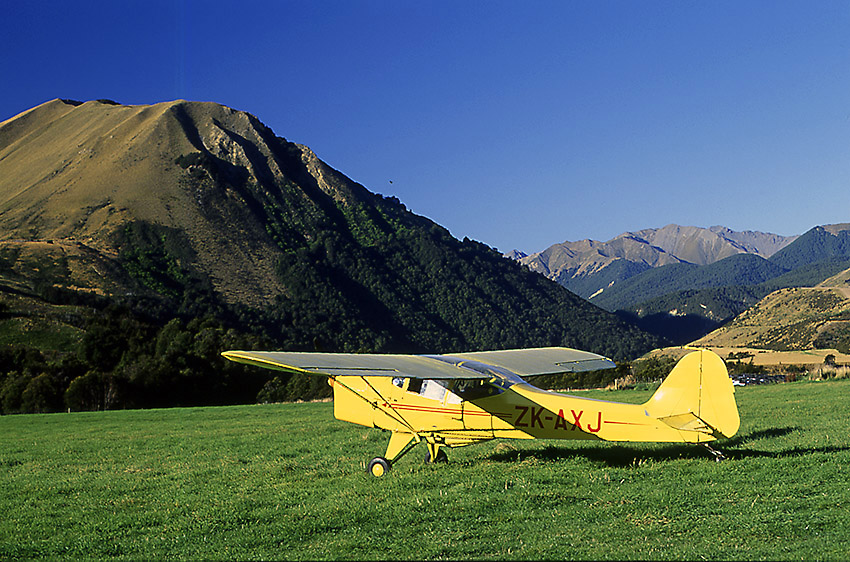
Dingle Burn Station, 31 March 1994, pausing during flight from Martins Bay via Makarora (refuel) to wait for the (temporary) tower at Wanaka to go off watch. Passenger Ross Macpherson.
His biggest aviation adventure was helping fly a Cessna 195 floatplane from an upstate New York lake all the way to Seattle, WA in 1984, taking in Oshkosh along the way and briefly flying in formation with an A-10 Warthog.
As well as editing the quarterly Sport Flying for more than 20 years from 1997, he edited the monthly New Zealand Aviation News from 2008 until it ceased publication shortly after its 2021 takeover and conversion to paywall online.
Rising costs, bureaucracy and the lack of time and ready access to an aircraft for staying current led to John’s hanging up his headset in 2008. In his retirement he now edits the NZ Aviation Historical Society’s quarterly journal The Aero Historian.
- Out of Options—Pinned in the Pass - December 15, 2025


Wow, that was tense and quite the bit of scud running. Glad you survived it and thanks for sharing for the rest of us to learn.
I tensed up, continued reading and greatly enjoyed your well written story! Thanks
I was so eager to read of your adventure, having onwed myself a J5 Auster for some time in France, that I became quickly concerned for your goodself, and your passenger friend, when learning of your weather related problems rapidly descending upon you.
And this of course in the most famous scenery of mountains enjoyed in the Southern part of your beautiful country (in normal vfr, naturally) . Although you do not mention of your equipment in your article, I had to assume that, like my Auster aircraft, it was not equiped with an artificial horizon of sorts, on top of no radio either. Flying special vfr in mountains procures an excitingly devastating feeling, as you metion, but for the fact there was little risk of meeting a fluffy local bird that day… This, and also a weak “hot carb” instrument, which as one knows, only gives you the meagre benefit of warm air from the engine now circulating under the engine cover used to confer to me a strong preoccupation in bad weather, with this plane I loved for all the pleasure it would gift me in any flights otherwise. I can very well relate to the lasting effect it left with you since.