
Lost and Found

|
Getting your Trinity Audio player ready...
|
A tribute to unparalleled human endurance and the spirit of a man who refused to die
There are many fine accounts of the adventures, travails, and tragedies of the men and women who fly. Yet there is always a flight in one’s lifetime that defines us indelibly. This one is legendary but has faded from history; perhaps the shadows of other events seem greater, but it deserves to be retold as a testament to the steely resolve of one Canadian aviator. His will to live serves as an inspiration for all pilots who contemplate resignation in the face of adversity.
This true story of courage, perseverance, and survival epitomizes the grit of a commercial pilot and the unwavering faith of his family and friends. It models the tenor of a rare human spirit that emerges only in times of extreme distress—or remains submerged when needed most. Some of us have it, many don’t, and in this case, it was tested—and prevailed. The incident occurred when Canada was on the world stage celebrating its centennial. It is a heart-wrenching event that unwittingly inscribed fortitude at a time when the country was showcasing its achievements and heroes.
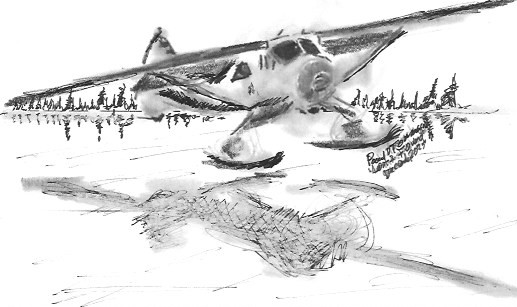 Every approach to touch down on an unimproved strip is risky for ski plane pilots. Robert René Gauchie, a professional flier and RCAF veteran, was at the controls of a De Havilland Beaver on such a landing after leaving Cambridge Bay, NWT, en route home to Fort Smith. Despite doing everything right to ensure a safe flight, he would not be heard from again for 58 days. What went wrong?
He encountered a multitude of failures. It was so cold that his instruments—including his compass—malfunctioned. He became lost and was running low on fuel. Despite his aircraft’s reliable reputation, he was clearly in trouble. Snow showers reduced visibility; he wisely chose to conduct a precautionary landing. While surveying the terrain, he made an emergency call, estimating his location, and landed safely on a frozen lake, prepared to wait it out.
He had provisions for short-term sustenance, including Arctic char he packed for his wife. He was also well-equipped with a rifle, flares, and the latest signaling technology, including a SARAH search-and-rescue transmitter and a CPI crash position indicator. Both radio location devices failed due to extreme temperatures, which dipped below minus 50 degrees Celsius at times.
Slow, agonizing hours rolled into freezing days and unbearable nights that grew into life-draining weeks. The vacuity of the endless, wind-blown boreal forest reinforced the omnipresence of his fading life. He was sheltered from Arctic blasts, but only by an uninsulated, unheated cockpit; curling up in a household freezer would have afforded more comfort. His body was wasting away. Under such stress, time stood still, punctuated only by disturbed, intermittent sleep and thoughts of a drawn-out death.
Flashes of optimism waned like a flickering candle. The minuscule chance of being found weighed on him, given that he was probably far off course. Rescue, if it came at all, would likely arrive via a random overflight—recovering his remains. Searchers must have been concentrating their efforts elsewhere, and hope might already have been abandoned. Nevertheless, he remained resolute.
Memories of his wife and daughters kept him fighting. He trampled “SOS” and “HELP” in the snow and tried to gather firewood from the shore despite the effort exhausting him. On occasion, he cooked a warm meal of fish using aviation fuel. There was no game to shoot, though a pack of curious but harmless wolves occasionally circled the plane before leaving in search of food. Despite folklore exaggerations, he knew wolves don’t harm people—but something else was poised to kill him.
His toes became frostbitten, and he knew it was only a matter of time before gangrene set in. He wrote a heartfelt farewell note to his family. Bob Gauchie began his flight on February 2, 1967, and vanished. After 12 days, the search was officially called off on February 17. Undaunted, other pilots who knew him, supported stubbornly by his loved ones, continued the search for another hundred flight hours. The odds were against him.
History has repeatedly shown that downed aircrew exposed to such harsh conditions rarely survive—even when found quickly. North of the 60th parallel is not unlike the Bermuda Triangle: it swallows unlucky travelers, rendering people and machines unrecognizable in a hostile landscape. On March 1, almost a month after his disappearance, a memorial service was held in his honor. The bush pilot was given up for dead.
On April 2, 1967, a red DHC-2 Beaver reverberated its radial engine’s thunder through dense winter air as it flew over Samandre Lake, a frozen body of water like thousands of others. Pilots Ronald Sheardown and Glen Stevens saw something unusual break the endless fabric of trees, rivers, and lakes—a bright reflection of sunlight at just the right angle. It appeared for only a fleeting moment, but experienced northern aviators knew it was an anomaly. Instinct took hold; they banked for another pass.
Spotting the crippled plane in the middle of the lake, they realized they had found the ghost. Trepidation turned to disbelief and then elation when they recognized a lone figure standing beside the disabled airplane with a suitcase in hand—“like a man waiting for a bus,” in the rescuers’ words. Bob Gauchie was finally found.
 Postscript: To this day, Bob Gauchie holds the unenviable record for solo survival in the Arctic; he lost 54 pounds during the ordeal. He went on to launch Buffalo Airways before selling the business to pilot and friend Joe McBryan, featured in the popular television series Ice Pilots NWT. Bob Gauchie died in a Victoria nursing home on August 31, 2013, at age 85.
- Lost and Found - January 16, 2026
- St. John’s Patronage: An IFR Odyssey to Newfoundland - October 10, 2025


After a little Googling, he also never ate fish again. I get it. What an incredible story.
One would think that the absolute worst place to camp out would be a steel tube with minimal insulation?
A snow cave or a built shelter would have been my first order of business. Then strip the plane of anything i could use. A fire in the entrance of a lean two or a snow cave with a nice piece of wing panel for a frying pan would have been my plan. The seats and any insulation from the cabin would have made a comfy bed at least.
To Bruce, the armchair survivalist: Building a snow cave solo, injured, in deep cold and wind is enormously risky and energy-intensive. Also, if you get wet (sweat) in that environment, you die.
The fuselage provided immediate wind protection, a dry interior—a known structure he didn’t have to spend calories creating. It also brought together everything he needed—fuel, wiring, fabric, foam, seats, etc.—under one roof and kept him visible to potential rescuers.
In hindsight, it’s easy to design the “ideal” survival setup while sitting in your armchair by the fire.
Bruce, just a question. Have you ever flown as a bush pilot in the north?
My guess is that you haven’t or you would know that all pilots carry survival gear including a bedroll sleeping bag and there would be an engine tent to act as insulation on the floor.
My survival kit also included a naptha camp stove which wouldn’t have lasted 58 days, but would have made enough boiling water to heat the dried food rations for several weeks at least.
Bob Gauchie’s ordeal was a living example that if properly prepared, you can survive a lot in the north, especially if you are on or near the barrens where caribou and ptarmagan and snowshoe hares are found in abundance.
The story of Martin Hartwell is also an instructive lesson to all bush pilots, as is that of Wop May and many others known primarily to the league of industrious and innovative esker rats.
I lived in a snow cave in Arctic Survival Training somewhere southeast of Fairbanks, AK in around 1975. During my time as a pilot at Eielson AFB, AK a GA aircraft flown by two enlisted men on a hunting trip went down north of the Arctic Circle north of Fairbanks. I flew several of the search missions but the search was unsuccessful and was called off and a memorial service was held.
Some days or weeks after that, the two walked into Fairbanks. Having attended the “Cool School”, they were well equipped for flight over the far north, including parkas and snow shoes. They said that when they heard a C-130, they set fire to a tire removed from their plane but it was so cold that the smoke went down the hill side into the valley rather than up.
A well-produced dramatic film version of this type of survival challenge is presented in the film “Island in the Sky” produced in the late 1940s. It’s based on a true story written by Ernie Gann, and shows a similar forced landing on a frozen lake in northern Quebec by a DC3, during WWII. In that case too a large scale search ensued and given the navigational tools of the era (celestial navigation, ADFs, hand-cranked “Gibson Girl” distress radios), that they eventually found the crew was a miracle. If I recall the real story correctly, after the crew was rescued, ski planes brought fuel and engine heaters up to the site and the aircraft was actually flown off the lake and back to base.
Having flown from Cambridge Bay to Yellowknife several times with only a VOR to start and then hopefully an ADF fix enroute, this is amazing. His survival equipment far surpassed what we carried.
I always had Martin Hartwell’s story in mind, especially after missing the Contwoyto beacon late one night. ( I drifted 100 nm North and picked up the YFS beacon. )
I’ve never heard this story before.
Wow! I’ve flown in -50 dC, but living in that condition, I’d likely have given up long before being found. Incredible story. Be prepared is a great motto, but this would have been ridiculous! Best to stay on the ground?
Thanks for sharing.
Thank you Paul for this article. Today is my Dad’s Arctic Anniversary of his rescue. It’s been 59 years. For our family it was a story of hope and a reminder that miracles can happen.