
|
Getting your Trinity Audio player ready...
|
The other day I was herding leaves off the lawn. I wouldn’t call it raking—it was too much work to use that word—more like a war.
As I smelled the leaves, memories of my childhood came rushing back: the burning leaves in autumn, the smoke in the evening on the way to a football game, the musty scent of an old barn.
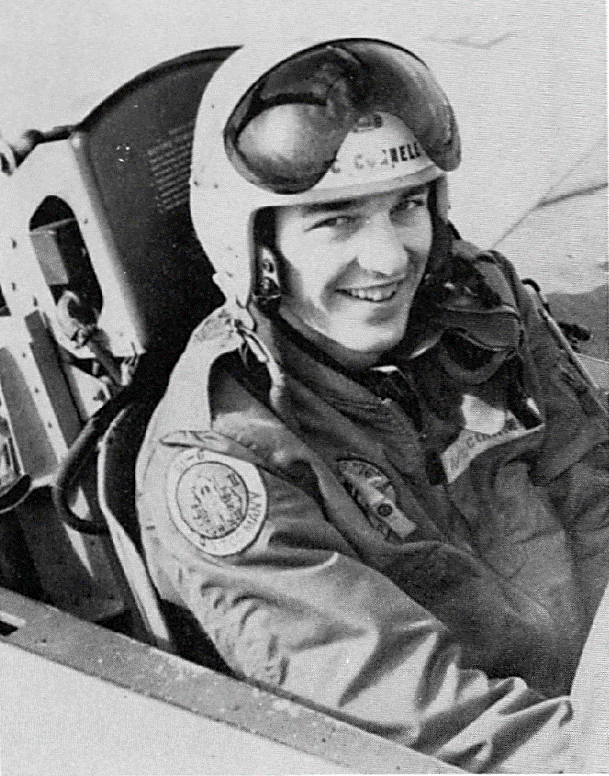
Lt. Joseph T. Connell
Several nights ago, I was grinding a piece of fiberglass and put on a respirator. As I smelled the rubber of the mask, I flashed back to late January of 1961. I was an Aviation Cadet at Vance AFB in Oklahoma, nearly five months away from receiving my commission and pilot’s wings. Our group, Class 61-G2, was the final class of the Aviation Cadet Program. That still, windless morning, I donned my oxygen mask and prepared to fly.
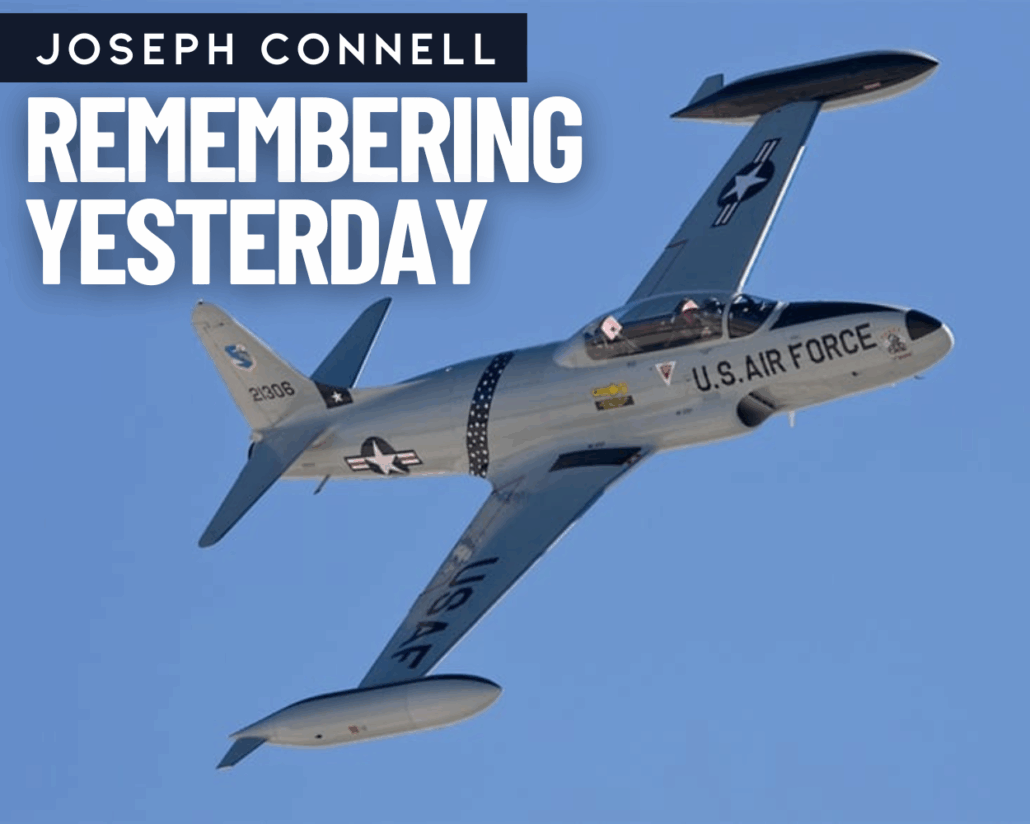
It was my first solo formation flight in a T-33, a two-seat tandem jet with straight wings and tip tanks related to the F-80s of the Korean War era. The 45-minute briefing and preflight had been uneventful. Engine start consisted of spooling to 13%, bringing the throttle around the horn to idle, and monitoring exhaust gas temperature as the engine rumbled up to 42%. The generators came online, and the gyro instruments began slaving to proper headings and attitude.
Next to me, the instructor pilot—call sign “Tipper One”—and his student were paralleling my chores. For this flight, I would be known as “Tipper Two.”
The crew chief held up three landing gear down-lock pins and two tip tank pins with their red streamers. I responded by removing the ejection seat safety pins; we acknowledged each other and stowed them away. He then pulled chocks at my signal. A radio check came through my helmet: “Tipper One.” “Two,” I replied. Moments later, “Vance, Tipper flight of two, taxi.”
Brakes released, a nudge of throttle, and we moved out together. “From the moment you leave this room, think as one,” we had been told repeatedly. Occasional taps of the brakes steered the jet. Woe to anyone who tried to taxi with the nose wheel cocked—it took extra power, noise, and fumes to correct, earning scowls and instructor cursing. We moved out to the runway, tip tanks full, rocking slightly over bumps.
T-33 formation over western Oklahoma on Armed Forces Day in 1961.
We toggled down our canopies simultaneously, locking them. Frost covered the grass, and the sun was just above the horizon. From Mobile Control, a small “tower” by the runway: “Tipper flight of two, cleared into position and hold.” “Tipper One,” acknowledged the lead T-33. “Two,” I echoed back. We eased into position on each side of the centerline, my nose just behind his tip tank, thirty feet between us.
The other student raised a finger and made rapid circles—engine run-up. Stand on the brakes, go to 80%, a quick check of lights, temperatures, pressures. He gave a thumbs up; I returned the same. We were ready.
“Tipper Flight is cleared for takeoff.” “Tipper One.” “Two.” A head went to the headrest; power advanced to 98%—the head snapped forward to signal brake release—and we accelerated down the runway together. Lead remained at 98%, leaving me 2% for play. I drifted a little behind, then added a touch of throttle to ease back into position. I realized I was holding my breath, concentrating on maintaining relative position. At sixty knots, the rudder became effective, and brakes were no longer needed for steering. At ninety knots, a touch of aft stick removed weight from the nose wheel. Slowly, his nose wheel lifted at 100 knots, spinning in the sun. At 120, he climbed with full fuel. I added aft stick, trimmed off pressure, and followed slightly under and behind.
We eased out of ground effect and climbed together. A hand flashed a quick thumbs up; our gear retracted, spinning into the wells. Up-turned hands signaled simultaneously raising flaps. The flap motor whined as surfaces tucked away, leaving us smooth turbulence from previous departures as we rolled into an echelon turn. The air was still and blue, patches of fog drifting, a little smoke from the farms.
All I could see was the tip tank of Tipper One as we arced toward the training area some forty miles distant and several thousand feet higher.
Years later, when I painted my homebuilt Kitfox, I relived that morning many times. Donning the mask, smelling JP-4 at any airfield, I was back in the cockpit. Night flying, the overwhelming silence of a field when the last jet rests, the twinkling blue taxi lights in the distance—memories as vivid as ever.
Sometimes I pick up the phone and catch the lingering scent of Jan’s perfume, and my thoughts take flight again. Wings can fly—and so can the human spirit.

- Remembering Yesterday—Reflections of Joseph Connell - November 21, 2025


Great example of how little things can trigger memories of such sensory rich experiences from years ago. Your recollection of starting a T-33 and the take off are spot on. I fly an early T-33A/TV-2 for a museum and you could have been describing my last start up and taxi out. I enjoyed hearing about your first solo in the Shooting Star.
Thanks, Chris.
Some years ago, I heard an audio clip of the start-up sequence of a Lycoming T-53 L-11A. Immediately I was back in Vietnam flying combat search and rescue missions. My emotional reaction caught me complete off guard. Later I heard an audio of the warbling sound of an emergency locator beacon (ELT). Back to Vietnam again! It seems memories lie in wait to be re-awakened by sight and sound “triggers”.
Joe,
Great story. I too learned to fly at Vance in the class of 79-02 and was retained as a T-37 IP following UPT. Now I train SPs in the Cirrus SR20 and every once in a while, I feel like I’m back in the Tweet teaching some aspect of flying, teaching a new generation how to “cheat death” and enjoy doing it.
Greg
Thanks Greg,
Do you operate out of the Cirris home base in Duluth?
Brrrr – preflights!
Joe
Joe, great piece. You had me thinking about Reese AFB and a sunny morning with my Tweet Student on the way to the aux field. Passing Brownfield, I dozed off. It wasn’t for long, and the student knew where we were going. Neither of us said anything and I didn’t tell the flight commander. We’d been flying triple turns and everyone was tired. Years later flying the C-5, I would fight the same tiredness eastbound from Dover to Ramstein in the middle of the night waiting for sunrise to get me more alert. Seems like yesterday and it was almost 50 years ago in the tweet and 40 years ago in the C-5. John, retired Air Force. T-37/T-38 and C-5.
used to live in Ct. and would hear the C-5’s throttle down on their approach to Westover AFB,MA …was the strangest sound but I loved it. To see that massive plane floating in the air is some kind of “miricale”! Thank you for your service!
Thanks John,
I was the rescue helicopter detachment commander at Reese from late ’65 – ’66. Small world…
Joe
Ahhhh… Thanks for the memories! I flew the T-38 in training back in ’73 and the war ended around the time I was soloing. I declined the opportunity to return to Columbus as a ’38 IP when I saw a T-Bird to Alaska. The job was training F-4e pilots and radar weapons controllers in intercept tactics and radar quality control flights over the far reaches of Alaska. A memorable flight was trying my luck hiding from the new F-15 during its cold weather trials. No way! His radar was far superior to that of the F-4 and his thrust and low wing loading made it impossible for me to dodge him. I could easily out turn an F-4!
And yes, so many things take me back to that T-Bird. What a joy it was to fly!
Thanks Don,
I had several rides in a Canadian-built T-33 at AirVenture in 2004-2006. After 40+ years, that aileron boost still took some getting used to (again)! I was wagging the wings for quite a while.
Joe
Great article, memories, memories! We were the last class of TBirds at Williams AFB (Willy) and had to taxi by the beautiful T-38s on our way out and back.
Went from Willy to TAC where I ended up AC on the B model C-130 and 2 years in SEA..
After active duty I joined the Guard in Ft. Smith, Arkansas, to fly the F-84, and my first assignment was, “take the T Bird and get single engine time.” What a wonderful time as was graduating to the F-84.
I continue to keep my hand in the game teaching a course on Military Aviation at Furman University.
Nice story Joe; really brings back a lot of USAF memories for me (but 15 years later…..).
If you ever get to Wright Pat. A.F .museum check out our memorial bench. Area 2.The Last Pilot Aviation Cadet Class 61-G.