
Winslow Crater

|
Getting your Trinity Audio player ready...
|
Joining the Red Baron Team
I began flying with the Red Baron Aerobatic Team in the spring of 1991. I was 29 years old. I flew with them for five memorable years until the fall of 1995. During most of those years the team had six modified Boeing Stearman aircraft that toured the country performing airshows, demonstrations, and media events.
There was the main four-ship team plus an additional two-ship team that toured smaller market areas. Prior to the two-ship team, when I first became a Red Baron pilot, there was only a single Stearman for touring and marketing in those smaller, remote areas. At that time I was the junior pilot, so I was assigned to these trips frequently.
I didn’t entirely enjoy that assignment for various reasons. It was a very busy flying schedule consisting of TV news cameras, newspaper reporters, photographers, and observers getting free pizza who all wanted to shake your hand and take a photo with you. I remember telling my boss that whatever I did to deserve this, I promised never to do it again. I honestly believe this is why we eventually got the second Stearman for that team.

Daily Flights
It’s hard to comprehend even today, but our daily flight schedule—both teams—was generally 12 formation aerobatic demonstration flights per day with passengers. Each flight lasted about 20 minutes.
The flights included a four-ship formation takeoff, if possible, followed by a formation loop, formation barrel roll, and whatever the leader of the day wanted to add. The flight would then break apart and perform about three solo aerobatic maneuvers before completing a four-ship rejoin.
A four-ship rejoin is not a random maneuver. It is practiced over and over during spring training and takes years to really master. Rejoins are the most dangerous part of formation flying. Every member of the flight needs to think in a three-dimensional universe with several relatively fast-moving aircraft all heading toward the same point at the same time.
Every rejoin was different depending on the weather, position of each team member, speed, and closure rates. At times you would be forced to join from the inside of the lead’s turn and perform a tight cross-under to tuck onto the lead’s wing—not an easy task. Other times it was from the outside of the turn. But in all cases you had to keep track of every aircraft in the formation.
Our speed, angle off lead, and closure rates all became second nature. It became instinctive.
Surviving a Midair
Closure rates were always at the top of my list since I had experienced a very destructive midair collision during one of my first training events in 1991.
I was an observer in the front seat while the pilot flying demonstrated two-ship rejoins. We had already completed several successful off-angle rejoins. On this particular rejoin we were on the inside of the lead’s right turn and coming in from above. We planned to cross under lead and join on the outside left wing.
As we started to cross under lead I lost sight of him, which wasn’t abnormal since I was in the front seat between the upper and lower wings. But then I felt a lot of G’s and suddenly got nervous.
The next thing I saw was the lead aircraft filling my windscreen.
I actually put my arms up to protect myself for impact.
Everything went into slow motion and I still remember it vividly. We recovered nearly vertical toward the desert floor. Wood and fabric were coming off the two right wings. The strut connecting the wings was bent, and an aileron control surface appeared to be coming off the bottom right wing, shaking violently in the wind.
I calmly unbuckled my seat belts and was halfway out of the front cockpit when I felt the Stearman start to recover. So I climbed back in, buckled up, and put on my helmet.
I asked the pilot how the airplane was flying. He said he was going to try to make it back to the airport and understood if I still wanted to jump out. I tightened my five-point harness and stayed with it.
All this time he kept transmitting to the lead pilot on our discrete frequency, but there was no response. I kept looking for a fireball on the desert floor, fearing he had been lost.
Finally he came up on our frequency and all he said was:
“I wish you had not done that.”
A smile broke out on my face when I heard that.
Then I saw him below us, very low, heading back toward the airport. The accident had basically destroyed two aircraft, but both were eventually repaired.
As a member of the Red Baron Squadron, during a rejoin each wingman might be required to fly as number two, three, or four. If qualified, you would most likely lead the flight. Everyone had their favorite positions.
Mine was lead, right wing, or slot. I never became comfortable on the left wing. If you had seniority you usually got to fly your preferred position, so I tried to avoid flying left wing whenever possible.
The team was scheduled to fly every day, so we rotated pilots in and out frequently during the season.
As an example, if I was flying number two in a four-ship rejoin and number three was ahead of me tracking in for a perfect join, I would adjust my join accordingly. I might barrel roll off to create spacing while always keeping the flight in sight. I would then initiate a join on three while he joined on lead, and at the last second slip into my proper position.
All the while knowing number four was doing the same thing behind me, so everything had to be smooth.
If done properly it was a beautiful thing to be part of.
With an experienced team there were no radio transmissions during the maneuver. Once lead saw everyone in position he would simply say:
“Red Baron check… Two! Three! Four!”
We just knew each other so well that we could anticipate every move. We did this all season long for years—probably thousands of times. We got very proficient. We were good.
Lead would then maneuver the flight for an overhead approach and break “over the numbers,” separating the flight for staggered landings.
Number one would normally land on the downwind side of the runway—usually the side with the exit taxiway—so he could clear the runway first without crossing in front of number two. Number two would land on the opposite side, with the remainder of the flight staggered left and right.
We always briefed each flight, but you had to be ready for last-minute changes and adapt in real time.
There were also times we were required to do four-ship formation landings. We practiced these many times during spring training in Marana, Arizona.
During one of those training camps our goal was to perform two-ship formation takeoffs and landings. The concept was simple: if you could hold position during a two-ship formation landing, you could do a four-ship landing.
On one particular day we probably completed half a dozen two-ship formation landings before departing for the practice area over the desert for formation aerobatic practice and rejoins.
On the return to the same runway we departed from, I was still on the right wing of lead setting up for our formation landing. This was just a day after my midair collision.
What we didn’t know was that an airport maintenance crew had placed barriers on one of the intersecting runways. The airport had no control tower or automatic information system, so we had no idea construction was underway.
Because I was on the right wing, I was looking left at lead to hold my position. After touchdown I suddenly felt the Stearman jerk to the right and heard the sound of fabric and wood tearing off my bottom right wing. Both the front and rear spars were broken.
With rudder and brakes I managed to keep the airplane on the runway.
I didn’t say anything to lead over the radio because there were always people monitoring the Unicom frequency on a speaker at the FBO. I didn’t want the public hearing that we had damaged another airplane.
The maintenance crew saw the damage as I taxied directly into the hangar—something we normally never did. They shut the hangar doors behind me as quickly as possible.
Three of our four team airplanes were now basically ruined in two days of training—and I had been in two of them.
I informed the team that I quit as soon as I climbed out of the cockpit and threw my parachute onto the bottom wing. Eventually they talked me into staying.
Spring training was officially cancelled.
And now I was a Red Baron pilot.
I still had a lot to learn.
The Winslow Crater Idea
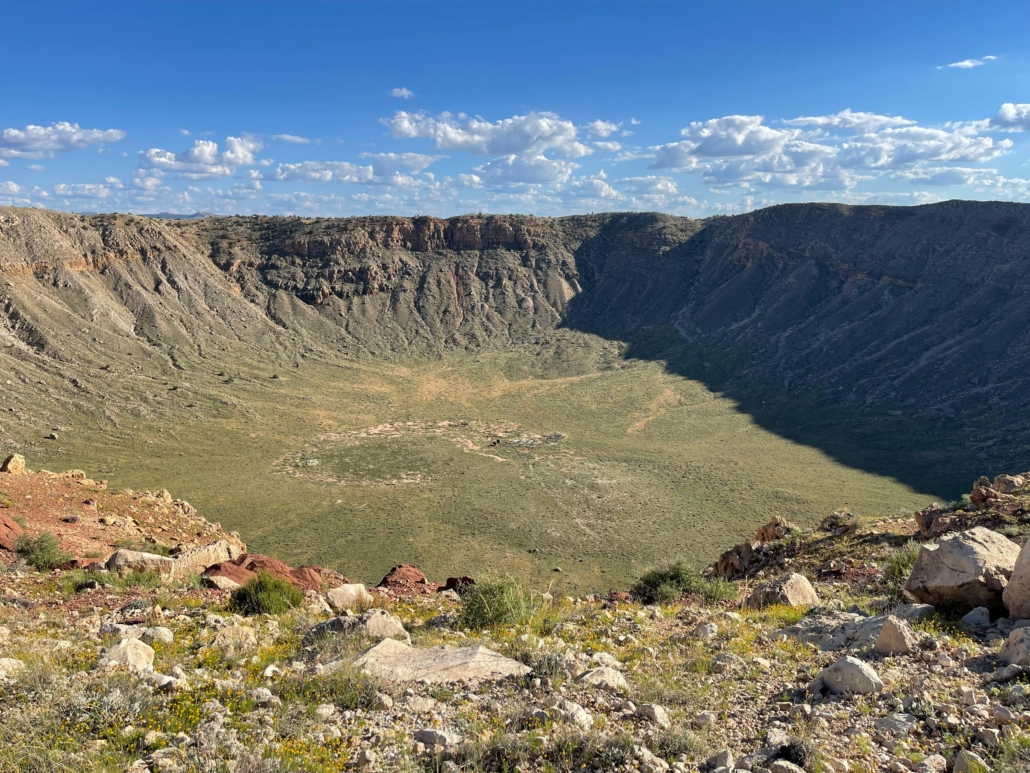 Fast forward a few years.
On this particular tour Tom and I were in Flagstaff, Arizona, flying as the two-ship Red Baron demonstration team. We had finished our scheduled 12 formation flights that day and were sitting at the hotel bar—very tired and ready to eat before an early cross-country departure the next morning.
While waiting for dinner I asked Tom if he had ever heard about a former team member’s idea of doing a loop inside Winslow Crater.
Of course he had. We all had.
Looking at Tom, I casually said that a formation loop inside the crater might be an even better idea.
We were joking around about how we might do it, but by the end of dinner we actually had a plan.
The next morning we took off from Flagstaff about 30 minutes before sunrise and headed east. It was a cool dawn in the high plains of Arizona. The desert colors in the rising sun were magnificent.
We had no GPS or Loran. Our primary navigation tools were worn sectional charts, a compass, and a watch.
Tom had his own set of charts in case mine got sucked out of the cockpit. If that happened he would have to take over as lead—and that would mean no loop attempt.
Tom was also one of the most experienced flight leaders on the team, but we hadn’t actually briefed that scenario. And honestly, I don’t think he was 100 percent committed to this stunt.
Fuel was always a concern in the Stearman, so we didn’t have much extra to play with. We needed to get this done quickly and continue on to our next stop.
We approached the crater at about 500 feet above the desert floor in our open-cockpit biplanes. Everything was quiet. Winds were calm and the morning air smooth.
As we neared the crater we lowered the noses of our 450-horsepower Stearmans almost to the desert surface and pushed the throttles to maximum power to gain speed.
Now every sense was awake in the way only a Pratt & Whitney nine-cylinder radial engine at full power can make a body feel.
We climbed over the lip of the crater and then dove steeply—still at full power—down into this ancient hole in the ground.
Just as I was about to pull up into the perfectly planned formation loop, I looked left.
The observation platform was packed with tourists.
Flashbulbs were popping. Buses were crowded together in the parking lot.
I didn’t say a word.
Tom was steady, just three feet from my right wing like he always was. He saw it too.
Still nothing said over the radio.
I pulled up and out of the crater on the opposite side and stayed low while maneuvering for another pass. That crowd had completely caught me off guard—it definitely wasn’t part of the plan.
We circled around the backside of the parking lot, staying low and out of view.
I was certain everyone within ten miles could hear us and was waiting to see what we would do next.
I was determined to loop the crater.
I climbed slightly to build some extra energy before the next dive.
Just as I started my second approach I finally heard Tom key the mic.
“Don’t do it, Boss.”
Those were the first words spoken since we had switched frequencies leaving Flagstaff.
He was right.
I broke off the approach away from the observation deck, pulled the power back, and passed the crater heading southeast—still staying low before beginning a climb to cruise altitude for our fuel stop.
At that moment I knew I would never have another chance to loop the crater.
Author’s note: This may—or may not—be a true story.

- Winslow Crater - April 1, 2026
- Deadstick in the Cassutt - September 15, 2025
- Storms, Strangers, and a Near Miss in Miles City - June 18, 2025


I wouldn’t believe a word of it if I didn’t know it was true. Although this story was between my three tours with the Squadron, it was a magical life we lived, not likely to be seen again.
Hey Randy, you know whose original idea was. If it wasn’t for him, I would’ve never thought about it. Well probably!
You should write about buzzing miss Liberty… I got great shots… As you know.
Peace
Snake
In the works my friend!
You original guys set the stage for the rest of us. Thank you for that!
Thanks, a great story.