

|
Getting your Trinity Audio player ready...
|
On a beautiful morning, October 2, 2025, I headed to the airport (KUGN) for a morning self-training flight. In the weeks before, I had several longer flights including an Angel Flight, breakfast flights, and at least one long cruise flight. All good, and my 2000 Mooney M20S Eagle was running about perfectly. It should be a great day. Sunny, high pressure, light winds, minimal turbulence – perfect to work on those basic skills: slow flight, stalls, steep turns, chandelles, lazy eights.
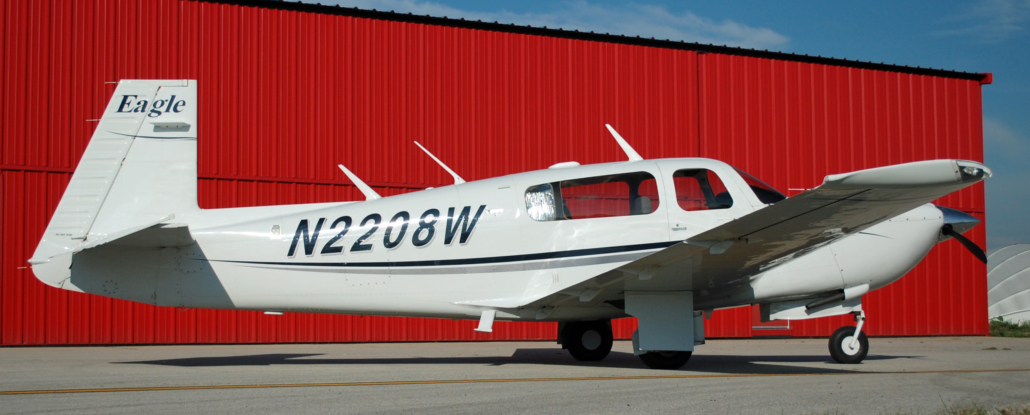
My 2000 Mooney M20S Eagle had been running about perfectly.
Pre-flighted and ready to go, except for one issue. I have a battery-powered Sensorcon Inspector AV8 Carbon Monoxide detector velcroed onto my panel, and turning it on is part of my checklist. It’s toward the very end of my checklist, well after engine start, because I added it a few years ago to a checklist that is much older.
In warm months, my engine start happens with the door and side window open, which results in a CO reading of 40 ppm or less while going through my pre-taxi checklist. Not a toxic level; it simply tells me the detector is working correctly. Today, however, it read 80 ppm, but I expected it would drop to zero once I took off and air began to flow – a highly optimistic assumption. Plus, red lights appeared on the detector, which I had never seen before. (A blinking red light really ought to tell me something!)
Everything else was perfect. Noise levels, vibration, power, and every instrument, except the CO detector, were exactly where they should be. So my optimistic brain said, “Let’s go – it’ll be cured in flight.” Always worked in the past.
Still reading 80 ppm as I taxied, I departed RW23 (6,000’ long), went full power, gauges live, totally focused on the takeoff, rotate and climb, gear up, flaps up. I glanced at the CO reading (mounted off to my lower right), and it was now 160 ppm. Uh-oh! Not what I expected. Past the point of landing straight ahead on RW23, I calmly called the tower to request a lap in the pattern, without explanation. The controllers were excellent, and my request was approved immediately. Make left traffic – report midfield left downwind, 23.
As I reached pattern altitude, I glanced at the CO detector again: 300 ppm – not good. Vents open, side window open, heat off, throttle back, gear down, partial flaps. I called at midfield and got immediate clearance to land. Fortunately, there was no one else in the pattern, so I could make an efficient approach. Had there been traffic, I would have declared an emergency for priority landing. Glancing again, the reading was higher; my brain was fogging, a headache building, and I don’t recall the peak, but it was over 300 ppm.
I did an unusually gentle full-flap landing, exited to the taxiway, opened the door to increase airflow, and breathed. Muscle memory was working fine, even as my brain fog threatened to override it. Then my habit almost got me: the tower cleared me to taxi back to RW23 for departure, and I started heading that way. A little fog cleared, and I requested taxi back to my hangar, citing a high CO reading.
Taxied, shut down, opened the door completely, and relaxed. One of the shorter flights of my 2,000+ hour career was also one of the most dangerous. Fatigue and a mild headache had set in, leaving me non-productive for the rest of the day.
The Cause
My A&P is methodical and detail-oriented. Opening the engine compartment, he traced the issue through air hoses, the muffler, and exhaust manifold route. The likely culprit emerged: surface discoloration on the left exhaust manifold indicated blow-by at the manifold connection, and the air intake hose feeding the cockpit had a hole worn by nearly 2,000 hours of vibration, strategically near the leaky exhaust manifold. Both issues will be fixed, the CO detector recalibrated, and a second mounted as backup before I fly again.
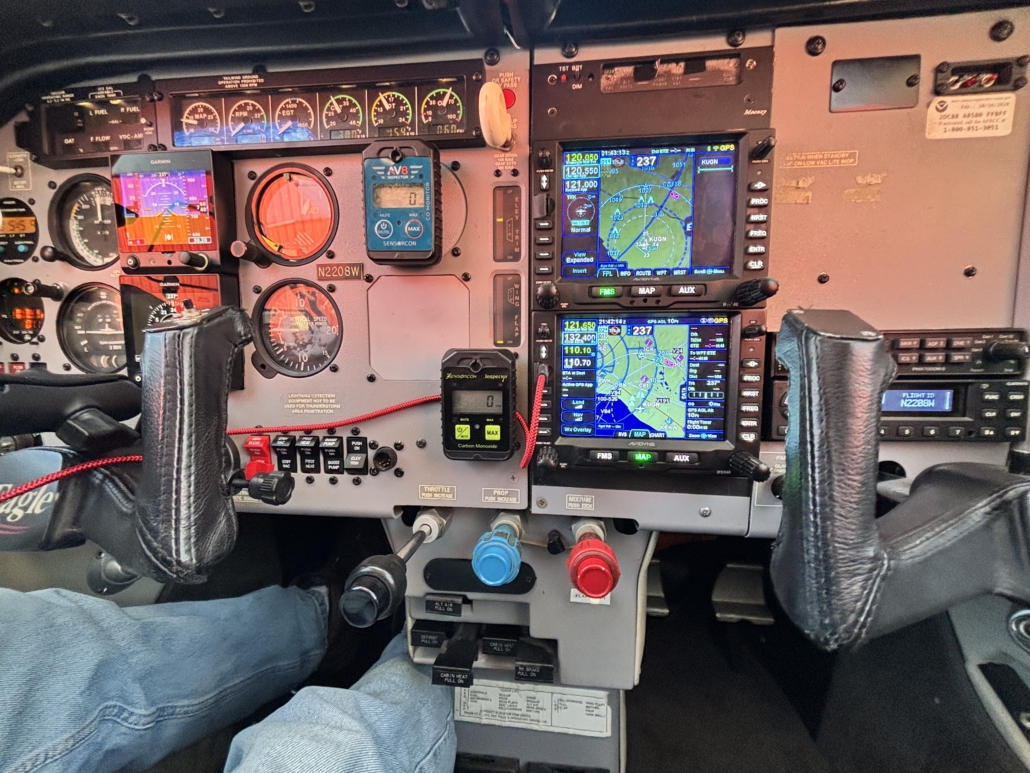
I now fly with a primary CO detector and a backup.
Reflecting
Without a detector, I would have had no warning. Any significant inbound traffic or pattern aircraft could have delayed my landing, and I likely would have ended up as an NTSB case study. I survived thanks to a chain of fortunate events: having a CO detector, Peyton Metzel sharing a tip from Mooney Summit speaker Dan Bass (a rare CO crash survivor), and paying attention to details.
I’ve updated my checklist: “Turn on CO detector” is now before “engine start,” and the detector is mounted in my primary field of view, with a second as backup. My grandchildren, in flight training, will soon receive their own CO detectors as Christmas gifts – hopefully used religiously. Grampa may be a bit old, but he got here for a reason, and paying attention to details is one of them.

Bob serves as the Treasurer for the Waukegan Post District, which governs Waukegan National airport, where he is based.
He is a Civil Engineer, retiring as Chairman of Gewalt Hamilton Associates, Inc.
Now married 53 years, he has 4 children and 8 grandchildren, 2 of whom are headed for an aviation career.
- Be Ready! Carbon Monoxide Could Happen to You - December 17, 2025
- I Am UNSAFE Checklist—Lessons Learned on a Fateful Night - February 28, 2025
- Multiple Cessna 172RGs Made Me a Better Pilot - September 27, 2024

Leave a Reply
Want to join the discussion?Feel free to contribute!