
|
Getting your Trinity Audio player ready...
|
Editor’s Note: Colonel Dale “Boots” Hill is not only a decorated Air Force veteran and longtime Air Facts contributor, he’s also the featured guest on a recent episode of the Air Facts Podcast. In the episode, Boots reflects on flying 165 missions in the OV-10 Bronco, leading a F-16 squadrons, and training the next generation of pilots. It’s a candid conversation filled with hard-won lessons about preparation, leadership, and staying sharp in the cockpit. Listen to the episode here.
When you operate and hangar an airplane over and near a body of salt water, you have to be concerned about the corrosion inherent to that environment. It helps to frequently wash your bird to keep corrosion from adversely affecting not only its appearance, but also its performance.
I commanded the 61st Fighter Squadron (the “Top Dawgs”) at MacDill Air Force Base (MCF), located on the southern tip of a peninsula that juts into Tampa Bay, a large saltwater ecosystem. As expected, the salt air in which we flew our missions—and parked our F-16 Vipers on the ramp—had a deleterious effect on them. We worked to keep those effects to a minimum.
However, we didn’t have to hook up a long hose, drag a bucket of soapy water, sponges, and a chamois cloth out on the ramp, then sweat under the Florida sun to complete the task. It was just a matter of using the local “birdbath.”
Our birdbath was one we could taxi through after returning from our flights. It was like a drive-through car wash—minus the brushes, Rain-X™ on the canopy, tire scrub, or credit card reader. It was always available, but we only used it when our maintainers asked us to. They kept a record of when our jets had last been through, and when one was due, your crew chief would, as you were conducting your preflight, ask:
“Sir, could you go through the birdbath after you land?”
The birdbath consisted of a series of nozzles that sprayed fresh (not salt!) water—no soap or wax—to douse our Vipers. The underside of the jets and open gear wells were directly rinsed down, while arcs of water cascaded over the upper surfaces. Every inch was exposed to a torrent of water, much like what happens at your local car wash.
If you’re thinking I forgot to close my canopy before entering the birdbath one day, let me squash that thought right now. The F-16 cockpit sits directly above the engine intake, and our engine sucked in a LOT of air—even at idle. Anything loose (a map, glove, or approach plate) could get sucked down the intake. So, we closed the canopy before starting the engine and didn’t open it again until shutdown in the chocks.
However, I did witness others getting hosed down. But first, let me describe how the birdbath operated.
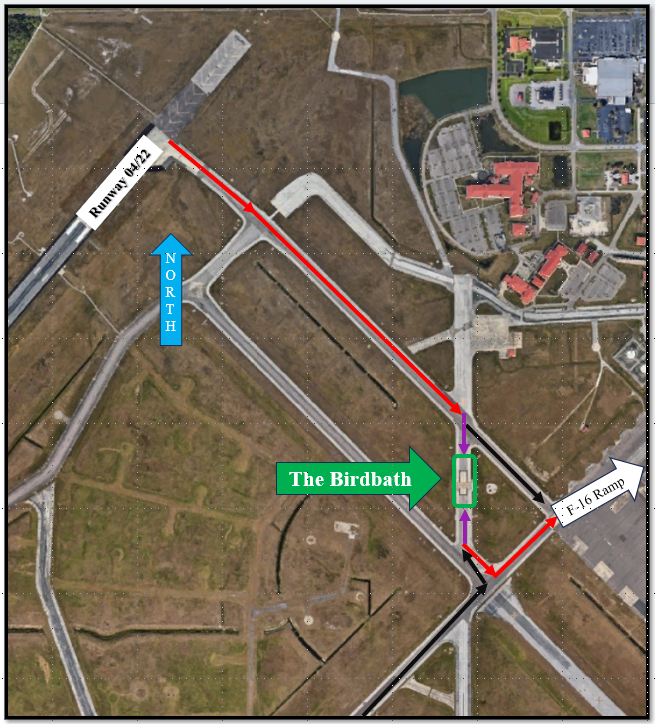
Note the picture showing where the birdbath (green box) is situated relative to MacDill’s single runway (04/22). Depending on the active runway, the birdbath taxiway (purple arrows) is southbound when runway 04 is active, and northbound when landing on runway 22. On either end of the birdbath is an electronic eye. As you enter, one eye starts the wash cycle; as you exit, the other shuts it off.
So, after taxiing clear of runway 04 (top of the picture), you follow the red arrows and make a right turn to enter the birdbath from the north. After exiting to the south, you make two left turns to continue to the F-16 ramp. After landing on runway 22, you follow the black arrows from the bottom of the picture, make a left turn followed by an immediate right to enter from the south, then exit northbound and make a right to the ramp.
Now, about that incident I witnessed one day…
To train our students in Dissimilar Air Combat Tactics (DACT), we hosted other fighter units flying something other than F-16s to act as “bandits.” It was excellent training for all involved, as fighting dissimilar aircraft is invaluable experience before doing it for real. Every fighter aircraft has different capabilities—speed, thrust, turn rate, g-loading—and you always sought to exploit your advantages while avoiding the enemy’s.
For example, during WWII, Japanese fighters would often dive away to disengage from a dogfight. But heavier, well-armored U.S. fighters could accelerate faster in a dive than their lighter opponents. So, when a Japanese fighter dove away, American pilots gained the edge.
One week, my squadron hosted an Air National Guard (ANG) unit flying F-4s with leading-edge slats—great dissimilar training for our students. Being F-16 jocks, they probably figured these older F-4s would be a piece of cake. What they didn’t account for was the Phantom Phlyers had been flying F-4s since these kids were still flying kites! Slatted F-4s were tough bandits for any F-16 pilot, especially one still mastering the jet. But that’s a story for another day.
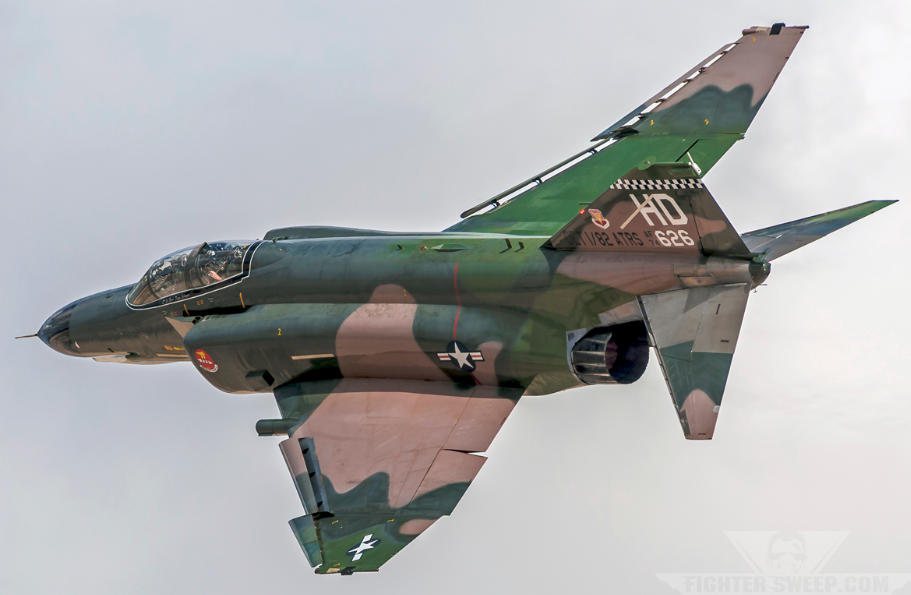
Slats on the leading edge of an F-4s wings.
You’re probably wondering what this has to do with the birdbath. I’ll tell you.
After landing on runway 04 one afternoon, I taxied to the birdbath (following the red arrows) to fulfill my promise to my crew chief. Just after exiting and making the left turn toward the F-16 ramp (following the white arrow), I saw a 6-pack—a four-door crew cab pickup—barreling my way. It was about at the “16” in the arrow.
I recognized it as the one we’d provided to our F-4 guests for their maintainers to get around the flight line. It was full—five or six in the cab, at least four in the bed—and they were headed to the approach end of runway 04. Apparently, there was a last-minute maintenance issue to check on one of their jets preparing to launch.
Did I mention all the windows were down? It was a typical hot and humid Florida afternoon.
I was in their way, so they detoured—turned right to backtrack the black arrow, then left at the first taxiway… right into the birdbath I had just exited.
There was nothing I could do but watch.
Thinking another F-16 was approaching, the birdbath came to life. The truck slid to a stop in the middle while the driver scrambled to find the wiper switch. Everyone else was furiously rolling up windows, while the guys in the bed just sat there, getting soaked. Once they got buttoned up, they moved on.
Other than getting drenched, everyone was OK. At the end of their visit, we had a squadron get-together with a few cold adult beverages. I presented their unit with a 61st “Top Dawg” plaque and thanked them for “dying for their country.” (NOTE: They only “died” on video—captured via our heads-up display.)
Oh—and I also presented shower caps to those who made an unexpected trip through the MacDill birdbath.

- (Mis)Adventures in the Birdbath - July 30, 2025
- A First Time for Everything - June 30, 2025
- Throttle Mismanagement: A T-38 Lesson That Stuck - May 14, 2025


Shoot, above, no emojis post. Funny story, thanks for sharing.
Thanks! Funny to watch, not so funny for the guys who got hosed down! ;-)
That is hilarious Col Hill! I can imagine your disbelief and laughter watch the truck go thru the birdbath. Always enjoy your stories sir n
Col. Dale Hill (Ret) Having spent part of a summer on the FL gulf coast, I suspect the birdbath wasn’t a completely unwelcome accident. Love your story telling style.
Not unwelcome, but certainly unexpected! And they got doused, not a sprinkled!
Thanks for the compliment, I just tell ’em like I see ’em!
Another great story, Boots!