
When Passengers Refused to Board My DC-3
|
Getting your Trinity Audio player ready...
|
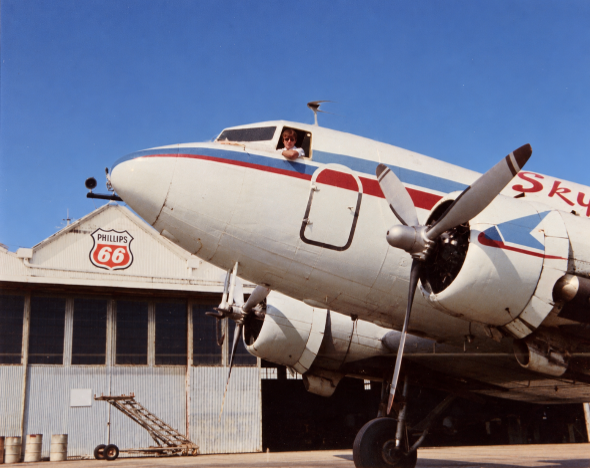
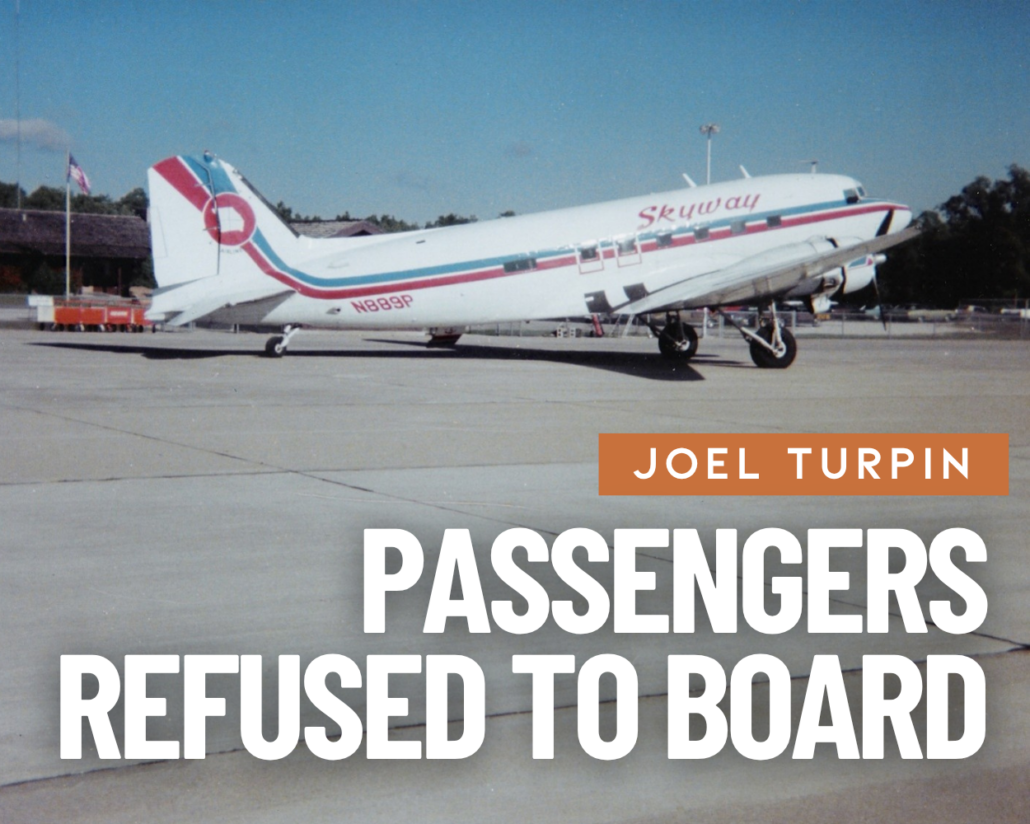
The 27 year old author in1977. This was the DC-3 he was flying in both stories. Note the small door behind the cockpit. That door allows access to the forward cargo compartment using a belt loader, or by hand carrying luggage up the cabin aisle.
While my original story, “Quincy, Illinois, the DC-3, and a Young Boy’s Dream,” was lighthearted and joyful, there was another part of that experience I left out. An incident two weeks earlier had led to something I had never experienced in more than 60 years as a pilot and over 30,000 hours in my logbook: passengers who refused to board my airplane.
In the first story, I was the captain of a DC-3 on a charter flight from Joplin, Missouri, to Quincy, Illinois, carrying the Missouri Southern University basketball team. That flight took place on December 28, 1977.
When I arrived in Joplin, the entire team and coaching staff refused to board my DC-3, the airplane they had paid for in advance as a charter flight. When I met the team in the airport terminal, they told me they were too frightened to fly on a DC-3. Here’s why.
On December 13, 1977, some two weeks before my flight to Quincy, the University of Evansville basketball team had contracted with a company called Air Indiana to fly the team to Nashville in a DC-3 for one of its games. This was exactly what I was about to do at Joplin two weeks later: fly a college basketball team in the same type of airplane.
Gust Locks
There are five gust locks on the DC-3: one for each aileron, one for the rudder, and two for the elevators. To install them, the flight crew would slide them into the gaps between the ailerons and the wing, the two elevators and the stabilizer, and the rudder and tail cone. They were painted red, and some even had small flags attached that said “Remove Before Flight.” Both features were designed to catch the pilot’s eye during the preflight walk-around.
The weather prior to Air Indiana Flight 216’s departure was 300 feet overcast, ¾-mile visibility in fog, and calm winds. However, except for the calm winds, this low IFR weather would play no role in the events that soon unfolded.
Never Be in a Rush to Go Flying!
Experienced pilots know that when you hurry during any phase of flight, bad things can happen, especially during preflight actions. In the Air Indiana crew’s rush to get airborne, the inexperienced first officer, whose actions were unsupervised by the highly experienced captain, committed two grievous errors that would soon lead to disaster.
First, he loaded all of the team’s equipment and baggage into the aft cargo compartment without regard to weight-and-balance limitations, ignoring the forward cargo compartment located in the cockpit. The DC-3 they were flying, like the one I flew, had a lavatory just to the right of the cabin entry. Behind the lavatory was the aft cargo compartment, both of which were located in the tail section of the airplane.
This arrangement made it very easy to move the center of gravity aft when too much baggage was loaded into the rear cargo compartment. When 26 basketball players, their coaches, and other university personnel were boarded, the resulting loading placed the CG aft of the optimum range, a fact unknown to the captain. However, this was only the first of the copilot’s two egregious errors.
In his rush to get the cargo loaded and the exterior walk-around inspection completed, he failed to remove the gust locks from the right aileron and rudder, even though the winds were calm and they would be taking off just minutes later. Why only two of the five gust locks remained installed was a mystery that was never solved.
With all preflight activities completed in just 12 minutes, the captain started the engines, and they taxied out for takeoff. But in their haste to get airborne, they missed one step on the Before Takeoff Checklist: the control check. This was not done! They lined up on the departure runway and took off.
The Takeoff
The normal procedure for making a takeoff in the tailwheel DC-3 was to advance the throttles to takeoff power, then push forward on the control wheel to raise the tail and establish a level, zero-angle-of-attack attitude. This was done for two reasons.
First, raising the tail improved forward visibility, which was limited in the three-point attitude. The second reason was to prevent liftoff in ground effect at a high angle of attack and below stall speed. Experienced pilots of tailwheel airplanes of any size know never to lift off in a three-point attitude. Normal liftoff speed for the DC-3 was 85 knots.
Disaster Strikes!
Because of the rearward CG, the captain could not get the tail up with forward elevator, and the airplane became airborne at about 65 knots in ground effect, some 20 knots below the normal liftoff speed. Due to the rearward CG, the nose pitched up, and the airplane lifted off in a three-point attitude.
It was then that the captain discovered he could not move the ailerons or rudder. Soon after liftoff, the airplane entered a steep, nose-high bank to the right, which the captain could not stop because of the rearward CG and the right aileron gust lock that remained in place. The DC-3 subsequently struck the ground, killing all 29 people aboard: the entire University of Evansville basketball team, their coaches, other university personnel, the flight attendant, and both pilots.
The Cruel Hand of Fate
Only one member of the team survived the circumstances that kept him off the accident flight: an ankle injury that had kept him off the team’s roster while he healed. Because of that injury, he did not accompany the team on the accident flight and was at home when it occurred. However, the cruel hand of fate would not spare his life. He was killed in a car crash just two weeks after Air Indiana Flight 216 met its fate, taking all of his teammates to their deaths.
I Have a Dilemma!
This crash was still in the news when I landed at Joplin two weeks later, but the cause of the accident had not yet been determined by the NTSB. When I met the Missouri Southern University basketball team and their coaches in the Joplin Airport terminal, I could see the fear on all their faces. They told me they were not going to board our DC-3 because of the crash and deaths of a fellow basketball team aboard the very same type of airplane.
To be honest, my first officer, our flight attendant, and I were a bit nervous, too, since the cause of the crash had not been determined. Was it due to some kind of structural failure because of the airplane’s age?
Our airplane was manufactured in 1943, while Air Indiana’s DC-3 was built in 1941. Although we as a crew were not as terrified as our passengers seemed to be, we were concerned.
I had the team assemble in front of me and tried to tell them that they were in no danger and that they would arrive in Quincy safely and ready to win their game. After all, we as a crew weren’t afraid to fly. That line seemed to calm their fears, and after answering a few questions from the coaches, I finally convinced the team to board our DC-3.
The flight to Quincy was uneventful, and I had no problem getting them to board our plane for the flight home. The only thing of note was that my crew and I attended their game and were the only ones in the stands who cheered when Missouri Southern scored a basket. When they did, the rest of the fans looked at us with laser stares, wondering who those three traitors were who were cheering against the home team!
A Second Disaster Averted!
Some time after the Air Indiana crash, the NTSB determined that the rudder and right aileron gust locks had remained installed during takeoff. Since I was my airline’s chief pilot and our only DC-3 captain, I changed our gust-lock storage procedure. Before learning that two gust locks had remained installed on the Air Indiana accident airplane, we routinely stored our gust locks in the aft cargo compartment. I changed our procedure so they would be stored in the cockpit, behind the copilot’s seat.
Then one day, as we taxied out for takeoff, I performed the control check and found that the ailerons would not move. I asked my copilot to count how many gust locks we had, and he counted only four instead of five. This meant he had failed to remove one of the aileron gust locks during his exterior preflight inspection.
I stopped on the taxiway and ordered my copilot to retrieve the gust lock still installed on the right aileron. After that incident, I added a step to our pre-takeoff checklist to count the gust locks and make certain all five were on the cockpit floor.
Conclusion
As this story illustrates, flying is not always pretty for the professional pilot. Even so, it is my sincerest desire that this ugly story does not dampen the lighthearted tenor of the original story, “Quincy, Illinois, the DC-3, and a Young Boy’s Dream.”
His professional credentials include 5 years as captain, training officer, and chief pilot for a commuter airline where he flew the DC-3, Beech 18, and Beech 99 in scheduled passenger operations, and 6 years as Director of Training for both FlightSafety International and Simuflite’s King Air Division. In addition, Joel flew the King Air 200 as a corporate pilot for 2 years in the DFW area.
Turpin was subsequently hired by United Airlines in 1986 where he flew the Boeing 727, 737, 757 and 767 in both domestic and international operations including 100 oceanic crossings, and several equator crossings. Turpin retired in 2015 at age 65 and currently has some 30,000 hours in his log book.
He is currently employed as captain and chief pilot flying the Pilatus PC-12NG for a company in Pennsylvania. Joel has been a current and active flight instructor since 1970 and teaches instrument flying in a variety of single engine airplanes. Turpin also writes technical articles and conducts seminars for general aviation pilots with an emphasis on instrument flying and airplane systems. In addition, Turpin also writes flying stories based on his personal experiences as a pilot.
In 2016, Joel Turpin earned the FAA Wright Brothers Master Pilot Award for 50 years of flying accident and violation free, and for his contribution to aviation safety for all those years. His professional qualifications include:Airline Transport Pilot License, Certified Flight Instructor with Instrument and Multi-engine ratings, Turbojet Flight Engineer, Advanced Ground Instructor, Type Ratings in the DC-3, B-737, B757 and B-767, and the FAA’s Wright Brothers Master Pilot Award.
He currently lives in Punta Gorda, Florida with his wife, who is a United Airlines flight attendant. While Joel has had an amazing career in aviation spanning over six decades, he still considers himself to be just a general aviation pilot who got lucky.
- When Passengers Refused to Board My DC-3 - November 6, 2026
- Quincy, Illinois, the DC-3, and a Young Boy’s Dream - August 12, 2026
- A Lesson on Being the Pilot In Command - June 5, 2026

Leave a Reply
Want to join the discussion?Feel free to contribute!