
Game Theory in Flying
|
Getting your Trinity Audio player ready...
|
As pilots, we are endowed with a desire to learn to fly an aircraft. It is a lesson in want, need, dedication, and stick-to-itiveness. The desire is driven by challenges that need to be undertaken.
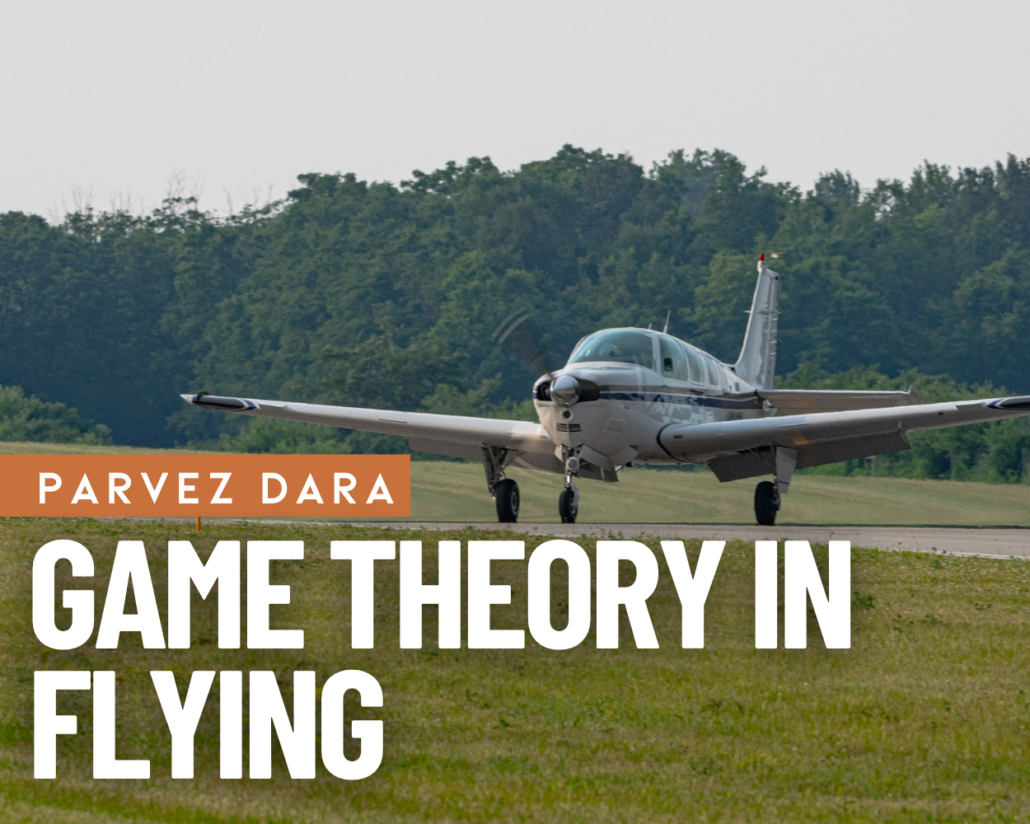
Most recently, I was waiting for traffic to clear a path for me to launch in the Bonanza. The sky was mostly cloudy, with bits of blue sky intervening, and the winds were blowing from 290 degrees at 18G25, flowing across the Appalachians. Not my happy place.
My preflight was complete as I sat patiently waiting for the Cessna, which finally appeared on final for the runway, slowed by the headwind component. It bobbed and weaved its way down, hitting the gusts with its wings thrashing away at those invisible slaps. As it neared Runway 24, it was steady for a moment, as if the invisible monster had wandered away temporarily. Then, at 20 feet above the runway, the unruly behavior started once again.

The pilot had made his last announcement a minute ago and had forgotten to take his finger off the push-to-talk button. Heavy breathing and a few expletives aired over the radio. The Cessna powered up to counter the winds, and then, as if the wind gods had not seen enough drama, the wind direction changed from the northwest to the north, as the windsock now stood fully erect in its new direction. The pilot applied crosswind controls to keep from being hammered into the trees to the south. The Cessna hesitated and then continued to drift slowly toward the left edge of the runway.
I was in my CFI mode now, with beads of sweat trailing down the back of my shirt. Suddenly, the whole unfolding drama seemed to go into slow motion. Hmm, I thought. That guy is having some serious problems right in front of me. What should I do? The only thing I could think of was to yell into the mic, “Go around!” He was still keyed in and did not seem to hear me. Unfortunately, the drama had to play out.
What were the implications of this scenario I was witnessing, and what should I do? My destination was a few hundred miles away. I had filed an IFR flight plan and was waiting for my clearance. Just about then, it came.
I read it back to the controller and entered it into the G1000. A crooked, leggy clearance if ever there was one, but that was what I got. I looked at the weather on SiriusXM and saw that the flight path was going to take me through some turbulence and precipitation. The area of turbulence was about 50 miles deep, around 4,000–6,000 feet, and the precipitation was more of the same. There was one tiny yellow region of moderate precipitation, and my flight path was just to the north of it. However, the cells were moving from southwest to northeast. The area would be past my path by the time I got there. Might it grow in the early-fall cold weather? Probably, especially with a trailing cold front.
A Bonanza is a transportation machine, capable of handling such conditions. I had plenty of experience in similar weather. But what was the likelihood of a safe, comfortable flight that day? That was the big question.
In game theory, PAPI is the acronym I use for players (P), in this case two: me and the weather. Humanizing the weather thus creates the perfect other player. The I stands for “Information,” which includes the weather data I had gathered, along with the current TAFs. The A stands for “Action,” the decision I was about to make, and the second P stands for “Payoffs,” in this case, safely negotiating the flight to my destination.
I mentally use this process before each flight to evaluate the risks. Essentially, it invokes the FAA’s IMSAFE (Illness, Medication, Stress, Alcohol, Fatigue, Emotion) and PAVE (Pilot, Aircraft, enVironment, External pressures) models in my mental game-theory exercise.

1. Dominant Argument
But then the laws of probability woke up in my brain. The dominant argument was, “Just go!” The assumption was, “Done it before and can do it again.”
I reflected on that for a moment, weighing the facts against the assumptions. I had plenty of experience and had flown in conditions like those before. But whether the same conditions would persist or worsen as I launched remained an unknown.
Did I get enough sleep the night before? I guess I did. Was I tired that afternoon? Maybe a little. Was I proficient at entering turbulent clouds at 2,000 feet? Yes. Was I proficient with instruments? Yes.
As that thought entered my mind, I instinctively checked the autopilot’s functionality again. All was good. The dominant argument seemed to win out, momentarily. It seemed to whisper, “You’ve done this before, and it’ll be easy to do it again.” The payoff would be arriving on time and getting the work done.
The Cessna was now downfield, bobbing and weaving its way over the runway, still five feet above the surface and dodging the gusty winds. Brave soul, I thought. His finger was still on the push-to-talk button, and his heavy breathing was audible.
2. Backward Induction
The counterargument in this game-theory scenario is backward induction. In that moment, I imagined the flight I was just about to undertake. Upon reaching my destination, around 400 miles away, I imagined looking backward. What had I encountered?
First, there was the crosswind takeoff, followed by the typical bumps one encounters in gusty winds. Entering the clouds, with the wind maintaining its gusty nature, the Bonanza would be bucking like a bronco, and I would be hand-flying it. As I flew through the 4,000–6,000-foot block, the turbulence would be more than just bumpy. That would take me well into my 10-minute window, when ATC was supposed to have cleared me to my final altitude of 10,000 feet. However, given the nearby Class B airspace, that climb would be in steps rather than straight up.
Around then, I would enter the moderate precipitation. I imagined the thumpity-thump of the bumps and the burst of rain hitting the windshield like paint-peeling pellets. That would all go away in roughly 15–20 minutes, though.
After that, near Cleveland, there was a chance of icing around 9,000 feet. I would be above that, and I was equipped with a deicing tank half full to get out of any such scenario. The rest of the flight would be easy, except that I might have to fly an approach at the destination due to low visibility from mist.
The Cessna suddenly thudded onto the runway. Oof! It veered a bit and then steadied itself. The pilot let out a “Thank God!” and gingerly taxied his way to the FBO. Success for him.
So, given that the probability of a successful flight was slightly less than one, at least in my mind, what should I do? I had to be there that night for a meeting the next morning. If I launched and didn’t like what I felt or saw, I could return to home base, especially if the going got rough. That option was there. But did I want to go through the turmoil and stress?
Game theory offers an interesting way to look at probabilities. You consider your capabilities, your physical and mental state, your experience, your proficiency, your aircraft’s condition, and your recency of experience with the conditions you might encounter. Then you mentally play back the pending flight using backward induction. If the probability is one, the risk-reward ratio points toward the reward; otherwise, it’s time to taxi back to the hangar.
I called ATC, canceled my flight plan, and taxied back to the hangar. I replayed the scenario multiple times. Did I make the correct decision? Did I let down those waiting for me on the other side? It all boiled down to this: In my mind, the probability was less than one. The Bonanza was ready, even if I had doubts. It was me, the pilot, who made the decision that day.
None of the thousands of hours I have flown comes in handy when we are faced with situations that might trip us up. It still comes down to that moment in the cockpit. Having faced such decisions many times, I have developed this backward-induction option from game theory. Why tempt fate?
Could I have made the flight? Obviously, yes. Could I have encountered difficulties? Another yes. Could those difficulties have created a dangerous scenario, putting the flight in jeopardy? The probability was low, but yes. Was my decision the correct one? A definite YES! Did the Cessna help with the decision-making? Probably. It made me think through the scenario and use the logic of game theory to advance my thought process.
3. Walk Away
Once again, when the dominant argument is winning, take time to do the backward induction. If there is even a shred of doubt that the probability of a safe flight is less than one, it is time to WALK AWAY and taxi back to the hangar!
The Aftermath
Sitting in the comfortable armchair that afternoon, wishing I were up there rather than down here, I watched the weather movement, and all my fears seemed to come alive. The tiny yellow dot mushroomed into purple, and instead of the five-mile spread of green, there was now a line of yellow and green extending from Vermont down to Tennessee, all within one hour of my planned departure.
Would I have been through that line? Difficult to say. Several PIREPs reported turbulence, from 4,000 feet up to a B737 reporting moderate chop at 10,000 feet. The B737’s moderate was my severe. The destination went full IFR, with a ceiling of 300 feet and an RVR of 2,400 feet.
The comfort of the armchair made me sink into the cushion and drift off for a nap. I left the next day, early in the morning, with 45-knot headwinds on the nose. A slow slog, but with blue skies above and green earth below.

- Game Theory in Flying - November 2, 2026
- Friday Photo: New York on a Crisp Morning - October 16, 2026
- Transition Flights - September 23, 2026

Leave a Reply
Want to join the discussion?Feel free to contribute!